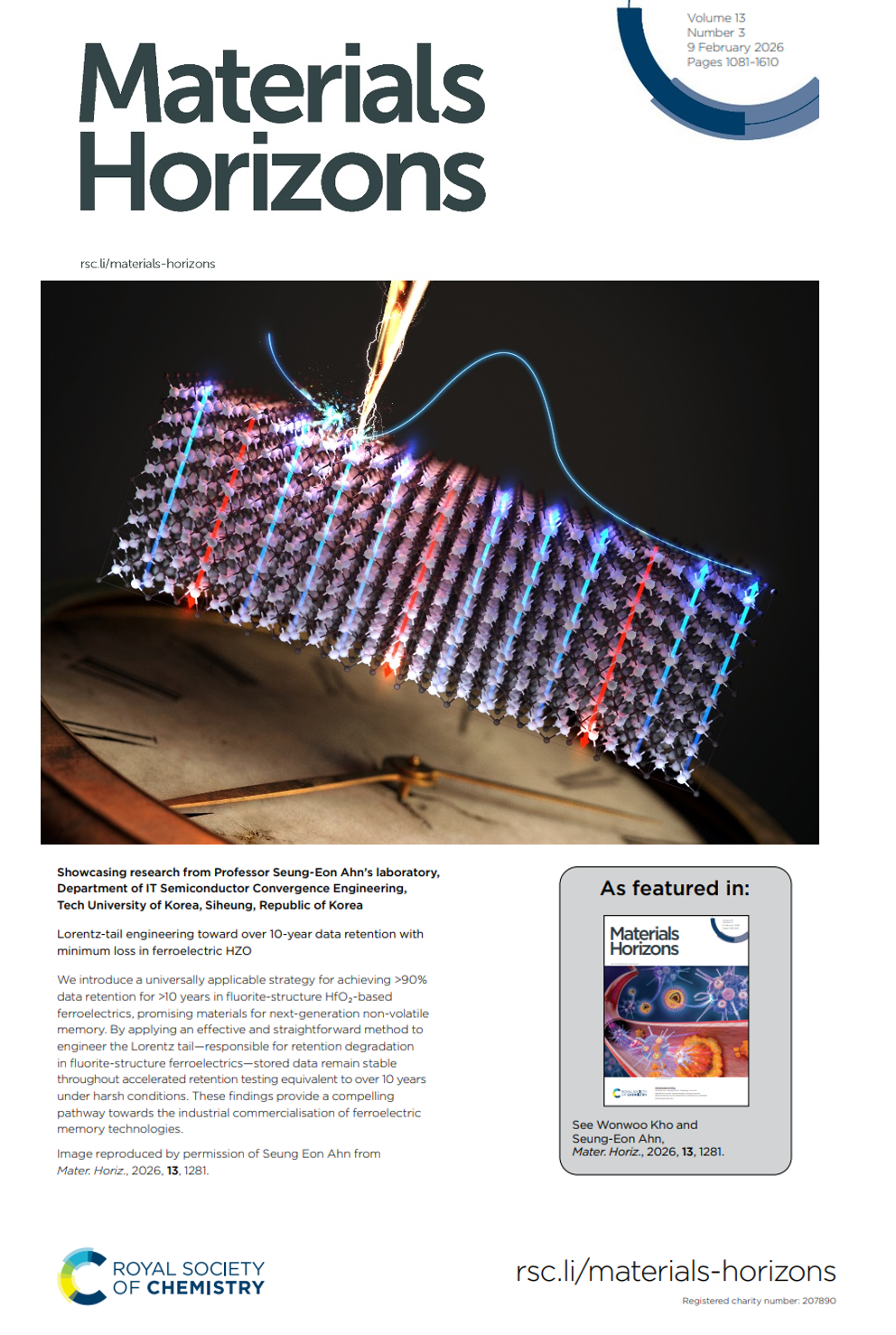
A paper by Professor Ahn Seung-eon’s research team in the Department of Semiconductor Engineering at Korea Polytechnic University has been selected as the cover article of “Materials Horizons.” Provided by Korea Polytechnic University
Korea Polytechnic University announced on the 19th that Professor Ahn Seung-eon’s research team in the Department of Semiconductor Engineering has developed a core technology that can improve the data-loss issue in next-generation intelligent semiconductors.
According to Korea Polytechnic University, as generative artificial intelligence (AI) technology has recently spread, concerns have been raised over power consumption arising from repeated large-scale data processing between memory and processors (CPU·GPU). Hafnium oxide (HfO₂)-based ferroelectric materials, which can enable low-power, ultra-high-speed neuromorphic computing, have drawn attention as an alternative. However, data retention reliability issues—where stored data gradually disappears over time—have been cited as a limitation to commercialization.
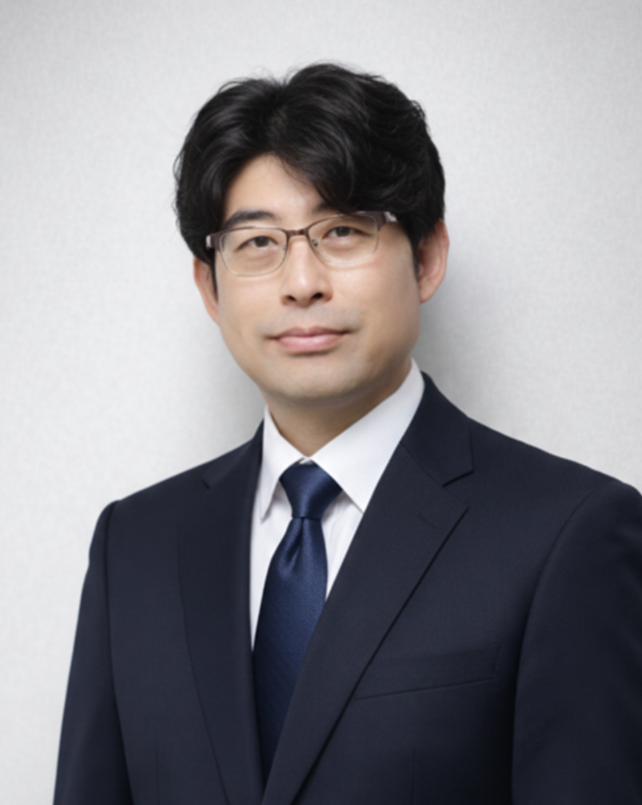
Professor Ahn Seung-eon. Provided by Korea Polytechnic University
Professor Ahn’s research team developed a “Lorentz-Tail Engineering” technology that selectively controls unstable polarization components generated during the ferroelectric polarization switching process. The team explained that this enables control of the causes of data loss and improves retention characteristics.
The research team stated that, after applying this technology, it confirmed that stable storage is possible for more than 10 years while maintaining a data retention rate of over 90%. It added that the technology passed accelerated aging tests conducted under harsh conditions, indicating that data stability is maintained in both normal environments and extreme conditions.
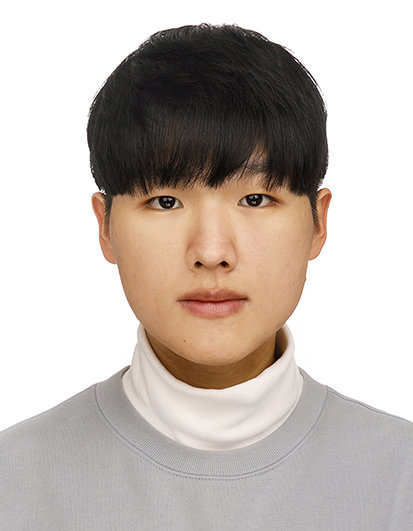
Doctoral student Ko Won-woo. Provided by Korea Polytechnic University
The research was selected as the cover article of the international materials science journal “Materials Horizons” on February 9. The paper is titled “Lorentz-tail engineering toward over 10-year data retention with minimum loss in ferroelectric HZO,” and Korea Polytechnic University doctoral student Ko Won-woo participated as the first author. The study was conducted with support from the Mid-career Researcher Program funded by the Ministry of Science and ICT and the National Research Foundation of Korea.
Professor Ahn said, “This research will serve as a turning point for this technology to emerge as a core material for intelligent semiconductors (PIM) that will lead the future AI era” and added, “It is expected to contribute to strengthening competitiveness in the next-generation semiconductor sector.”
Ji Hee-soo
AI-translated with ChatGPT. Provided as is; original Korean text prevails.
ⓒ dongA.com. All rights reserved. Reproduction, redistribution, or use for AI training prohibited.