Hyundai E&C-backed SMR seen breaking ground by March
Part of 110GW U.S. ‘AI campus’ project… additional EPC orders for four nuclear reactors also anticipated
IEA: “Installed capacity to expand 70% within 15 years”… industry: “Could mark the first year of a nuclear renaissance”
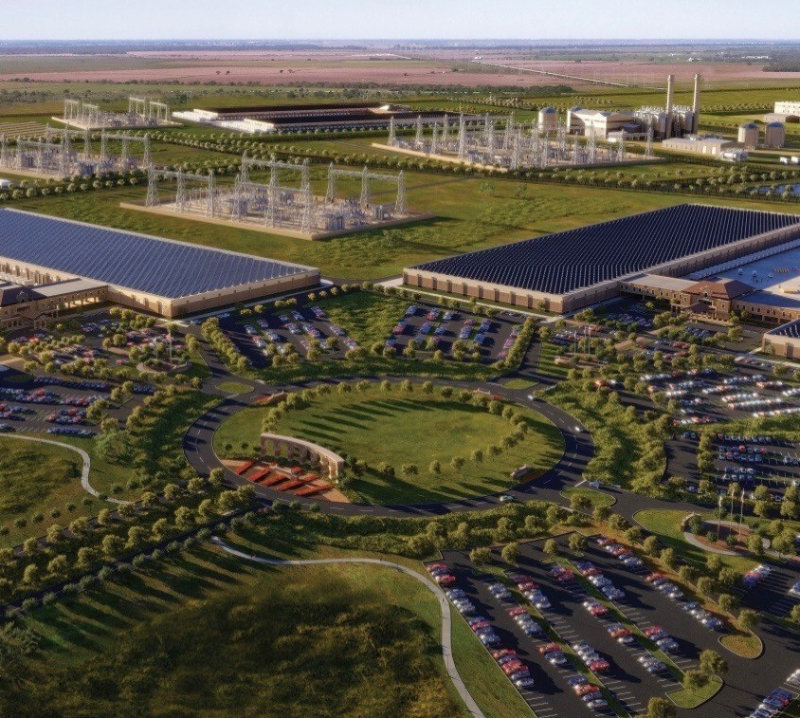
Artist’s rendering of the “Integrated Energy and Artificial Intelligence (AI) Campus” being developed in Texas by U.S. energy developer Fermi Energia America. Hyundai Engineering & Construction has been commissioned to carry out the basic design for four large nuclear power units in this project. Photo source: Fermi Energia America “X”
As electricity demand surges due to advances in artificial intelligence (AI) technology, Korean construction companies are moving in earnest to expand their footprint overseas. The small modular reactor (SMR) project in the United States involving Hyundai Engineering & Construction (Hyundai E&C) is expected to break ground this year, and new project orders are anticipated in the United States, Europe and other regions. Following last year’s contract for the Dukovany nuclear power plant in the Czech Republic, there are projections that this year could mark the first year of a full-fledged “nuclear renaissance.”
● World’s first SMR with Hyundai E&C participation set to break groundWhile Hyundai E&C secured nuclear power orders in Europe, including the Czech Republic, last year, expectations are high for additional nuclear power contracts in the United States this year. According to the construction industry on the 15th, two SMR units at the Palisades nuclear power plant site in Michigan are expected to start construction by March this year. The project is being developed jointly by Hyundai E&C and U.S.-based Holtec International, with completion targeted for 2030. Once construction begins, Hyundai E&C will hold the distinction of participating in the world’s first SMR groundbreaking. SMRs are small nuclear reactors manufactured as modules in factories and then installed at required sites.
The 110GW (gigawatt) “Integrated Energy and AI Campus” being promoted in Texas by U.S. energy developer Fermi America is also cited as a major project. The project calls for the construction of four large nuclear power units totaling 4GW, two SMR units, a combined-cycle gas-fired power plant, and a power grid integrating solar power and battery energy storage systems, along with an AI data center. Hyundai E&C won the basic design contract for the four large nuclear units last year and is now eyeing additional engineering, procurement and construction (EPC) contracts this year. Shin Dae-hyun, an analyst at Kiwoom Securities, said, “Considering the U.S. government’s strong commitment to nuclear expansion, the main EPC contract is highly likely to be signed within this year.”
In Europe, the main contract is expected to move forward for Bulgaria’s Kozloduy nuclear power plant, for which Hyundai E&C signed a design contract last year. If concluded, it is expected to become a mega-project worth tens of trillions of KRW. Additional nuclear power projects are also being discussed in Finland, Slovenia and the Netherlands.
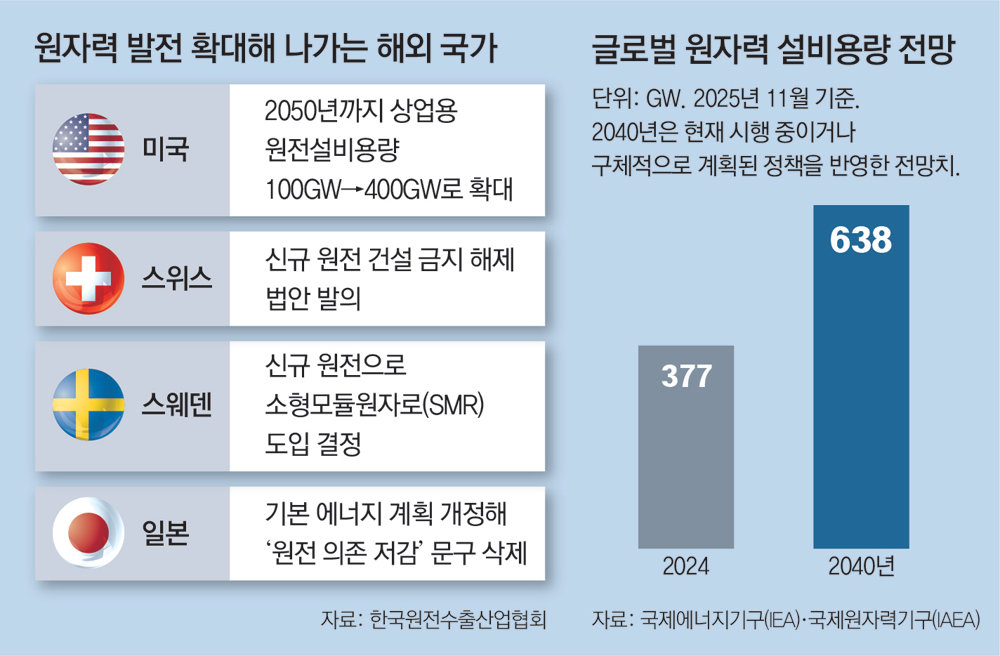
● “Nuclear capacity to grow more than 70% within 15 years”New nuclear-related projects overseas are emerging one after another because nuclear power, which can supply large-scale electricity in a stable manner, is being highlighted as a solution to AI-driven power shortages. Its role as clean energy in responding to the climate crisis is also being emphasized. In May last year, the United States announced plans to expand its nuclear power generation capacity from the current roughly 100GW to 400GW by 2050. Europe is pursuing a plan to increase nuclear capacity to 109GW by 2050. Japan, India and other countries are also detailing nuclear development and operation plans to secure power grids.
According to the Korea Nuclear Export Industry Association, the International Energy Agency (IEA), in its “World Energy Outlook 2025” released in November last year, projected that global nuclear power capacity will expand to 638GW by 2040. This represents an increase of more than 70% compared with the current capacity of 377GW compiled by the International Atomic Energy Agency (IAEA). The projection assumes that the plans currently being implemented or specifically decided by each country will proceed as scheduled.
With the prolonged slump in the domestic housing market, major Korean construction companies are increasingly viewing overseas SMR and other nuclear-related businesses as next-generation growth engines beyond the domestic housing sector. Korean builders are seeking orders by emphasizing their ability to manage the entire process, from basic design to procurement and construction. Given that “on time, on budget” completion is critical due to the long-term nature of nuclear projects, Korean companies highlight their extensive construction track records.
Major construction firms are entering foreign markets by forming partnerships with overseas companies and public entities. Hyundai E&C has partnerships with U.S. nuclear companies Westinghouse and Holtec International; DL E&C is partnering with U.S. SMR developer X-energy; and Doosan Enerbility has a partnership with Westinghouse. Daewoo Engineering & Construction is participating as lead contractor for construction at the Dukovany nuclear power plant in the Czech Republic and is strengthening cooperation with domestic partner companies.
ⓒ dongA.com. All rights reserved. Reproduction, redistribution, or use for AI training prohibited.
Popular News