Sales of 182,948 units… customized strategy proves effective
8% market share and 4th place… Toyota in 5th
Sales likely to exceed 200,000 units by year-end
“USD 1 billion for eco-friendly vehicles by 2032”
Hyundai Motor Company is strengthening its presence in Brazil, the largest automobile market in South America, by surpassing Japan’s Toyota and recording the highest sales volume among Asian finished vehicle manufacturers.
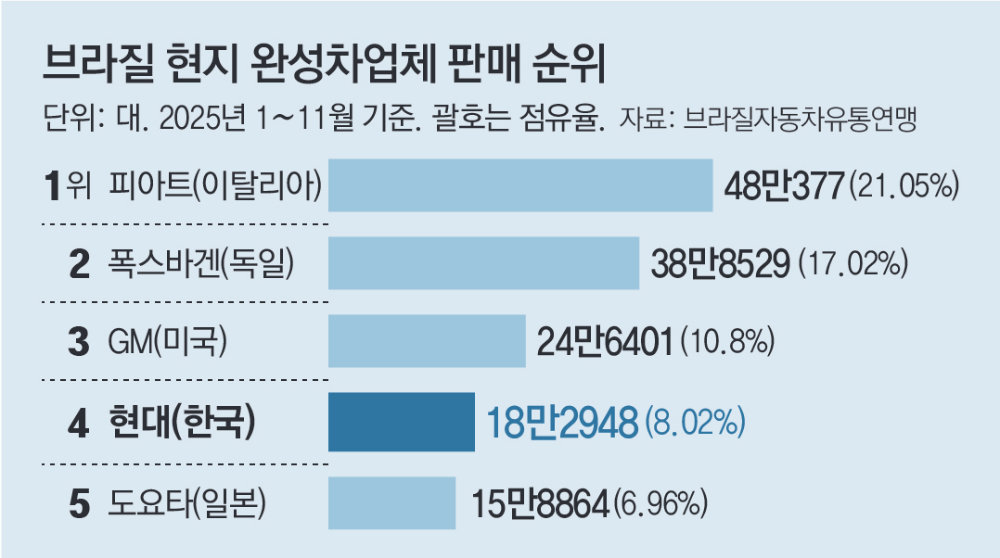
According to Hyundai Motor and statistics from the Brazilian National Federation of Motor Vehicle Distributors (Fenabrave) on the 14th, Hyundai sold a total of 182,948 passenger cars and commercial vehicles in the Brazilian market between January and November this year. Its market share stood at 8.02%, the fourth highest in Brazil.
In particular, this ranking is notable because it is higher than that of Japan’s Toyota. Over the same period, Toyota sold a total of 158,864 vehicles in Brazil, with a market share of 6.96%, placing it fifth after Hyundai. First place went to Italy’s Fiat (480,377 units, 21.05%), second to Germany’s Volkswagen (388,529 units, 17.02%), and third to U.S. manufacturer GM (246,401 units, 10.8%).
Hyundai has been selling more than 19,000 vehicles every month from September to November. If this trend continues through December, Hyundai’s annual sales in Brazil are expected to exceed 200,000 units. Hyundai sold 206,029 units in Brazil last year. This not only marked the first time in five years since 2019 that the 200,000-unit threshold had been surpassed, but it also represented a sales volume higher than Toyota’s 203,793 units. Supported by strong sales, Hyundai ranked fourth in overall market share in Brazil last year.
The key to Hyundai’s rapid growth in Brazil is cited as a thorough localization strategy, including local production and a focus on selling customized models. Hyundai operates a finished vehicle plant in Piracicaba, São Paulo state, Brazil. The plant has an annual production capacity of up to 210,000 units. The company invested about 125 million Brazilian reals (KRW 33.8 billion) in 2019 to expand the facility from its previous capacity of 180,000 units.
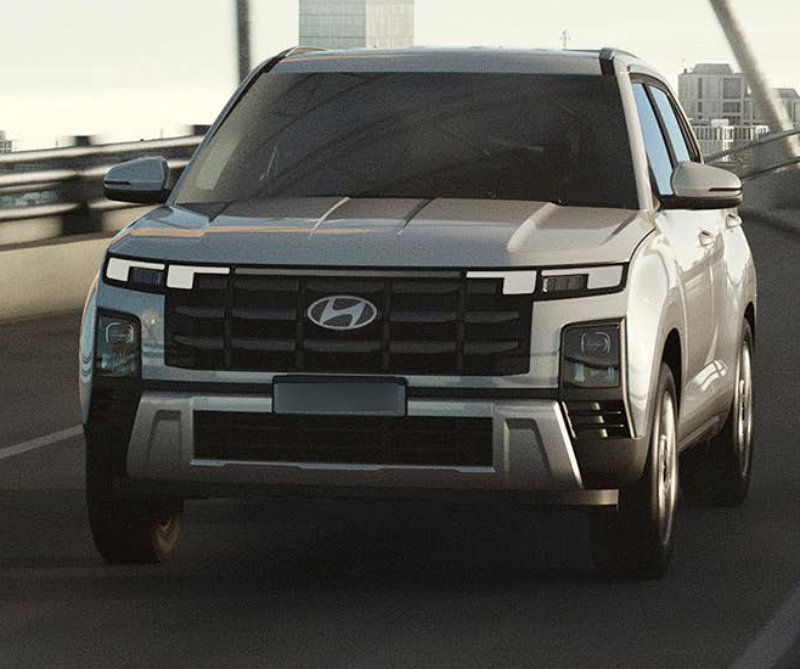
The small sedans and hatchbacks HB20, as well as the sport utility vehicle (SUV) Creta, produced at this plant consistently rank within the top 10 in monthly sales by model in Brazil. The HB20 is a small vehicle tailored to the South American market, and the Creta is a compact SUV sold in parts of South America and Southeast Asia. While small cars are particularly popular in Brazil, demand for SUVs has also been gradually increasing. The most popular model in Brazil is Volkswagen’s Polo, which sells around 10,000 units per month.
Brazil is currently promoting a “Green Mobility Innovation” scheme that grants tax benefits to automakers investing in the carbon neutrality sector. As a result, there are expectations that Hyundai, which has a broad lineup of eco-friendly vehicles such as electric vehicles and hydrogen fuel cell vehicles, could benefit. A Hyundai official said, “In the Brazilian market, we plan to invest more than USD 1 billion in hydrogen and other eco-friendly sectors by 2032, and to expand electric and hybrid vehicle offerings as well.”
ⓒ dongA.com. All rights reserved. Reproduction, redistribution, or use for AI training prohibited.
Popular News