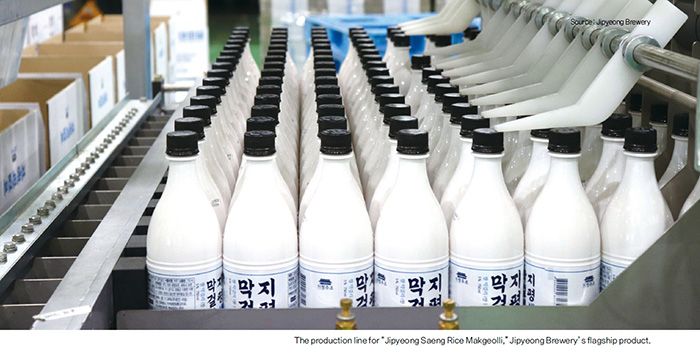
How did Jipyeong Brewery, South Korea’s oldest operating makgeolli brewery, grow into a major player in the makgeolli industry over the past decade after remaining a small local brewery for decades? Outsiders attribute Jipyeong Brewery’s rapid growth to “successful marketing.” However, the company’s internal assessment is quite different. CEO Kim Ki-hwan explains that Jipyeong Brewery’s success came from “staying true to the basics.” In fact, to achieve “consistent taste,” Jipyeong Brewery has automated its production processes, an uncommon practice among small breweries, and researched microorganisms that enhance flavor to improve the taste of Jipyeong Makgeolli. The company also adheres to fundamental principles in its sales operations, including pursuing mutually beneficial relationships with distributors. In the process, young consumers drawn to Jipyeong Makgeolli’s distinctive, clean taste began actively promoting it on social media, while improved relationships with distributors helped the company become the first in the industry to establish a nationwide distribution network. However, Jipyeong Brewery emphasizes that these achievements are merely the results of its efforts and that the real secret lies in “sticking to its principles.”
Editor’s Note | Kim Mi-ra, a research intern at the Dong-A Ilbo Future Strategy Institute and a senior majoring in media and communication at Sungkyunkwan University, contributed to this article.
“A cheap drink for middle-aged and older people, typically consumed in shabby backstreet taverns.”
This is the common image we have of makgeolli. However, there was a time when makgeolli enjoyed greater popularity than wine or beer. Around 2010, makgeolli became hugely popular in Japan under the name “makkori” (マッコリ). This was largely because a perception had spread in Japan that makgeolli, with its lower alcohol content (about 5% to 6%) than Japanese sake (about 14% to 16%), could be enjoyed even by people with a low tolerance for alcohol and was a fermented beverage believed to be good for the skin and health. In addition, following the 2011 Great East Japan Earthquake, Japanese beer production was disrupted as breweries suspended operations, and makgeolli benefited from the resulting shortage of Japanese beer. The Korean Wave sweeping Japan at the time also contributed to makgeolli’s popularity in the country. As a result, makgeolli exports increased sharply. According to data from the Korea Customs Service, makgeolli export volume increased nearly sixfold, from 7,405 metric tons in 2009 to 43,082 metric tons in 2011.
This surge in makgeolli’s popularity in Japan crossed the Korea Strait and had an impact on South Korea as well. Bars specializing in makgeolli began springing up one after another in bustling areas such as Hongdae and Gangnam. The growing popularity of makgeolli also led to a sharp increase in shipments. Makgeolli shipments rose 47.8% in just one year, from 176,000 kiloliters in 2009 to 261,000 kiloliters in 2010.
15,000개의 아티클을 제대로 즐기는 방법
가입하면, 한 달 무료!
걱정마세요. 언제든 해지 가능합니다.
This content was originally written in Korean in the DBR, and translated into English by the original author with the aid of AI
The DBR has all legal authority over this content. Please note that unauthorized use and distribution may be subject to legal sanctions














 경제·경영 질문은