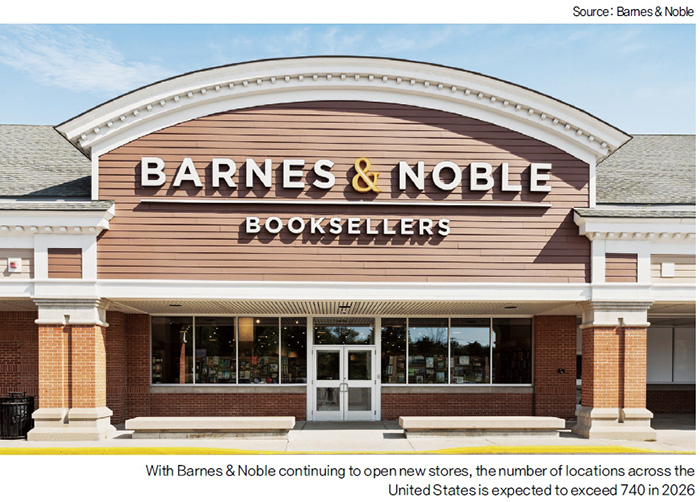
Barnes & Noble, the giant bookstore chain that dominated the U.S. market in the 1990s, began its decline in the late 2000s. Following the rise of online giant Amazon, the company gradually lost its competitive edge through excessive IT investments, rigid, centrally controlled store operations and complacency fueled by advertising revenue from publishers. As the company lost its core function of selecting books, its return rate reached an unusually high 30%. After hedge fund Elliott Management acquired Barnes & Noble in 2019, CEO James Daunt was brought in to turn the company around and implemented a counterintuitive strategy: transforming bookstores into spaces for serendipity, or unexpected discovery. He first eliminated paid promotional display tables altogether. He also dismantled centralized control. Authority over book purchasing and displays was handed over to individual stores. Meanwhile, he cut headquarters staff by half. Daunt turned frontline booksellers and the viral buzz generated by BookTok, TikTok’s reading community, into powerful marketing tools. Barnes & Noble has staged a remarkable comeback, expanding to approximately 740 stores nationwide and pursuing an initial public offering (IPO). The key to its future growth will be whether it can withstand the pressure to deliver financial results following its planned listing in 2027 while continuing to innovate.
Employees at Barnes & Noble stores across the United States received a single sheet of paper from headquarters every week. It was a set of shelf display instructions known as a planogram. Once headquarters distributed the planogram, specifying which books to display, where and how to arrange them, and for how long, every store followed the instructions mechanically, without exception. Victoria Harty, an assistant manager who had worked at the Upper West Side store in New York for more than a decade, recalled those days in an interview with PBS. “We used to be told what table to do, how to curate it, where that table should go,” she said, adding that even the angle of the tables and the discounts were dictated. “There was no thought.”11“How Barnes and Noble Made a Comeback by Revitalizing Its Philosophy,” PBS, Jan. 2, 2025.닫기
Barnes & Noble wielded enormous influence over the U.S. book market in the 1990s and 2000s. One in every eight books sold in the United States passed through Barnes & Noble. The tables near store entrances effectively served as advertising space where publishers paid thousands of dollars to display their books. Which books appeared in Barnes & Noble stores, where they were placed and how long they remained on display were determined by the amount of advertising fees publishers paid. The weekly planogram was, in effect, a space-rental agreement that governed display tables at bookstores nationwide according to the logic of capital.
When James Daunt took over as Barnes & Noble’s new CEO in 2019, his first move was to eliminate the planograms altogether. He also abolished co-operative advertising, a practice that allowed publishers to pay for prime display space in bookstores. In doing so, he broke with a practice that had persisted for more than two decades. Daunt’s decision to voluntarily give up one of the bookstore chain’s most reliable and substantial revenue streams sent shock waves through the U.S. publishing and book distribution industries. He declared, “I want to turn bookstores into places of serendipity, where customers experience unexpected discoveries.”
15,000개의 아티클을 제대로 즐기는 방법
가입하면, 한 달 무료!
걱정마세요. 언제든 해지 가능합니다.
This content was originally written in Korean in the DBR, and translated into English by the original author with the aid of AI
The DBR has all legal authority over this content. Please note that unauthorized use and distribution may be subject to legal sanctions














 경제·경영 질문은


 닫기