Article at a GlanceFounded in 2015, Testworks is a social enterprise that employs people with developmental disabilities, including autism and intellectual disabilities, to process training data for artificial intelligence (AI). The company generated approximately 4.9 billion KRW in revenue in 2019 and currently processes and supplies AI data to about 50 client companies. In its early days, the company faced setbacks, including a client’s notice of early contract termination over poor quality, after prioritizing its social mission of creating jobs for disadvantaged groups and its sincere commitment to that mission without adequate preparation. However, it overcame the crisis by improving quality within a short period through 1) a systematic quality management system and 2) established procedures for communicating with clients. Since then, through measures including 1) a structured hiring process for people with autism, 2) improvements to management and support systems to help employees with autism adjust to their work and 3) training for employees without disabilities on communicating with colleagues with autism, the company has earned recognition as a model of “inclusive employment,” enabling people with disabilities to work without prejudice or discrimination.
J.A.R.V.I.S., a character in the “Iron Man” film series, is widely regarded as the archetype of the artificial intelligence (AI) we aspire to create. Yet even an AI as sophisticated as J.A.R.V.I.S. cannot be intelligent from the outset. Training data is needed to make machines think for themselves like humans. This inevitably involves data preprocessing. Because machines cannot think for themselves from the start, they must be fed data that people have individually processed by hand.
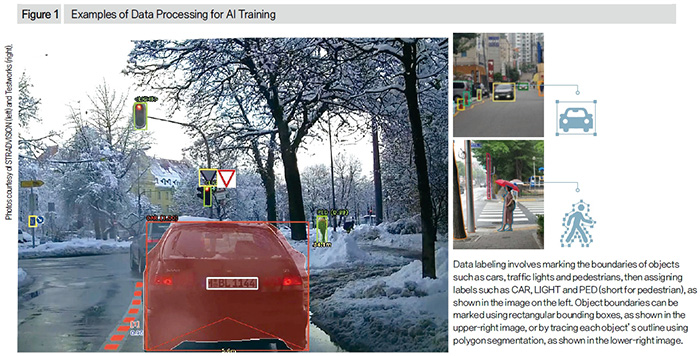
For example, to enable image-recognition AI for autonomous driving to distinguish people from cars, it must be shown visual data repeatedly so it can learn which objects are people and which are cars. Simply showing it unprocessed photos or videos is, of course, insufficient. Each object in an image must first be delineated with a rectangular bounding box or an outline that follows its shape, a technique known as polygon segmentation, and then individually identified through a process called data labeling (Figure 1).
As the AI industry grows and demand for machine learning training data increases, interest in data processing services for AI development is also rising. Testworks, founded in June 2015, is one of the companies that have recently gained prominence in this field. STRADVISION,
1
a leading South Korean autonomous driving startup with deep learning-based image-recognition technology, is a key client of Testworks. In 2019, Testworks processed and delivered approximately 4.6 million AI training data items to STRADVISION alone, counted by the number of objects, such as people and cars, within the images.
2
In 2019, Testworks processed approximately 18 million AI training data items. Since its founding, the company has processed approximately 33 million data items in total, as of the end of February 2020.
Copyright Ⓒ 동아비즈니스리뷰. All rights reserved. 무단 전재, 재배포 및 AI학습 이용 금지














 경제·경영 질문은


 닫기