Article at a Glance
Founded in 1947, Daedong grew in Korea’s agricultural machinery market before expanding into global markets including North America and Europe under its KIOTI brand. In 2025, the company posted record consolidated revenue of 1.4847 trillion KRW. Overseas sales accounted for 76.8% of the total. Daedong’s growth strategy for strengthening the competitiveness of its overseas business despite repeated market crises can be summarized in four points.
1. Even during the COVID-19 pandemic, Daedong monitored the market daily, trusted its growing dealer network, and chose not to cut production.
2. It turned data accumulated through its dealer network into a competitive advantage, evolving its promotions from broad regional programs to pinpoint support tailored to individual dealers.
3. It treated dealers not merely as sales channels but as partners in building the market together, incorporating voices from the field into its business.
4. To overcome the limitations of the North American market, it diversified into Europe and expanded its product portfolio into mid- to high-horsepower and autonomous tractors, securing new engines for future growth.

The North American agricultural machinery market has been declining for four consecutive years. According to the Association of Equipment Manufacturers (AEM), U.S. agricultural tractor sales, which stood at roughly 240,000 units in 2019, surged to around 320,000 in 2021 on pandemic-driven demand. However, sales have declined by 8% to 14% annually since 2022, falling to about 190,000 units in 2025. In the first half of 2026, the North American agricultural machinery market also contracted 13% year over year. The market is returning to levels last seen in 2012 and 2013. During the three years of the pandemic, the market effectively pulled future demand forward, and as tariffs and inflation pushed tractor prices higher, households tightened their spending, leaving the agricultural machinery market with little sign of recovery.
Yet one company has steadily increased its market share even amid the downturn. It is Daedong, Korea’s No. 1 agricultural machinery company. Daedong’s share of the North American tractor market rose from 4.2% in 2018 to 9% in 2025. The number of Daedong dealers in North America increased from 348 in 2018 to 574 as of September 2026. Dealers newly added over the past two years generated 13% of the North American subsidiary’s revenue in the first half of 2026. In searching for a breakthrough amid the market slump, Daedong turned to two weapons: its dealer channel and the data drawn from that channel. Daedong collected sales data from its dealer network to build a market database and used it to replace uniform promotions across North America with customized campaigns targeted down to the individual dealer level.
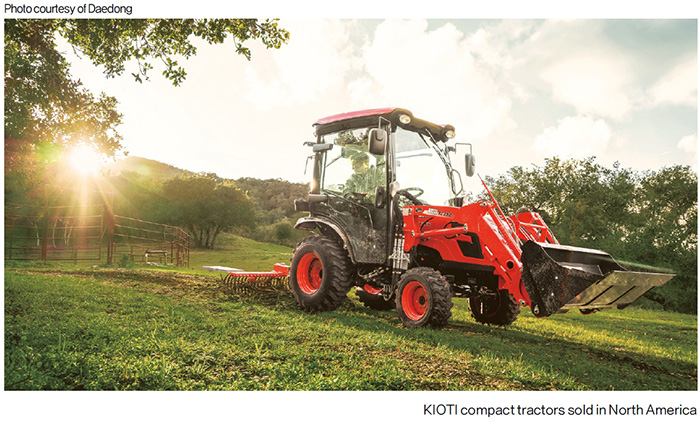
Strong performance in North America alone, however, is not enough. Daedong’s flagship compact tractors sell in large volumes but have relatively low unit prices, limiting profitability. Moreover, because they are not essential equipment for earning a livelihood, their sales tend to fluctuate when the economy weakens. Daedong’s answer to overcoming these limitations was diversification across both markets and products. Moving beyond its traditional compact tractors, Daedong entered Europe with mid- to high-horsepower tractors. After declaring Europe its “second overseas hub” in December 2023, Daedong launched the premium 140-horsepower HX1403 model in July 2025 for the European market. Revenue at its European subsidiary reached 74.1 billion KRW in the first half of 2026, up 31% year over year. While the North American tractor market remained depressed, Europe became Daedong’s fastest-growing market. The company is also securing future growth engines through technology-based new businesses, including the launch of Korea’s first AI-powered autonomous tractor. Daedong sold roughly 150 of its AI autonomous tractors, each priced at more than 100 million KRW, in 2026.
Copyright Ⓒ 동아비즈니스리뷰. All rights reserved. 무단 전재, 재배포 및 AI학습 이용 금지














 경제·경영 질문은