POSTECH–Samsung Electronics research team develops new technology For use in everyday life through glasses-like devices
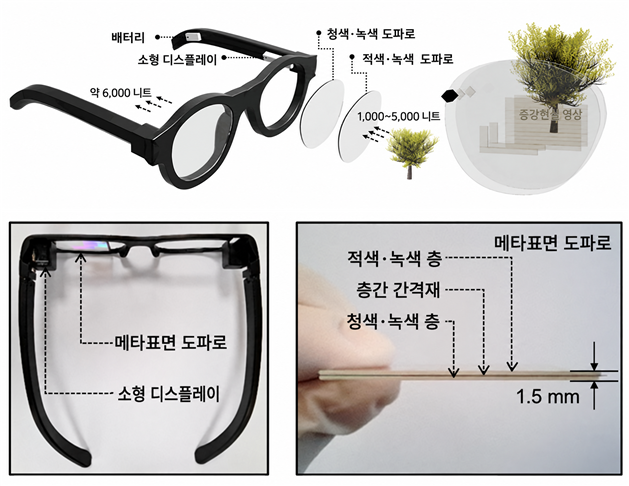
A domestic research team has developed a prototype augmented reality (AR) glasses lens with a thickness of 1.5 mm that allows users to read text even in bright outdoor environments. Because the display remains bright even when the position of the eyes shifts slightly, the technology is expected to be used in the development of AR devices that can be worn in daily life like ordinary eyeglasses.
On the 11th, the Ministry of Science and ICT announced that a research team led by Professor Noh Joon-seok at POSTECH, in collaboration with Samsung Research under Samsung Electronics, has developed a technology that reduces light loss within the lenses of AR glasses. The research results were published in the international academic journal Nature at 4 p.m. (local time) on the same day.
AR glasses are smart devices that project information such as navigation guidance or text onto real-world scenes by transmitting light from a small display embedded in the frame through the lenses to the eyes. Previously, there was a problem of the screen suddenly darkening because the direction of light frequently changed and was lost inside the lens. With existing technology, it was difficult to simultaneously achieve both a thin lens and sufficient screen brightness, and the thick lenses made prolonged use uncomfortable.
The research team addressed this issue by engraving microscopic structures onto the lens surface. This design gathers scattered light into the eyes to increase brightness and secure a wider field of view. The lens was structured by stacking a layer that mainly delivers blue and green light with a layer that mainly delivers red and green light, enabling the reproduction of full-color images.
These functions can be used not only for navigation but also for smart glasses in which artificial intelligence (AI) displays information appropriate to the surrounding context. Because light can be utilized efficiently, the technology is also expected to help reduce power consumption. Professor Noh stated, “We will secure mass-production technology and, in connection with AI image-processing techniques, further develop this into AR glasses that can be worn comfortably in everyday life.”
Im Jae-hyeok
AI-translated with ChatGPT. Provided as is; original Korean text prevails.
ⓒ dongA.com. All rights reserved. Reproduction, redistribution, or use for AI training prohibited.