LN Energy & Frontier (L&F) announced on the 5th that it will expand its penetration of the electric vehicle and energy storage system (ESS) markets, focusing on high-nickel NCM (nickel·cobalt·manganese) cathode materials and LFP (lithium iron phosphate) cathode materials. The company is pursuing a two-track strategy of strengthening its existing core business in high-performance cathode materials for premium electric vehicles, while expanding production capacity and its customer base for ESS-use LFP cathode materials.
The global battery market has grown mainly around electric vehicles, but demand is now expanding to AI (artificial intelligence) data centers, power grid stabilization, and renewable energy storage facilities. Performance requirements also differ depending on the intended use of the battery. High-nickel NCM cathode materials are used in premium electric vehicles that require high energy density, while LFP cathode materials are used in ESS applications where price competitiveness and cycle life for repeated charging and discharging are critical.
L&F plans to respond to these market changes by concurrently producing and supplying both materials. In high-nickel products, the company will strengthen the technological competitiveness and customer base for high-performance products, and in LFP it plans to expand production facilities and supply chains targeting domestic and overseas ESS markets.
● Targeting the premium EV market with ultra-high-nickel and 46-φ products
L&F is responding to the high-performance EV battery market with a focus on high-nickel NCM cathode materials. High-nickel cathode materials are designed to improve energy density by increasing the nickel ratio, which is advantageous for enhancing driving range and output performance in limited battery space.
Building on its technological capability as the first company in the world to successfully mass-produce ultra-high-nickel cathode materials, L&F is further advancing product performance. In particular, it is focusing on the stable supply of high value-added ultra-high-nickel products and the expansion of cathode material sales for next-generation 46-φ cylindrical batteries.
The 46-φ cylindrical battery is a next-generation battery with a diameter of 46 mm and a larger structure than existing cylindrical products. It can be applied to electric vehicles that require high energy density and output performance, prompting global battery manufacturers and automakers to expand development and production of related products.
L&F began supplying cathode materials for 46-φ batteries at the end of last year and is expanding sales, mainly to new customers in North America. The company plans to widen the scope of applications through increased supply volumes to existing customers and participation in new projects.
New demand sources such as humanoid robots beyond electric vehicles are also under review. In robotics, battery performance that allows high energy storage in limited space while maintaining stable output is crucial, raising the potential use of high-energy-density cathode materials.
L&F plans to leverage the technological characteristics of high-nickel cathode materials to respond to the premium EV and next-generation mobility markets and increase the proportion of high value-added product supply.
● LFP supply contracts with Korea’s three major battery makers…annual capacity of 60,000 tons by 2027
In the LFP cathode material business, the company is working to secure customers and expand production facilities, centering on domestic and overseas ESS markets.
LFP batteries use iron and phosphate instead of nickel and cobalt, reducing raw material costs, and they have strengths in thermal stability and lifespan. They are mainly used in ESS applications that require long-term, repeated charge and discharge, and in mass-market electric vehicles where price competitiveness is important.
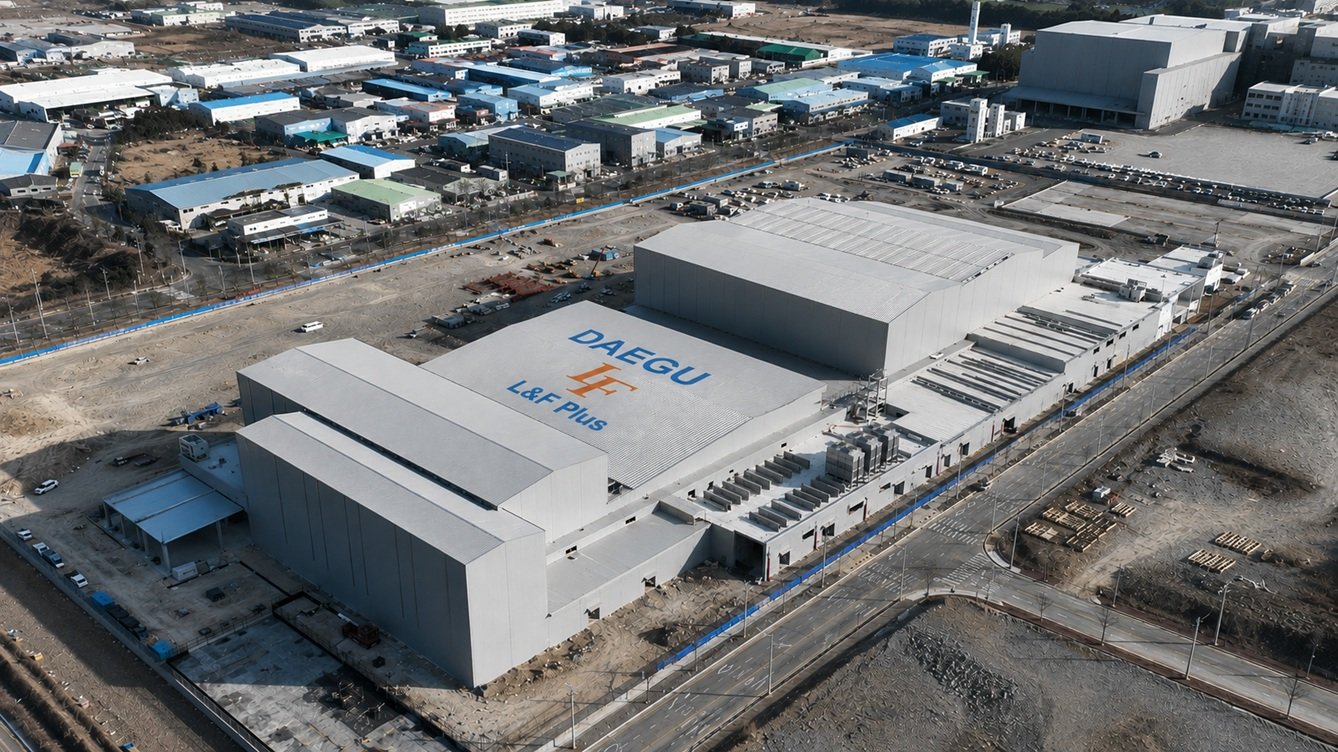
L&F has been developing LFP cathode materials since 2015. Last year it established L&F Plus, a wholly owned subsidiary dedicated to the production and sales of related products, and it began full-scale mass production of LFP cathode materials at the end of the third quarter of this year.
Customer acquisition has also been progressing. In March, L&F signed a mid- to long-term LFP cathode material supply contract worth about KRW 1.6 trillion with Samsung SDI, and in July it concluded a supply contract with U.S. battery technology company Coreshell Technology.
Subsequently, it signed a supply contract worth about KRW 160 billion for ESS-use LFP cathode materials with SK On and also concluded a long-term supply contract with LG Energy Solution. As a result, L&F has secured LFP cathode material supply contracts with all three major Korean battery cell manufacturers.
As Korean battery manufacturers expand LFP battery production and supply targeting the North American ESS market, L&F is also broadening its role as a material supplier. By securing supply channels with Korea’s three battery makers and overseas customers, the company has established a production and sales base for the new LFP business.
The company is also undertaking investment in production facilities. L&F plans to expand the annual production capacity of its dedicated LFP plant located in the National Industrial Complex in Dalseong-gun, Daegu, to 60,000 tons by the first half of 2027.
Thereafter, it will review additional capacity expansion based on demand from domestic and overseas customers and additional orders, with a long-term plan to secure annual production capacity of more than 120,000 tons.
The company is also reviewing measures to secure key raw materials such as precursors and lithium required for the expansion of the LFP business. Along with production facility expansion, it plans to establish raw material procurement and working capital plans to respond to customer supply needs.
● Expansion of AI data centers and grid investment…stronger push into the North American ESS market
L&F’s expansion of its LFP business is being driven by the growth of the global ESS market and the trend toward diversifying battery supply chains in North America.
ESSs are used to store electricity generated at renewable energy facilities and to supply stored electricity during peak demand periods. Recently, investment in facilities to ensure stable power supply for AI data centers and power grid operation has also been increasing.
According to U.S. investment bank Goldman Sachs, global new ESS installed capacity is projected to increase from 375 GWh in 2026 to 1,627 GWh in 2035, representing an average annual growth rate of 17.7%. The new installation market in North America is also expected to reach 330 GWh by 2035.
Particularly in North America, efforts are underway to diversify supply chains to reduce dependence on Chinese batteries and materials. As a result, interest in LFP cathode materials produced outside China is increasing.
L&F plans to respond to this demand based on its domestic production facilities. The company intends to apply the production and quality control expertise accumulated in its existing high-nickel cathode material business to the LFP business and is in discussions with global customers on additional supply.
The company is focusing on the fact that high-nickel NCM cathode materials and LFP cathode materials can address different market needs. It will supply ultra-high-nickel and 46-φ products to the premium EV market, which demands high energy density and output performance, and LFP cathode materials to the ESS market, where price competitiveness and long-term operational stability are key.
Through this approach, L&F aims to maintain its existing EV material business while expanding into new demand areas such as ESS and mass-market electric vehicles. Based on a business structure that concurrently handles NCM and LFP cathode materials, the company plans to respond to demand shifts in the global battery market and expand product supply tailored to each customer.
ⓒ dongA.com. All rights reserved. Reproduction, redistribution, or use for AI training prohibited.
Popular News