National Institute of Health: “Promotes movement between brain cells” Likely to provide a key clue for developing new treatments
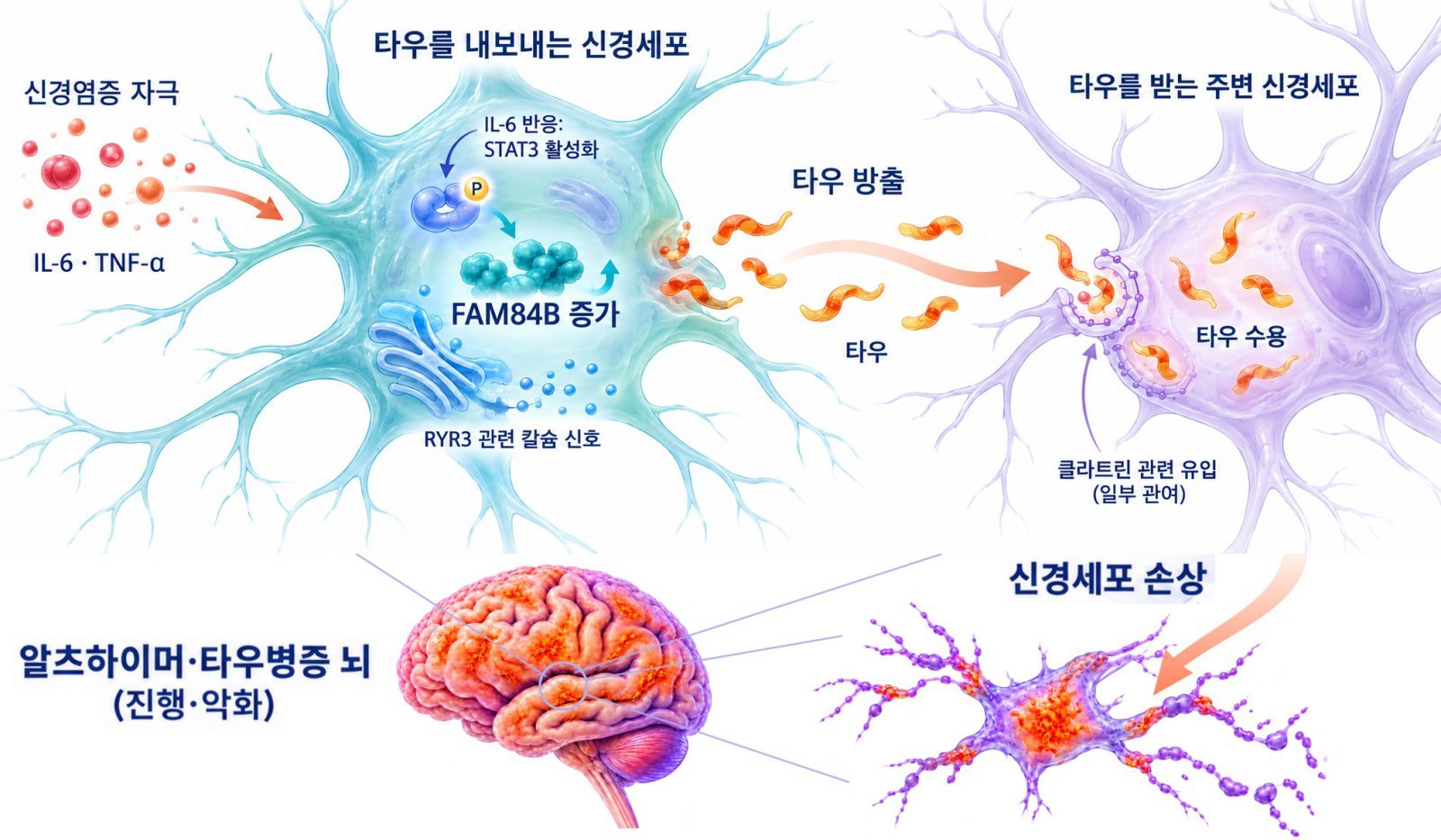
FAM84B-mediated tau propagation and progression/aggravation of Alzheimer’s disease caused by neuroinflammation. Provided by the Korea Disease Control and Prevention Agency
Domestic researchers have discovered for the first time worldwide that a protein called “FAM84B” is involved when dementia-related proteins, such as those linked to Alzheimer’s disease, spread to brain cells. The finding is expected to provide an important clue for the future development of dementia treatments.
The National Institute of Health under the Korea Disease Control and Prevention Agency announced on the 4th that it had confirmed that a protein called “FAM84B” promotes the intercellular transfer of “tau protein” between brain cells. Tau protein normally serves to maintain the structure of neurons in the brain, but when it becomes modified due to aging and other factors and accumulates in the brain, it can damage nerve cells. It has been known that dementia worsens when tau spreads to surrounding cells, but the processes that facilitate tau movement have not been sufficiently clarified.
The research team analyzed postmortem brain tissue from patients who had suffered from Alzheimer’s disease and other conditions, as well as neurons derived from patients’ stem cells. As a result, FAM84B was found in much greater abundance in the brain tissue of patients with tau-related diseases such as Alzheimer’s disease than in the control group without dementia. In cell experiments, when the amount of FAM84B was increased, both the amount of tau released outside the cells and the number of surrounding cells receiving tau increased. This demonstrated that FAM84B is involved in the movement of tau.
Cho Cheol-man, a researcher at the National Institute of Health and lead author of the study, stated, “It has been confirmed for the first time that FAM84B plays an important role in the process by which neuroinflammation affects tau transmission,” adding, “Follow-up studies are needed to verify how this pathway actually affects disease progression.”
The research findings were published online on the 2nd of last month in the international journal “Journal of Neuroinflammation.”
Lee Su-yeon
AI-translated with ChatGPT. Provided as is; original Korean text prevails.
ⓒ dongA.com. All rights reserved. Reproduction, redistribution, or use for AI training prohibited.