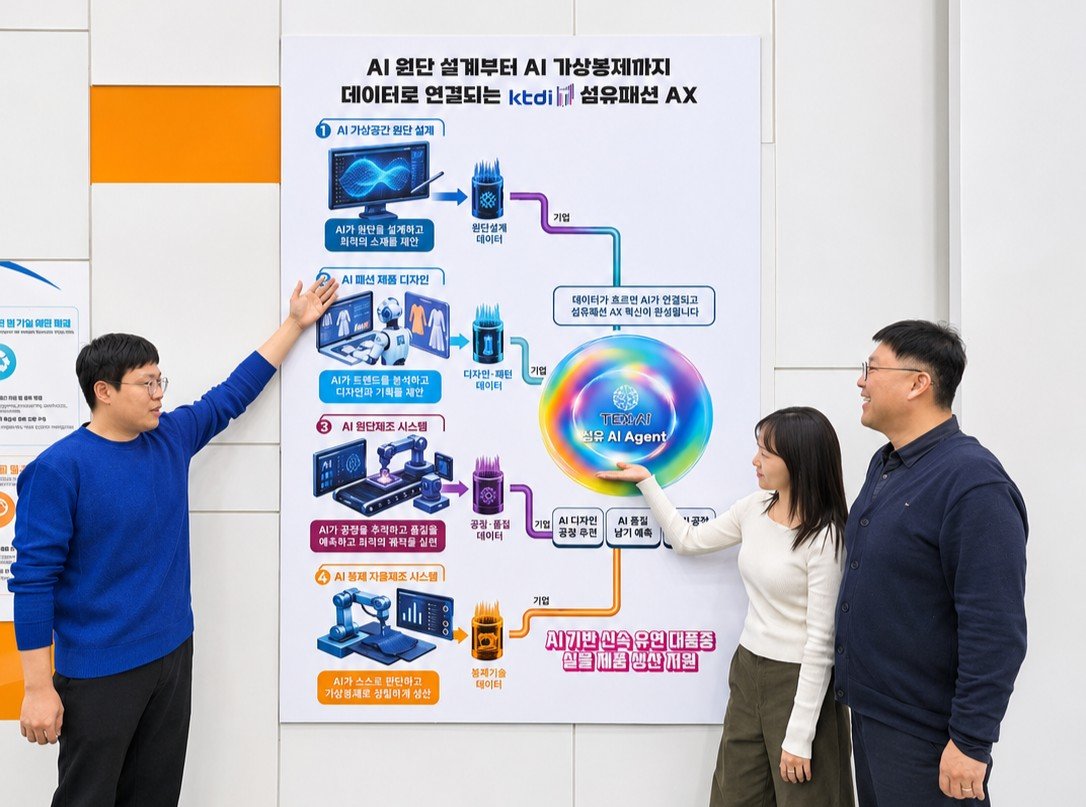
At the promotional hall in the lobby on the first floor of the Korea Textile Development Institute in Seo-gu, Daegu, on the 9th, staff members explain exhibits on manufacturing innovation processes in textile fashion. Provided by the Korea Textile Development Institute
Daegu’s traditional flagship industry, textiles, has begun transforming into an advanced manufacturing sector through convergence with artificial intelligence (AI). Facing difficulties such as a decline in skilled workers, rising production costs, and deteriorating profitability, the textile industry is using AI to overhaul its entire manufacturing framework, from product development to production. Expectations are growing that this will be a turning point to move away from a labor-intensive industrial structure and restructure into a high value-added future industry.
The Korea Textile Development Institute (KTDI) in Seo-gu, Daegu, announced on the 9th that it is working to build an artificial intelligence transformation (AX) ecosystem that connects all processes in textile fashion with data, including AI-based virtual fabric design, fashion design, intelligent weaving, and autonomous sewing manufacturing. The goal goes beyond equipment automation to shorten product development lead times and manufacturing costs while simultaneously improving quality and productivity.
The textile industry is relatively well suited to the integration of AI technology because key information in the manufacturing process—such as yarn type, weave structure, and color—can be converted into data. Shim Seung-beom, head of the Textile Fashion Support Division at KTDI, explained, “In particular, the lack of skilled technicians and the high reliance on foreign workers in simple production processes are part of the workforce structure on the shop floor that is driving the push for AI transformation.”
The core technologies are KTDI’s proprietary virtual fabric design technology “Meta-Fabric” and the textile-specialized generative AI platform “TEX-AI.” Meta-Fabric is a technology that digitizes the characteristics of fabrics—such as yarn type, weave structure, color, and physical properties—into data. Traditionally, skilled technicians had to produce fabric multiple times to check design and quality. By using this technology, however, it is possible to predict and verify fabric characteristics in virtual space before producing actual fabric.
Some results have already been achieved. KTDI has filed two patents related to Meta-Fabric and completed technology transfer to companies. Recently, it received export orders from overseas buyers using only digital fabrics, without physical samples. This is a case in which AI technology has moved beyond the research and development stage to contribute directly to companies’ order-winning competitiveness.
Virtual fabric data are linked to AI fashion design. Before making actual garments, designs can be checked through virtual try-on, and a single fabric dataset can be used to design a variety of clothing products. This enables faster responses to overseas buyers’ requirements and changing trends while reducing prototype production costs and development time.
Changes are also underway on the production floor. KTDI has established a production system in which AI recommends optimal production conditions and predicts quality by using process data collected at its “Intelligent Weaving Micro Factory.” The system enables multi-variety, small-lot production, which is expected to strengthen the competitiveness of small and medium-sized textile enterprises.
AI and robots are also being introduced into sewing processes, which have a high dependence on human labor. KTDI has launched a project to build an “AI autonomous sewing manufacturing” foundation that connects pattern making, automatic cutting, robotic sewing, and quality inspection through AI-based video analysis. The initiative is aimed at alleviating chronic labor shortages and the burden of labor costs.
TEX-AI serves as the control center that integrates these technologies. The platform has learned textile-specific expertise, skilled techniques, and research and development data accumulated over the past three years, and recommends product designs and manufacturing process conditions suited to each company.
KTDI plans to link data from each manufacturing process with TEX-AI to implement customized “AI agent” services for individual companies. It will also support dedicated AI environments enabling companies to use their own production data. The institute’s aim is to shift manufacturing methods—previously dependent on the experience of skilled technicians—to a data-centric approach and to disseminate this model to local small and medium-sized enterprises.
ⓒ dongA.com. All rights reserved. Reproduction, redistribution, or use for AI training prohibited.
Popular News