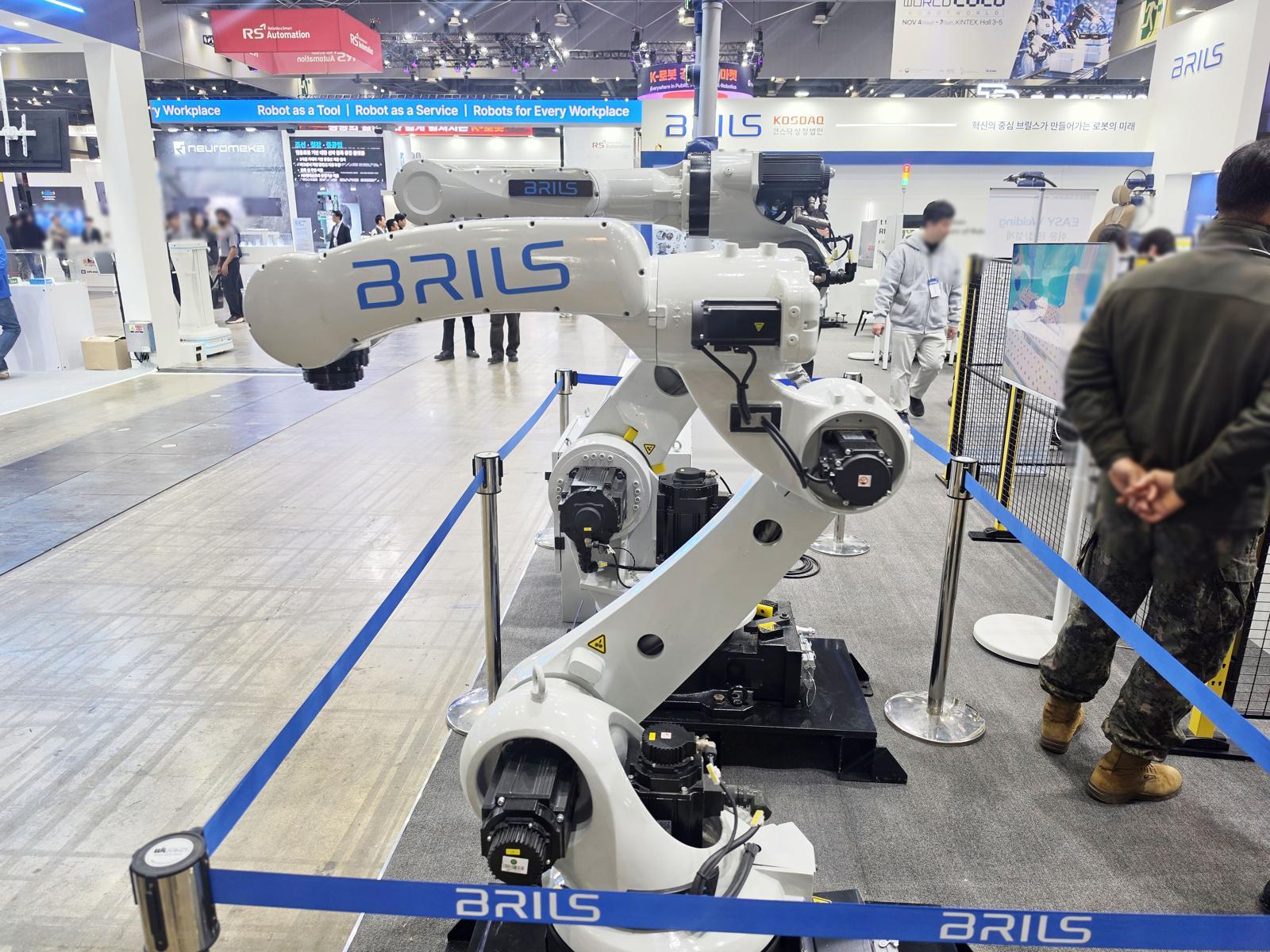
On the 4th, at ‘ROBOTWORLD 2026’ held at KINTEX in Goyang, Gyeonggi Province, Brills exhibited industrial robots. This year’s event features 402 companies from 17 countries, showcasing technologies such as manufacturing automation, humanoids, and core robot components. Industrial robots from Brills on display. Photo by Choi Jae-ho cjh1225@donga.com
Last year, about 354,000 new industrial robots were installed in China, 12 times more than in Korea (about 30,000 units). While China expanded its robot market by accounting for 59% of the world’s new installations, the number of installations in Korea declined by 1%. Having established one of the world’s most advanced manufacturing automation bases, Korea now faces the task of securing new demand for robots and expanding into overseas markets.
Against this backdrop, ‘ROBOTWORLD 2026’, where domestic and overseas robot companies showcase their technological capabilities and commercialization potential, opened on the 4th at KINTEX in Goyang, Gyeonggi Province. The event runs until the 7th, with 402 companies from 17 countries operating 1,198 booths. The latest technologies are being presented, ranging from humanoids and physical artificial intelligence (AI) to manufacturing automation and core robot components.
● China’s robot installations rise 20%… Why is Korea at a standstill?According to the ‘World Robotics Report 2026’ released by the International Federation of Robotics (IFR) in September, the number of new industrial robot installations worldwide in 2025 reached about 603,000 units, up 11% from the previous year. The number of industrial robots operating in factories around the world also surpassed 5 million units.
China’s new installations increased 20% year-on-year to 354,000 units. Of these, products supplied by Chinese robot manufacturers totaled about 195,000 units, accounting for 55% of the domestic market. China has established itself as both the world’s largest robot demand market and the main sales market for its own manufacturers.
By contrast, the number of new installations in Korea was about 30,000 units, down 1% from the previous year. Although it maintained its position as the world’s fourth-largest market, the annual installation volume has remained stagnant at around 31,000 units since 2019.
However, it is not possible to judge technological superiority solely based on new installation figures. China’s manufacturing sector is far larger, and the level of penetration of existing automation equipment differs by country.
Korea ranks first in the world in ‘robot density’, defined as the number of industrial robots in operation per 10,000 manufacturing workers. According to IFR’s 2024 statistics, Korea’s robot density is 1,220 units, meaning there is roughly one robot operating for every eight manufacturing workers. As automation has already advanced significantly, it has become important to discover new application areas beyond existing manufacturing sites.
● Chinese humanoids land in Korea… How competitive are Korean robots?
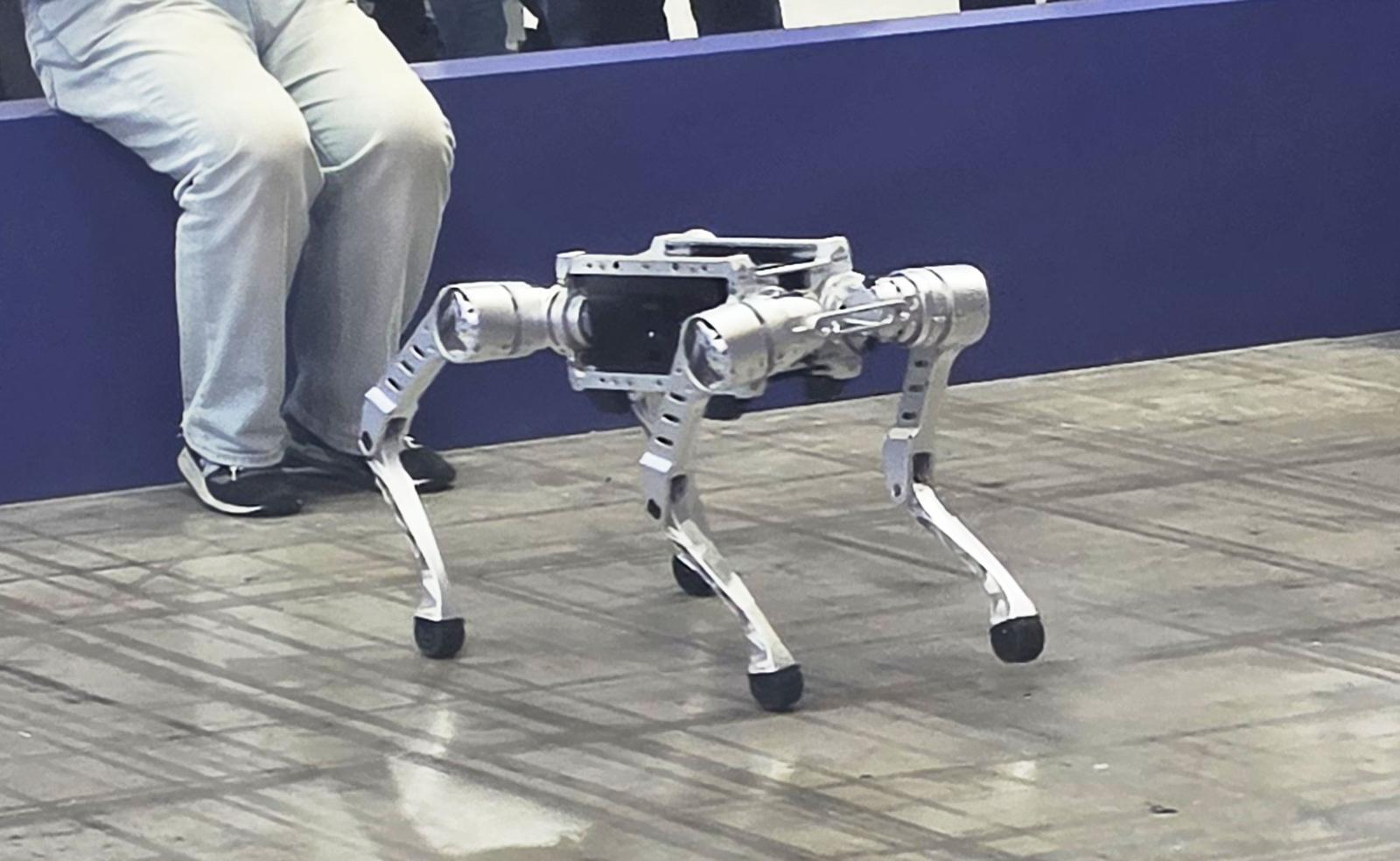
On the 4th, at ‘ROBOTWORLD 2026’ held at KINTEX in Goyang, Gyeonggi Province, quadruped robots from Samhyun and CL Robotics performed demonstrations. Photo by Choi Jae-ho cjh1225@donga.com
At this year’s ROBOTWORLD, Chinese robot companies are participating to showcase their technologies alongside domestic firms. Booster Robotics and Fasten Robotics have set up exhibition booths, while robots from Unitree, Agibot, and UBTECH are being introduced through domestic distributors. Japan’s FANUC is exhibiting its industrial and collaborative robot technologies.
Domestic companies are highlighting physical AI, manufacturing automation, and core components. Physical AI refers to technology that enables AI to perceive the surrounding environment through cameras and sensors and perform actual movements or tasks.
Rainbow Robotics is exhibiting mobile humanoids and quadruped robots, while Neuromeka is presenting a humanoid platform that applies physical AI-based work technologies. Robotis, A-Lot, and T-Robotics are also showcasing robots and drive technologies that can be used in manufacturing and logistics sites.
In the manufacturing automation field, DN Solutions has unveiled a ‘machine tending’ solution that automates the process of loading raw materials into machine tools and unloading finished products. Brills is exhibiting a modular robot platform that can be configured to meet process-specific requirements such as inspection, transfer, and machining, while Samhyun is showcasing ‘BOLDUM’, a high-payload AI autonomous mobile robot.
In the core components segment, Korean companies are also demonstrating their technological capabilities. SPG and SBB Tech are exhibiting precision reducers and actuators, while RS Automation is presenting servo drives and motion controllers that control robot movements. A reducer is a component that lowers the rotational speed of a motor while increasing torque, and an actuator is a drive unit that moves robot joints and other parts.
Many challenges remain before humanoids can be fully commercialized. Moving like a human in an exhibition hall and working reliably for long hours in an actual factory or logistics center are very different matters. The success rate and safety of repetitive tasks, adoption costs, and maintenance burdens all factor into decisions on industrial deployment. Whether technology demonstrations can be translated into real deliveries and revenue is expected to determine the competitiveness of domestic companies.
● Beyond technology exhibitions to exports and investment… Will it lead to actual deals?This year’s ROBOTWORLD also focuses on helping companies secure overseas sales channels and attract investment. The aim is to go beyond showcasing technology and directly connect domestic and overseas end-user companies with robot manufacturers.
The export consultation session, held from the 4th to the 6th, will be attended by more than 100 overseas demand companies from East and West Asia, North America, and Western Europe, along with over 150 Korean robot companies. The Korea AI & Robot Industry Association has invited about 100 overseas buyers with strong purchasing intentions and is supporting one-on-one consultations.
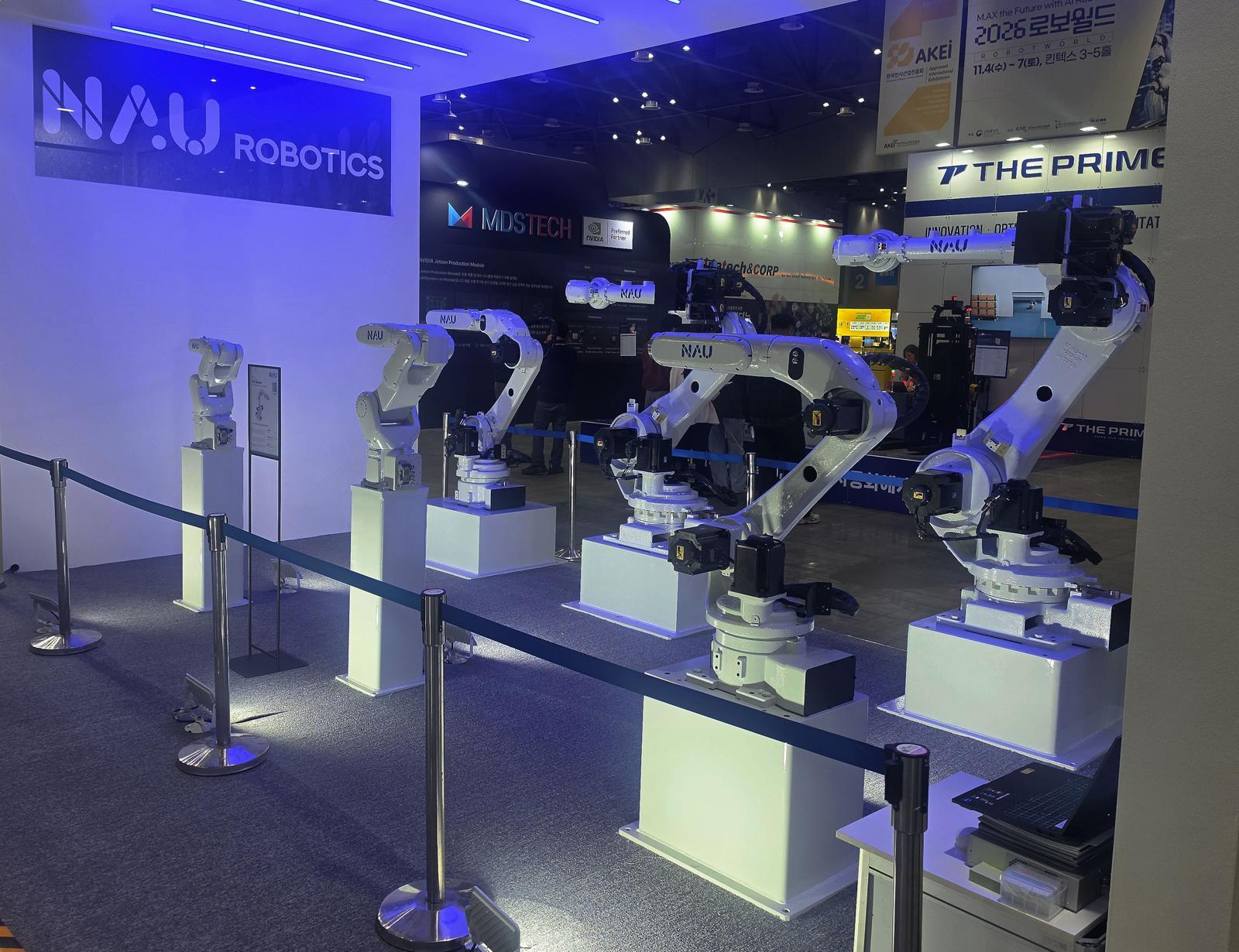
Industrial robots from Now Robotics on display at ‘ROBOTWORLD 2026’ at KINTEX in Goyang, Gyeonggi Province, on the 4th. Photo by Choi Jae-ho cjh1225@donga.com
A purchasing consultation event has also been arranged, with 30 large and mid-sized domestic corporate customers and 50 robot suppliers participating. It is a venue for companies to review robots needed for their actual production and logistics sites and to discuss potential business cooperation.
On the 6th, ‘AI & Robot Global Scale-up Day’ will be held. An investment attraction event that had previously focused on startups has been expanded to include AI and robot small and medium-sized enterprises in need of growth capital. Overseas venture capital (VC) firms, mergers and acquisitions (M&A) specialists, and strategic investors will participate, and five U.S. VC firms have confirmed attendance.
Technology exchanges with overseas companies will also take place. NVIDIA and Qualcomm will participate in the International Robot Business Conference. A delegation of 10 companies from Canada will visit, and five Indian startups will join for the first time.
At the opening ceremony, Oh Jun-ho, chairman of the Korea AI & Robot Industry Association, said, “It is necessary to enhance the technological competitiveness of robot hardware and core components, while at the same time creating technologies and solutions that can be used in real industrial sites by converging AI and robot technologies,” adding, “We will expand cooperation between domestic and overseas companies and support the commercialization and overseas expansion of promising technologies.”
Lee Min-woo, Director General for Industrial Growth at the Ministry of Trade, Industry and Energy, stated, “Korea has ample potential to emerge as a robotics powerhouse, given its abundant manufacturing data and highly skilled technical workforce,” and added, “The government will strengthen policy support so that the robotics industry’s potential can be realized quickly and become a second semiconductor industry, while also leveraging private-sector capabilities to ensure that robots are rapidly introduced into national defense.”
While China is expanding robot adoption on the back of its massive domestic market, Korean companies must secure new industrial demand and overseas markets. Attention is focusing on whether the technologies showcased at this year’s ROBOTWORLD will lead to actual purchase contracts, exports, and investment deals.
ⓒ dongA.com. All rights reserved. Reproduction, redistribution, or use for AI training prohibited.
Popular News