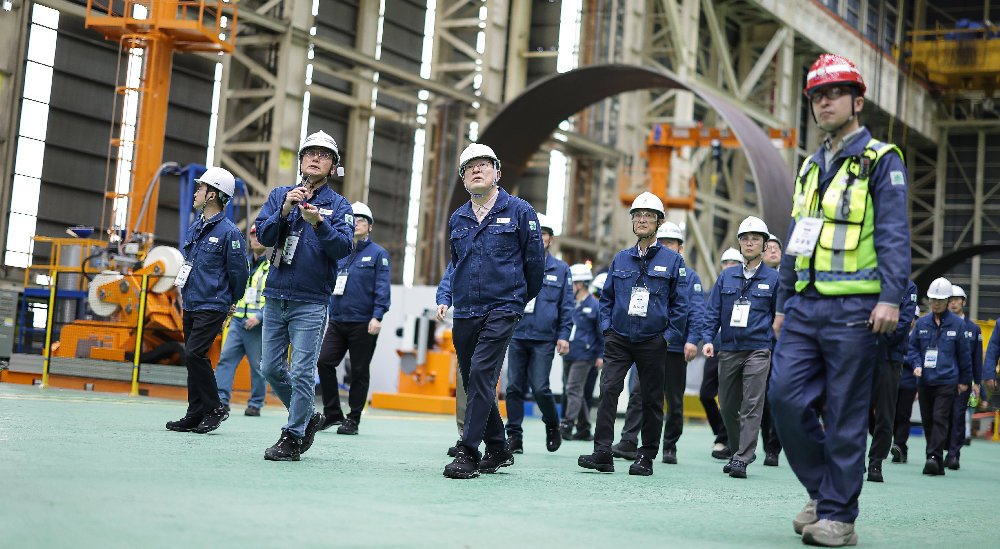
GS Group Chairman Huh Tae-soo (center) inspects offshore wind monopile production facilities at GS Entec’s Yongjam plant in Yongjam, Nam-gu, Ulsan, on the 26th. Provided by GS Group
“Today’s completion ceremony is not simply an occasion to showcase a newly refurbished plant, but a moment to move toward a new turning point based on the technology and capabilities accumulated over a long period.”
At the “Completion Ceremony for Dedicated Automated Monopile Production Facilities” held on the 26th at GS Entec’s Yongjam plant in Yongjam-dong, Nam-gu, Ulsan, GS Entec CEO Huh Cheol-hong made these remarks. The ceremony was attended by about 60 people, including GS Group Chairman Huh Tae-soo, GS Group Vice Chairman Hong Soon-ki, and Cees (Kun) Bøhmer, CEO of Sif in the Netherlands.
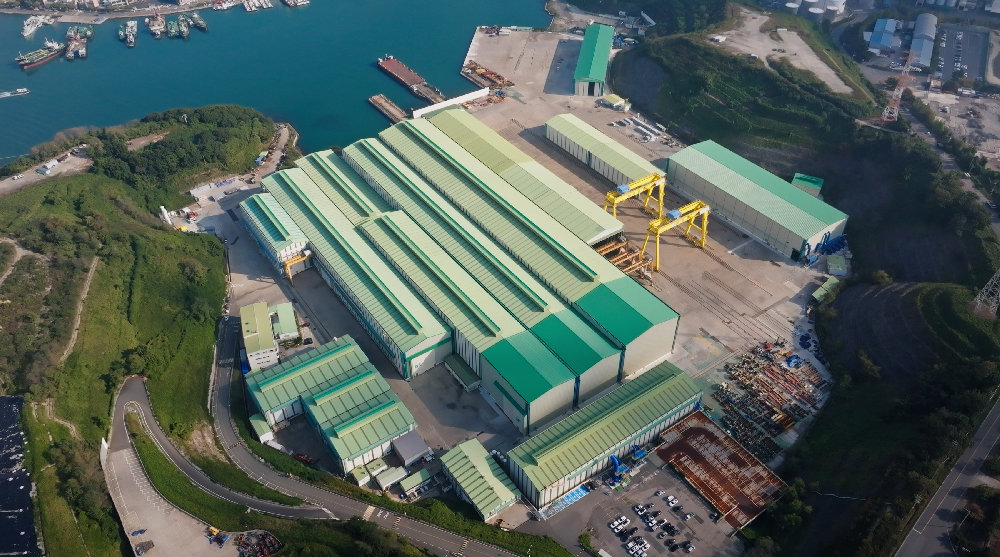
Panoramic view of GS Entec’s Yongjam plant. Provided by GS Group
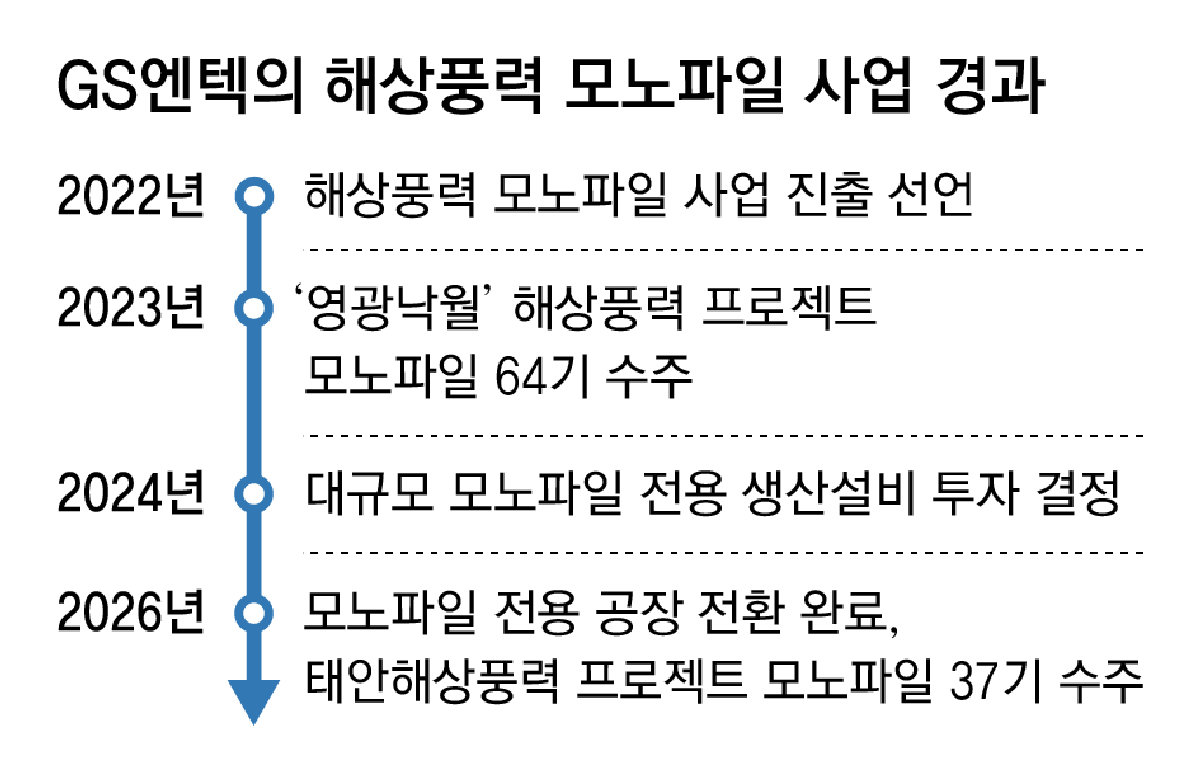
Completely transformed into an offshore wind monopile production plant, this facility was manufacturing petrochemical and refining plant equipment as recently as 2024, two years ago. However, with a global boom in renewable energy and GS Entec’s decision to designate the offshore wind monopile business as a new growth engine, the plant was revamped through an investment of KRW 300 billion over about two years starting in 2024.
“Monopiles” are giant piles that support offshore wind installations, taking the form of massive steel cylinders with outer diameters of 9–11 meters. Because they are made of extremely large and thick steel, welding them together properly is the most crucial core competency in monopile manufacturing. Based on welding capabilities accumulated in its existing plant equipment manufacturing business, GS Entec has become the only producer in Korea capable of manufacturing ultra-large monopiles. Collaboration with Sif of the Netherlands, which holds a 40% share of the European offshore wind monopile market, has also been a major support. In 2022 GS Entec entered into a strategic partnership with Sif and established the latest automated production system at the Yongjam plant.
On the 26th, when the Yongjam plant reopened after two years, work was in full swing to produce prototype offshore wind monopiles. The prototype monopile under fabrication had an outer diameter of 9.6 meters, equivalent to the height of a three-story apartment building, and a thickness of 75 mm. Song Won-gil, GS Entec Co-CEO and Head of Production, said, “Offshore wind turbines are becoming larger, and the monopiles that support them are getting thicker and heavier,” adding, “The Yongjam plant is equipped to produce ultra-large monopiles with a maximum outer diameter of 11 meters, thickness of 160 mm, and height of 80–100 meters.”
Although demand for ultra-large monopiles is increasing, there are only a limited number of facilities capable of welding and producing them with high precision, which, according to the company, ensures a sufficient pipeline of orders. In 2023, GS Entec signed a contract to supply 64 monopiles, worth about KRW 200 billion, to the Yeonggwang Nakwol offshore wind project and completed all installations in June this year. In September this year, the company signed a contract to supply 37 monopiles for the 504 MW Taean Offshore Wind Power Project. The monopiles to be supplied to Taean are large units with an outer diameter of 10.6 meters and thickness of around 100 mm, and will be delivered sequentially from July next year through August 2028.
The volume to be supplied to Taean is about 51,000 tons by weight, roughly one-third of the Yongjam plant’s annual production capacity of 150,000 tons. The company plans to raise utilization rates with a goal of winning orders for six offshore wind projects in Korea and three in Japan between 2028 and 2030.
Starting with Japan, GS Entec also plans to accelerate exports to the Asia-Pacific region, including Southeast Asia and Australia. However, one challenge cited is the lack of dedicated berths large enough to stack and transport monopiles, each of which weighs up to 1,600 tons. Song said, “Offshore wind components are so heavy that there are limits to storing them in general ports,” stressing, “With energy security becoming an increasingly serious issue, there is an urgent need to expand infrastructure such as dedicated offshore wind berths.”
ⓒ dongA.com. All rights reserved. Reproduction, redistribution, or use for AI training prohibited.
Popular News