Medical Innovation, The Era of Robotic Surgery 〈1〉 Run Hospital
Robot‑guided precise control of bone cutting angles
Customized to each patient’s anatomy and ligament balance
Preserving muscles and tendons to ease recovery
Park Joon-gu, head of the Robotic Joint Replacement Center in charge of knee joints and sports medicine at Dalryeora Hospital, discusses the latest trends in robotic surgery for joint replacement. Lee Jin-han, Medical Correspondent·Physician likeday@donga.com
The competitiveness of robotic surgery does not lie in whether advanced equipment is introduced, but in how much the technology actually changes surgical outcomes. Even with the same category of robotic surgery, the treatment approach and clinical results differ depending on each system’s technical characteristics, the operating surgeon’s level of expertise, and the conditions being treated.
Dong-A Ilbo, through a three-part series on robotic surgery, will spotlight major robotic surgery systems and provide detailed analysis of the differentiating features and clinical utility of each technology. In particular, it will speak directly with leading specialists in each field to examine how these methods differ from conventional surgery, the benefits patients can perceive, and the technological limitations.
For the first installment, Park Joon-gu, an orthopedic surgeon and head of the Robotic Joint Replacement Center in charge of knee joints and sports medicine at Dalryeora Hospital in Gangdong District, Seoul, was interviewed in depth about robotic knee replacement surgery. Dalryeora Hospital is the first in Korea to operate three different robotic systems for joint replacement and is advancing surgical techniques based on extensive experience with robotic procedures.
―It has been about 50 years since joint replacement surgery began. What is the current level…. “Modern knee replacement surgery began in the 1970s. Over the past 50 years or so, the materials and design of implants and the associated surgical techniques have steadily evolved. Today, the 10-year survival rate of knee implants exceeds 95%, and the 20-year survival rate has reached around 90%, indicating significantly improved durability. In the past, the main concern was how long a joint replacement would last; now, it has advanced to the point where many patients can essentially use the implant for a lifetime.”
―Some patients still feel discomfort in the knee after surgery. “That is correct. The longevity of an implant and the patient’s satisfaction with the surgical outcome are separate issues. Some patients experience stiffness or a sense of awkwardness in the knee after surgery, and it is known that 10–20% of patients are not fully satisfied with the results. To overcome such limitations, customized surgery that preserves each patient’s unique knee structure as much as possible has recently drawn attention. This approach combines precise bone cutting using robots, preservation of muscles and ligaments, and strategies to minimize bleeding, with the goal of optimizing not only joint function but also recovery after surgery.”
―Technological advances are bringing a new turning point to joint replacement surgery. What has changed? “The biggest change is that surgery can now be tailored to the shape of each patient’s knee. In the past, bones were cut at fixed angles using standardized instruments. With the development of robotic technology, it is now possible to accurately identify the anatomical differences in each person’s knee and adjust the cutting angle of the bone in fine increments of 1–2 degrees, enabling surgery that keeps the knee as close as possible to its original shape.
Based on this technology, Dalryeora Hospital applies what is known as the ‘restricted kinematic alignment’ method. This technique preserves the patient’s natural knee alignment as much as possible while correcting excessively deformed segments within a safe range. Previously, the focus was on making every patient’s leg look similar. Now, the varying morphology of each patient’s knee and ligament balance are taken into account. This reduces unnecessary ligament release and helps create a knee that feels more natural and comfortable after surgery.”
―Preserving the muscles and ligaments around the knee is also said to be important…. “In joint replacement surgery, preserving the surrounding muscles and ligaments is just as important as cutting the bone accurately. The commonly used approach involves opening the front of the knee and incising part of the quadriceps tendon. This method is a time-tested and stable access route that offers good visualization of the surgical field. However, because it involves incising a tendon that plays a key role in knee extension, it can be disadvantageous in terms of early postoperative pain and recovery of muscle strength.
For this reason, the sub-vastus (under the vastus medialis) approach, which minimizes damage to muscles and tendons, has recently been adopted. This method accesses the joint underneath the medial muscle of the knee, without cutting the quadriceps tendon that is crucial for knee extension. While the conventional technique secures the surgical field by cutting part of the tendon, the new method is distinct in that it preserves this tendon to the greatest extent possible. It also has advantages in terms of pain and rehabilitation. Achieving precise bony alignment while preserving muscles and ligaments as much as possible is the surgical direction pursued here.”
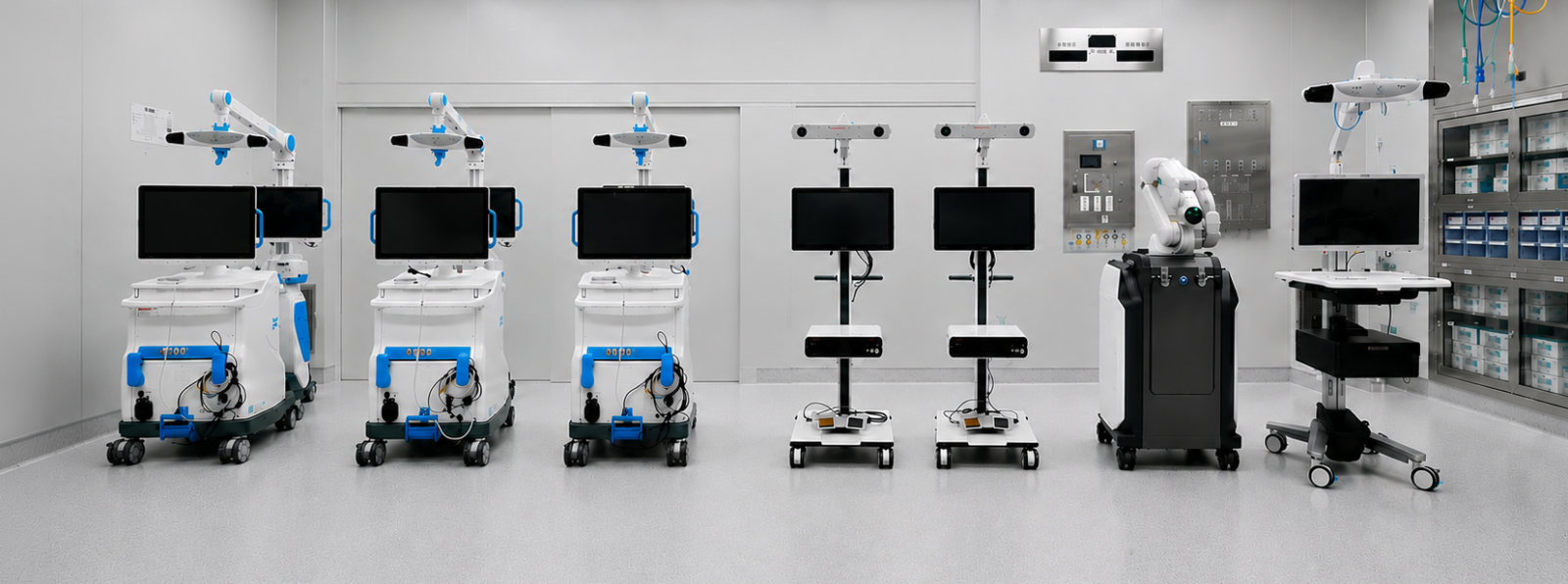
Dalryeora Hospital operates a total of six joint replacement robots across three models—ROSA (from left), COTY, and CUVIS-joint. It performs customized joint replacement surgery by considering the condition of each patient’s knee and the characteristics of each robot.
―How would you compare the characteristics of the three knee robotic surgery systems? “Our hospital has three robotic systems for joint replacement: COTY, ROSA, and CUVIS-joint. All three are designed to assist in performing precise joint replacement surgery, but they differ in how they cut bone and how the surgery is planned. COTY is a precision milling-type robot that the surgeon holds and manipulates directly by hand. A small milling device rotates at high speed, shaving away the bone gradually. Because the system controls the device so that it does not move outside the pre-planned boundary, the surgeon can mill only the required areas with great precision. Unlike the large saw blades used in conventional surgery, it uses a small milling tool. Research has reported that indicators related to blood loss were lower in COTY-assisted procedures than in conventional surgeries. However, further study is needed to determine whether this outcome is attributable specifically to the milling method itself.
The second system is ROSA. ROSA uses a robotic arm to guide the location and angle at which the bone is cut with high accuracy. A particular advantage is that it allows the surgeon to check leg alignment and ligament tension numerically during surgery and to fine-tune the position of the implant accordingly.
The third system is CUVIS-joint. CUVIS-joint uses preoperative computed tomography (CT) to analyze the patient’s knee in three dimensions and establish a surgical plan. During surgery, a cutting tool attached to a robotic arm then mills the bone in line with the planned positions. Although each of the three robots operates differently, they all serve the common purpose of inserting the most suitable implant for each patient with maximum accuracy.”
―What is the future direction of robotic joint replacement surgery? “It can largely be summarized in three points. First is customized surgery that preserves the patient’s original knee anatomy as much as possible using robotic assistance. Second is maximizing the preservation of muscles and ligaments that are vital for knee motion to support faster recovery. Third, and also very important, is minimizing intraoperative blood loss and unnecessary blood transfusions. Transfusions, in particular, can be associated with postoperative infections and various complications, so there is a strong effort to reduce them wherever possible. At our hospital, anemia is actively corrected before surgery, and a technique is used in which an intramedullary alignment rod is not inserted into the femur when operating with robots. Efforts are also under way to minimize damage to surrounding tissues.”
―What would you like to say to patients considering joint replacement surgery? “Patients preparing for joint replacement surgery are often anxious about whether the operation will be painful, how long recovery will take, and whether they will be able to walk as before. Joint replacement surgery has advanced dramatically over the past 50 years and has now reached a level where implants can be used for a long time without the need for replacement. Building on this, efforts are being made to further reduce postoperative pain and discomfort and to help patients return to their daily lives more quickly. However, robotic surgery does not automatically guarantee better outcomes for every patient. The key is to select the most appropriate surgical method based on the condition of each patient’s knee. The goal is not just for the implant to last a long time, but for patients to be able to use their knee as naturally and comfortably as if it were their own.”
ⓒ dongA.com. All rights reserved. Reproduction, redistribution, or use for AI training prohibited.
Popular News