Japan, Singapore and others loosen rules on unmanned driving AtoG wins KRW 12 billion project in UAE Mars Auto enters U.S. long-haul freight market
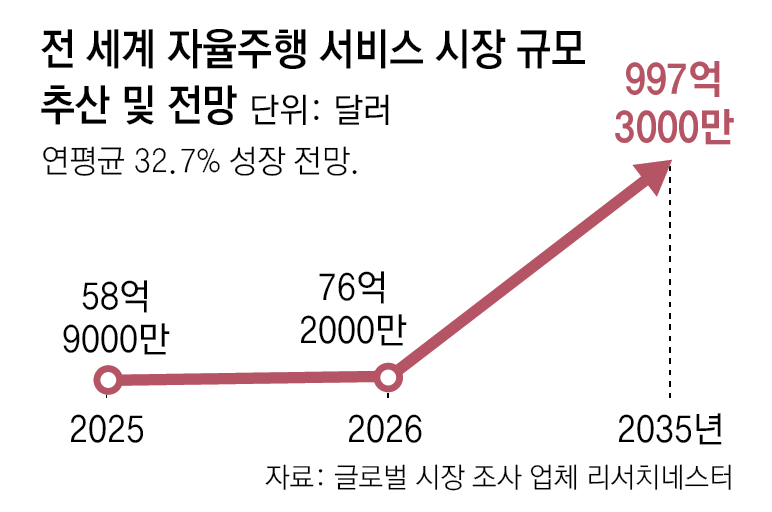
Although the global autonomous driving market is led by US and Chinese big tech companies, Korean startups are gradually securing business opportunities overseas. They have focused on “niche markets” such as public transportation in the Middle East and Southeast Asia, where markets opened earlier than in Korea and big tech’s influence backed by massive capital and data is relatively weaker, as well as long-haul logistics in the United States.
The frontrunner in overseas expansion is Autonomous A2Z (A2Z), which ranked seventh globally in Guidehouse’s “2025 Autonomous Driving Leaderboard.” In November last year, A2Z formed a joint venture with UAE artificial intelligence (AI) company Space42, with both parties investing USD 4 million (approximately KRW 6 billion) to secure an autonomous driving project in Abu Dhabi worth USD 8 million. In February, it became the first Korean company to obtain government approval to export “national core technology,” removing a major hurdle to commercialization in the local market. Building on this, A2Z plans to deploy its fully autonomous “Level 4” unmanned mobility service “ROii” and aims to win additional projects worth USD 7.6 million (approximately KRW 11 billion) in the UAE within this year. With the UAE government pursuing a plan to make 25% of Dubai’s public transportation autonomous by 2030 and to fully convert Abu Dhabi to autonomous driving by 2040, the market outlook is favorable.
The company is also accelerating its expansion into Southeast Asia and Japan. A2Z has obtained an autonomous driving license in Singapore and is operating an urban shuttle service in partnership with Grab, the country’s largest super app. During President Lee Jae-myung’s state visit to Singapore in March, the company signed memorandums of understanding (MOUs) with three local partners, including ICT firm NCS, broadening its partnership network. In Japan, A2Z is expected to explore commercialization opportunities after participating in an autonomous taxi pilot project in Naruto City, Tokushima Prefecture, between February and March.
Expansion into logistics and special-purpose vehicle markets is also underway. Autonomous truck startup Mars Auto began transporting freight in March on a fixed route of approximately 3,379 km connecting the Port of Long Beach in California and the State of Georgia in the United States. This is one of the world’s longest pilot operations in which high-risk long-haul routes, where driver fatigue often leads to accidents, are replaced with autonomous driving. Mars Auto’s technological capabilities have been recognized by the Korea Institute for Advancement of Technology (KIAT), which selected the company for its new industry creation program, providing KRW 2 billion in research and development (R&D) funding over two years.
RideFlux is preparing to enter the Japanese and Southeast Asian markets in line with its planned launch of unmanned commercial services in 2027. ThorDrive has begun commercial deployment of autonomous towing tractors for cargo at airports in Saudi Arabia. These companies aim to gain a foothold in the rapidly growing global autonomous driving market by preempting regions and segments that remain largely untouched by big tech.
Kim Jae-hyung 기자 monami@donga.com; Jeon Hye-jin 기자 sunrise@donga.com
AI-translated with ChatGPT. Provided as is; original Korean text prevails.
ⓒ dongA.com. All rights reserved. Reproduction, redistribution, or use for AI training prohibited.