[Autonomous Driving in Crisis, Golden Time Slipping Away] Part 3 – For Korea, Delay Means Losing Its Chance
“We’ll learn from anyone if there’s something to learn” – Hyundai to deploy 200 vehicles in Gwangju in the second half
Socar and Krafton preparing a KRW 150 billion joint venture
“Overlapping regulations persist, support bodies remain scattered… A control tower is needed to catch up with advanced economies”
“US companies such as Tesla and Waymo and Chinese firms are doing extremely well. To make up for what we lack in technology, we will learn from any company in the world if there is something to learn.”
Hyundai Motor Group Chairman Chung Euisun made these remarks on 14 May in response to questions from reporters about autonomous driving, ahead of a town hall meeting held at Hyundai Motor Group’s Yangjae headquarters on Heolleung-ro, Seocho-gu, Seoul. Market observers say his comments indicate a shift in Hyundai Motor Group’s autonomous driving strategy. After Chung personally visited Las Vegas, US, in January for CES to meet NVIDIA CEO Jensen Huang, Hyundai Motor has recently been focusing on boosting its autonomous driving capabilities by actively “opening doors” to collaboration or joint ventures with artificial intelligence (AI) companies. The group believes that securing a highly intelligent autonomous driving “brain” first, and then conducting demonstration projects in the US and Korea to accumulate data, is key to accelerating the commercialization of autonomous driving.
● Hyundai to deploy large number of autonomous vehicles in Gwangju, mobility companies also stepping up
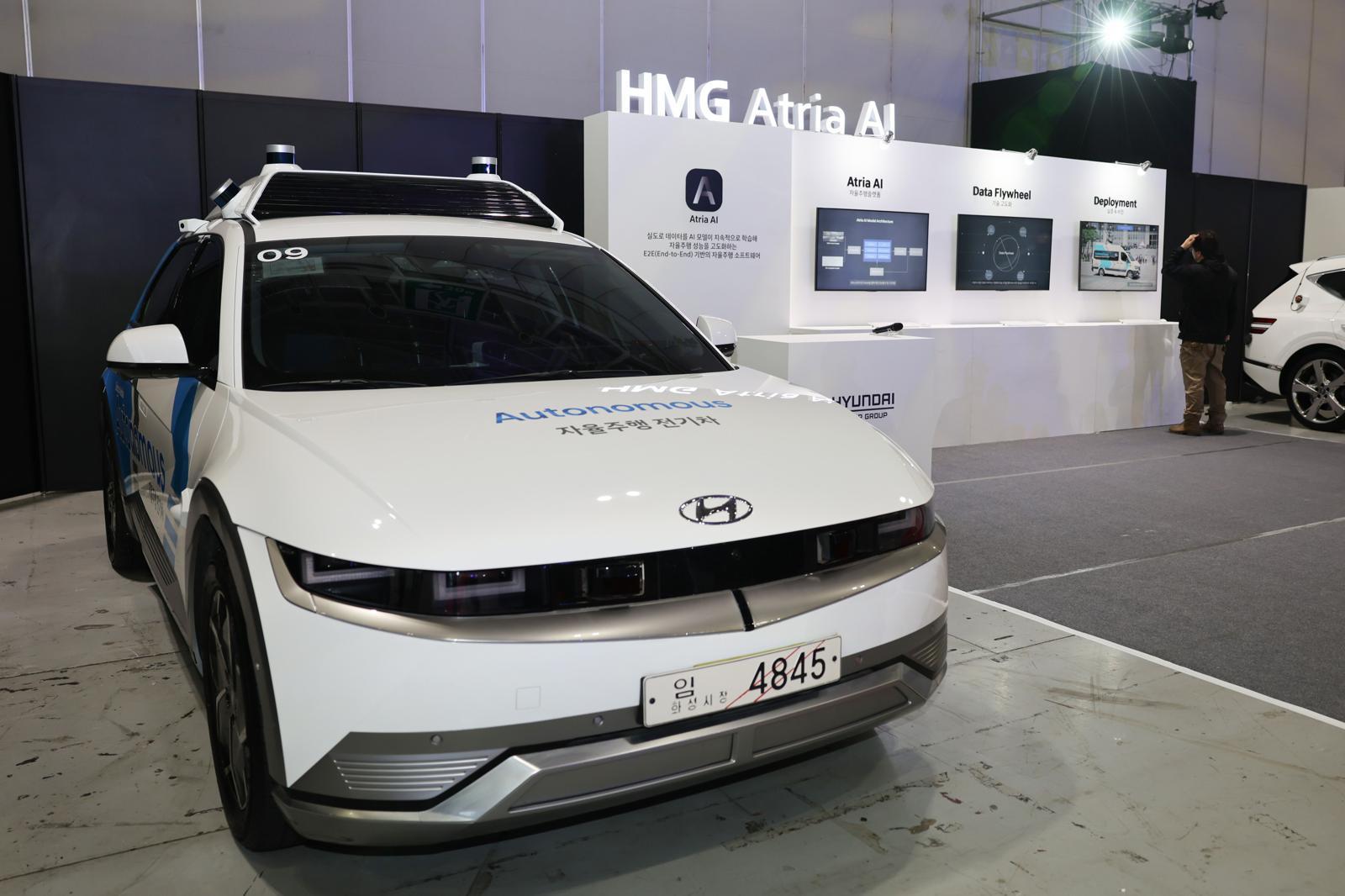
An exhibition view of the Hyundai IONIQ 5-based test vehicle that will operate in Gwangju, which is set to become a citywide autonomous driving testbed.
As the autonomous driving market grows rapidly and enters commercial stages around the world, Korean companies are also feeling the urgency. There is a sense of crisis that the autonomous driving market—considered the “core battleground” of the physical AI era—is being taken over by US and Chinese companies. According to global research firm CMI, the global autonomous driving market is projected to expand from USD 293.2 billion in 2025 to USD 3,105 billion (about KRW 4,300 trillion) by 2032.
For Hyundai Motor, which is seeking a turnaround, Gwangju is expected to become an important test stage. Last month, the entire road network of Gwangju Metropolitan City was designated as an autonomous driving test zone. Previously, Level 4 autonomous vehicles (capable of self-driving without a supervisor) could operate only in limited areas or on designated roads and only at restricted times. This is the first time in Korea that Level 4 autonomous vehicles are allowed to operate across the entire road network of a metropolitan-level city.
Accordingly, Hyundai Motor Group plans to deploy 200 autonomous vehicles in Gwangju in the second half of the year. Each vehicle combines eight cameras and one radar. While Hyundai Motor Group had previously centered its advanced driver-assistance systems (ADAS) on radar and infrared sensors, it is now actively incorporating cameras. The company has gained experience in significantly improving the performance of safety features—such as forward collision avoidance assistance—through the adoption of cameras.
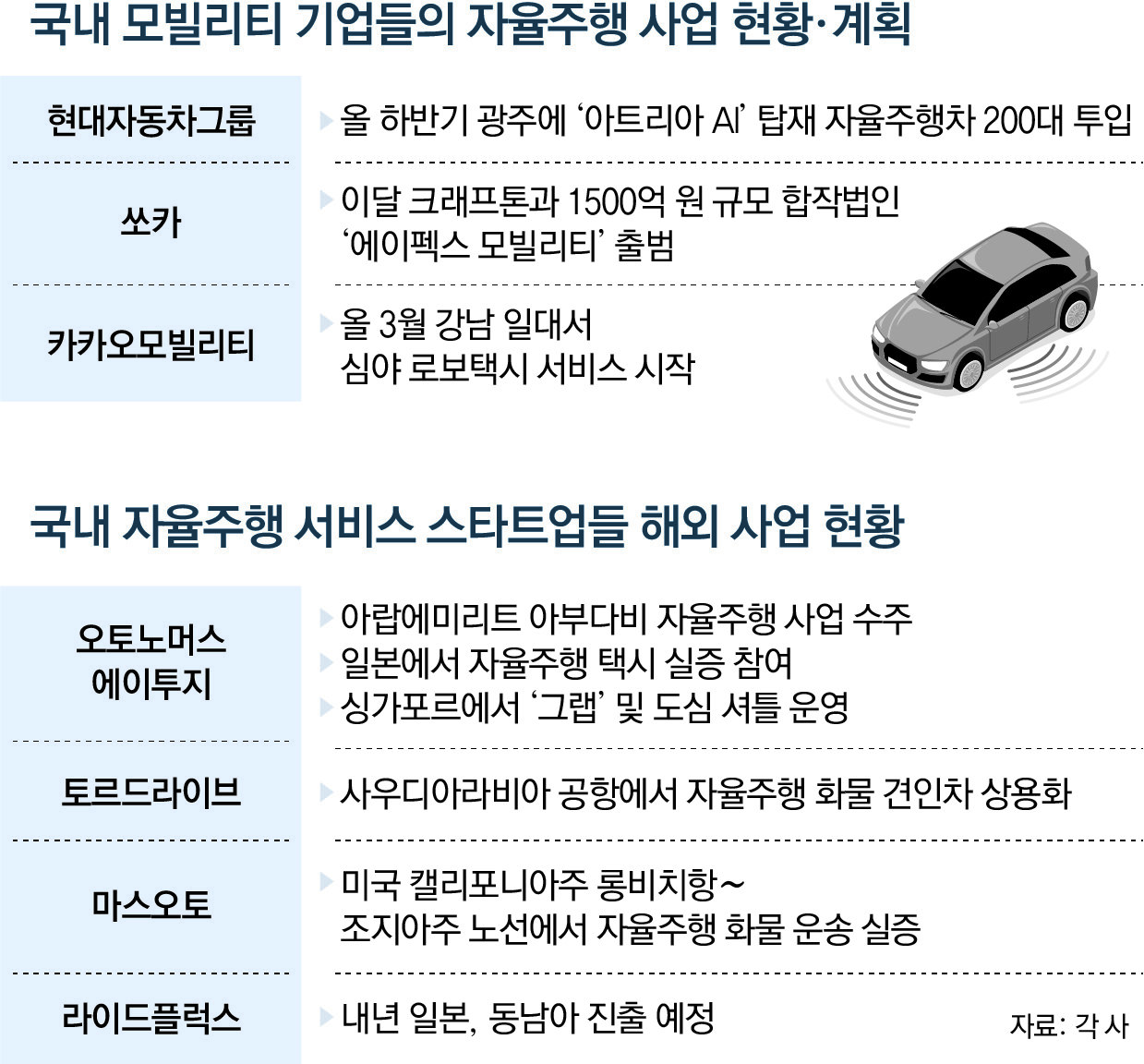
The Gwangju test vehicles will also be equipped with “Atria AI,” Hyundai’s proprietary autonomous driving system. Hyundai Motor Group’s autonomous driving subsidiary 42dot released a video of autonomous driving based on Atria AI in December last year. At the time, some evaluations said it “fell short compared to Tesla,” but Hyundai states that it has continued to enhance the technology since then. The company is particularly confident that the more the vehicles run in the Gwangju demonstration project, the more Atria’s quality will improve.
In addition, Hyundai has appointed Park Min-woo, a former vice president at NVIDIA, as president and CEO of 42dot and head of the Advanced Vehicle Platform (AVP) Division, and has decided to actively adopt NVIDIA’s autonomous driving model “Alfa-Mayo.”
The mobility sector is also moving quickly. Car-sharing company SOCAR has entered the domestic autonomous driving ecosystem, leveraging its vast data assets and automation technologies. SOCAR’s 25,000 car-sharing vehicles deployed nationwide travel an average of 1.1 million km per day, generating driving video and accident data. Building on this data, SOCAR plans to launch a KRW 150 billion joint venture “Apex Mobility” with game company Krafton within this month.
● Entangled regulations, lack of control tower remain challenges
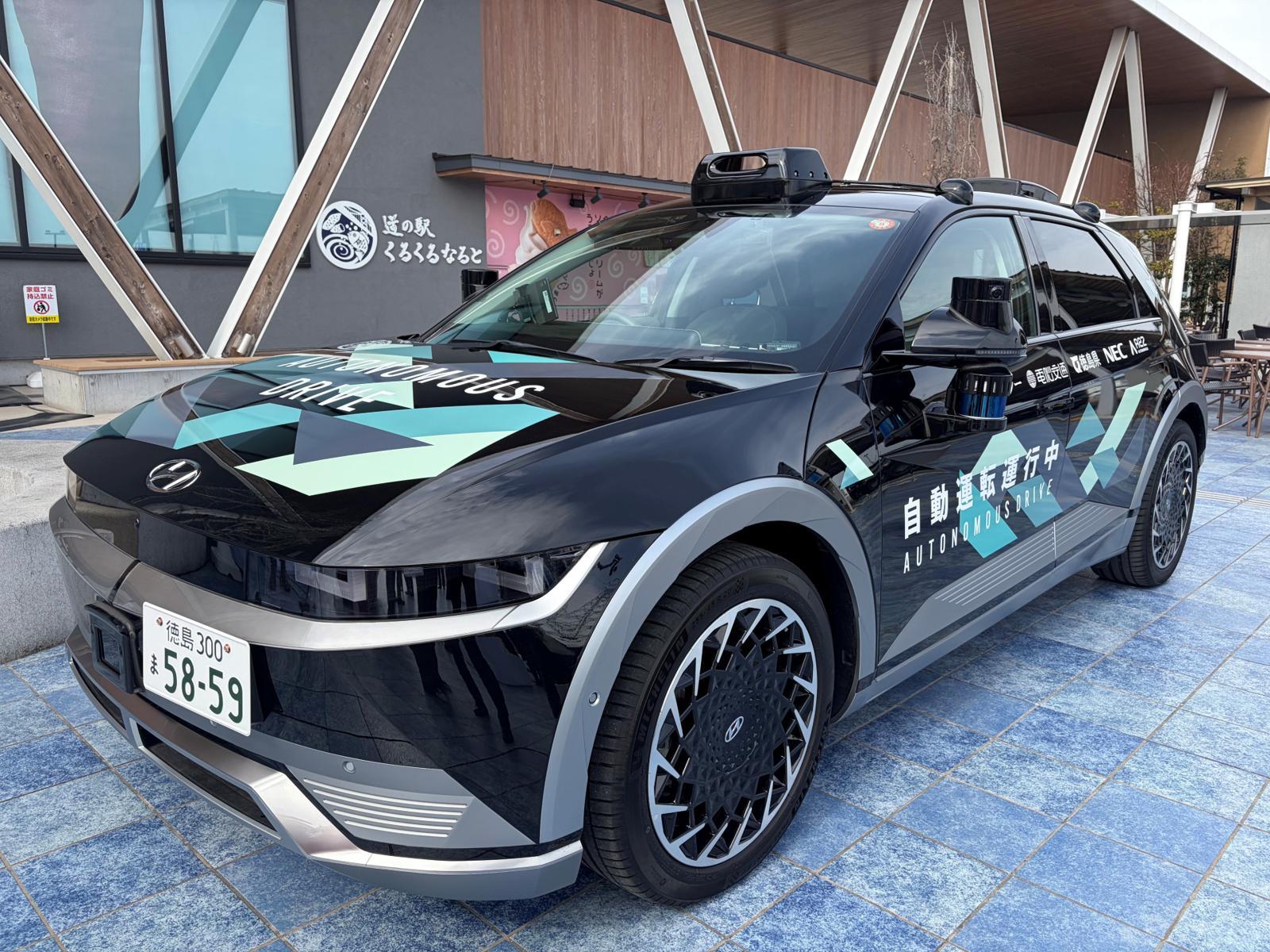
Autonomous A2Z is actively venturing onto the global stage, including participation in an autonomous taxi project in Naruto City, Tokushima Prefecture, Japan. Pictured is an IONIQ 5 vehicle equipped with a Level 4 system used in the demonstration project.
However, there are still significant challenges before domestic companies can truly scale up in the autonomous driving market. According to the Institute of Information & Communications Technology Planning & Evaluation (IITP), Korea’s autonomous driving technology scores 89.4, ranking fifth after the United States (100), the European Union (98.3), China (96.4), and Japan (89.7), but its market size does not even place within the global top 10.
The autonomous driving industry points out the absence of a “control tower” to foster the market from a long-term perspective. Autonomous driving-related support divisions and regulatory bodies are scattered across the Ministry of Land, Infrastructure and Transport (MOLIT), the Ministry of Trade, Industry and Energy, the Ministry of Science and ICT, and the National Police Agency. In its “Audit Report on the Government’s Response to the Fourth Industrial Revolution” published in 2024, the Board of Audit and Inspection analyzed that “differences of opinion among ministries during the introduction of new technologies have led to prolonged delays in government decision-making, thereby widening the technology gap.” It also pointed out that MOLIT and the Ministry of Science and ICT had disagreed since 2019 over the standard communication technology for cooperative automated driving systems, wasting four years.
The National Assembly Research Service, in its 2023 report titled “Legislative Trends and Issues Related to Autonomous Vehicles in Korea and Overseas,” noted that “autonomous driving systems responsible for driving are governed by the Motor Vehicle Management Act, while drivers’ roles and responsibilities are defined by the Road Traffic Act,” and raised the need to review and streamline linkages among related statutes.
Professor Kim Pil-soo of Daelim University College’s Department of Future Automotive Engineering said, “Regulations are layered across ministries and inter-ministerial cooperation does not function well, leaving many blind spots,” adding, “A mere advisory committee is not enough to keep pace with the speed of autonomous driving development in advanced countries. A presidential commission-type control tower is needed that can instruct each ministry, ‘This policy should be improved in this way.’”
ⓒ dongA.com. All rights reserved. Reproduction, redistribution, or use for AI training prohibited.
Popular News