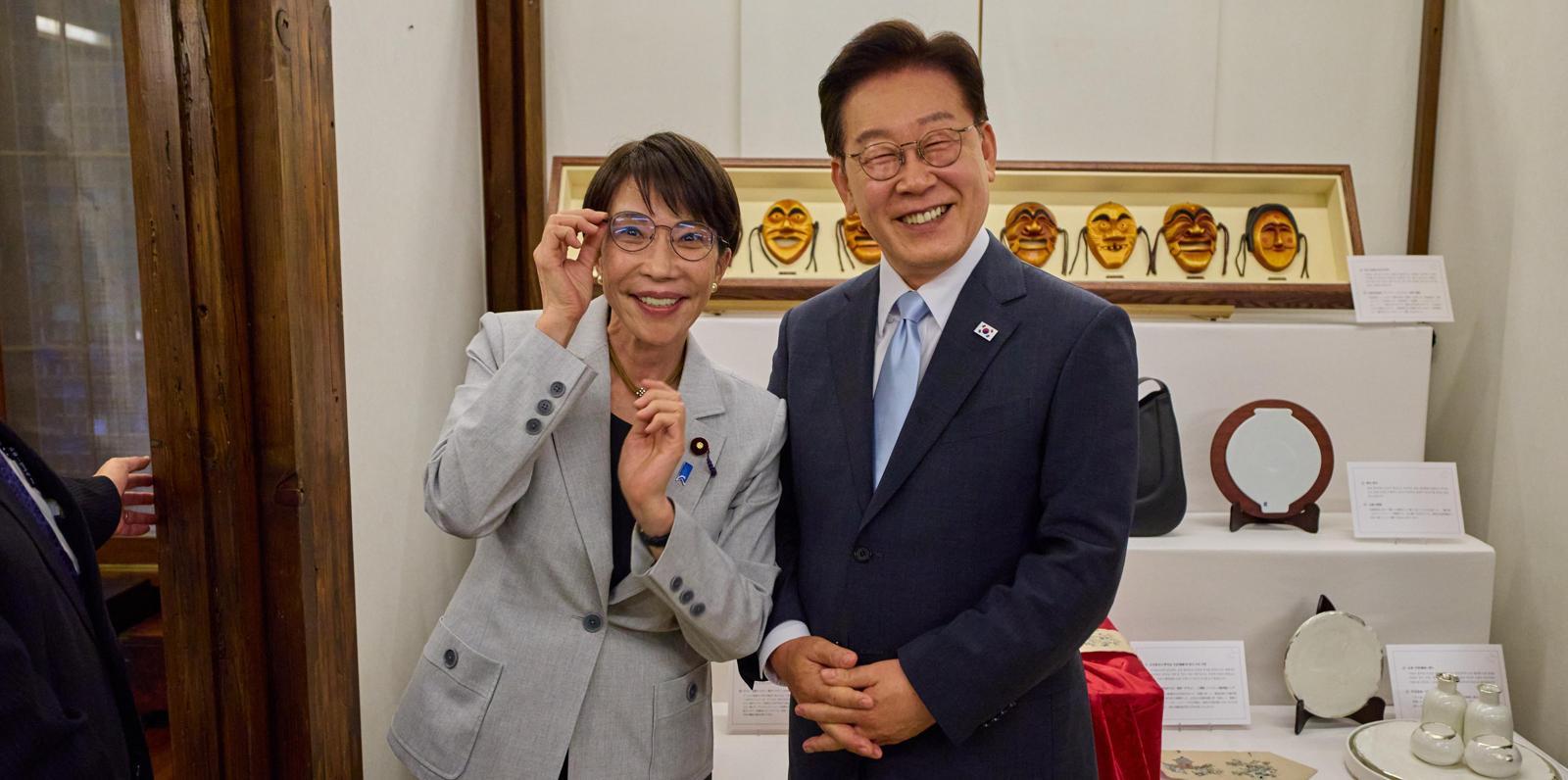
President Lee Jae-myung wearing the eyeglass frames presented by Japanese Prime Minister Sanae Takaichi on the 19th, and Prime Minister Takaichi wearing President Lee’s glasses. Provided by the Office of the President
President Lee Jae-myung and Japanese Prime Minister Sanae Takaichi (高市早苗) agreed on 19 May at a summit held in Andong, North Gyeongsang Province, to strengthen bilateral coordination in response to energy and other supply chain crises arising from the prolonged ceasefire talks between the United States and Iran. The Korea-Japan “shuttle diplomacy” has thus become not only a means of building personal rapport between leaders but also a tool for cooperation as strategic partners in addressing geopolitical risks. President Lee stated, “The international situation is in the midst of a storm,” adding, “Through facing difficulties together, the two countries are realizing how important they are to each other as cooperation partners.”
● Promotion of crude oil, petroleum product, and LNG swaps
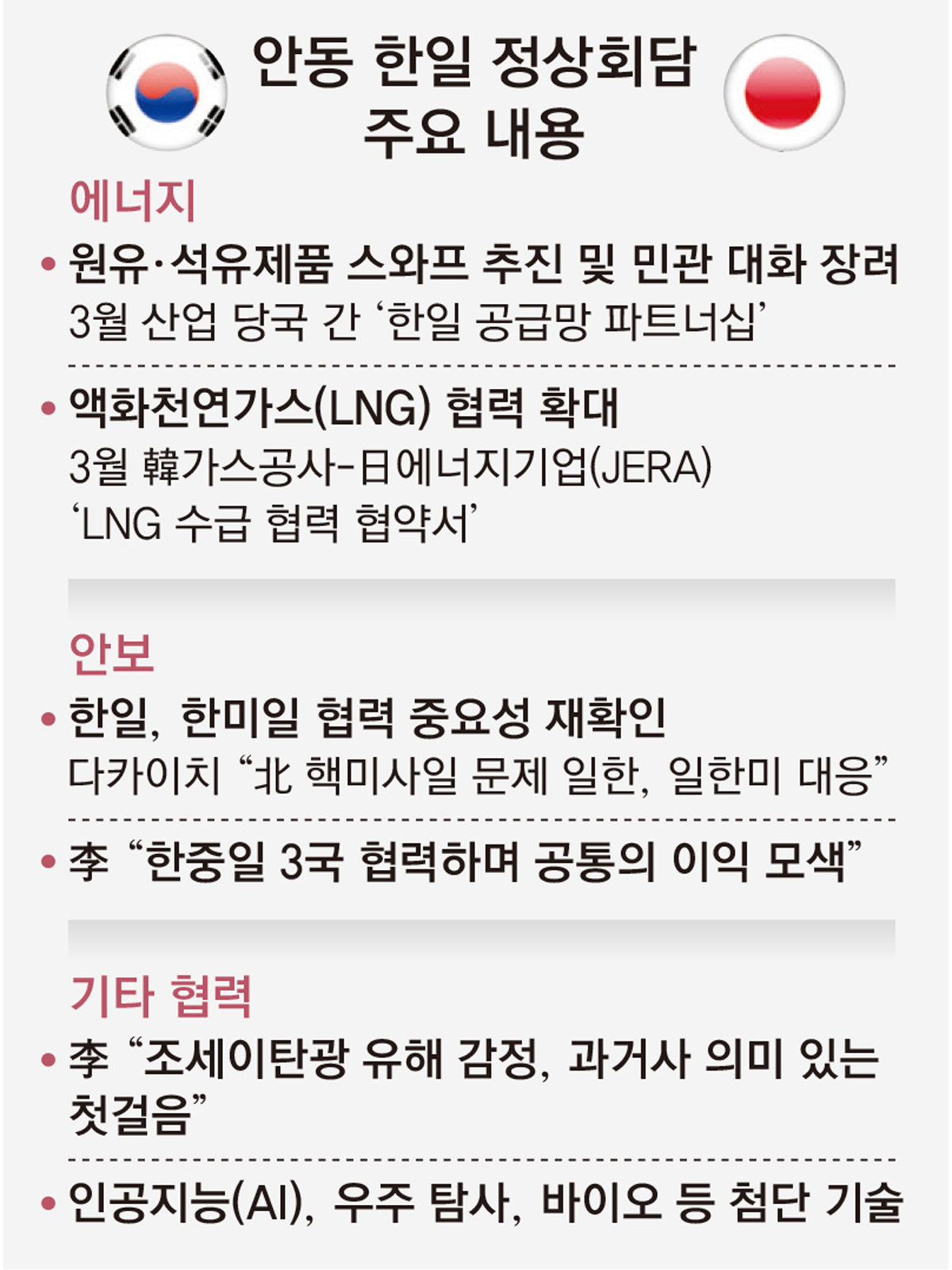
The small-group and expanded meetings, which lasted 105 minutes, focused on bilateral responses to an energy crisis as the situation in the Middle East has continued for a third month. Both Korea and Japan are highly dependent on external sources for crude oil, liquefied natural gas (LNG), naphtha, and other petrochemical feedstocks. In particular, Japan imports 93% of its total crude oil and Korea 69% of its crude oil via the Strait of Hormuz. In a joint press announcement after the summit, President Lee said, “We shared the view that the need for close cooperation between the two countries has grown even greater regarding supply chain and energy market instability stemming from the recent situation in the Middle East.”
Prime Minister Takaichi said, “We agreed to launch Japan-Korea cooperation with two main pillars: strengthening energy supply, including reinforcing stockpiles in the Indo-Pacific region, and enhancing energy security through mutual flexible swap transactions of crude oil, petroleum products, and LNG, and to jointly examine concrete actions.”
Industry authorities of the two countries decided to use this summit as an opportunity to encourage public-private dialogue on crude oil and petroleum product swaps and mutual supply. Japan expects, through this, to be able to procure stably Korean jet fuel and other products, in which Korea has strengths in refining. The two leaders agreed to expand cooperation centered on the “Korea-Japan Supply Chain Partnership (SCPA),” which was concluded in mid-March immediately after the outbreak of war between the United States and Iran.
Referring to the “Agreement on Cooperation for LNG Supply and Demand” signed in March between Korea Gas Corporation and JERA, Japan’s largest power company, President Lee also emphasized, “We decided to expand LNG cooperation between the two countries while also deepening information sharing and communication channels related to crude oil supply, demand, and stockpiling.” The two countries plan to utilize the “Korea-Japan Industrial and Trade Policy Dialogue,” newly established as a regular communication channel between the Ministry of Trade, Industry and Energy and the Ministry of Economy, Trade and Industry, to continue discussions on flexible petroleum product supply, restraint of export controls, crude oil procurement, and LNG cooperation.
Regarding the Japan-led “Power Asia” initiative mentioned by Prime Minister Takaichi, President Lee said, “I expressed my agreement and my intention to actively participate.” The Power Asia initiative seeks to expand influence by providing financial and technological support for securing crude oil in Southeast Asian countries.
● Discussion on Middle East peace and stability, including safe navigation in the Strait of HormuzThe two leaders also spoke with one voice on the need to bring the situation in the Middle East to an end. President Lee said, “We shared the view that peace and stability in the Middle East region must be promptly restored.” Prime Minister Takaichi also stated, “We agreed that each side will continue efforts to promote progress in the situation, including ensuring free and safe navigation in the Strait of Hormuz.”
Regarding the appraisal of remains from the Chosei (長生) coal mine, which was agreed upon at the January summit, President Lee said, “DNA testing of the excavated remains will begin soon,” assessing it as “a small but meaningful first step in which the two countries cooperate on humanitarian issues related to historical matters.”
ⓒ dongA.com. All rights reserved. Reproduction, redistribution, or use for AI training prohibited.
Popular News