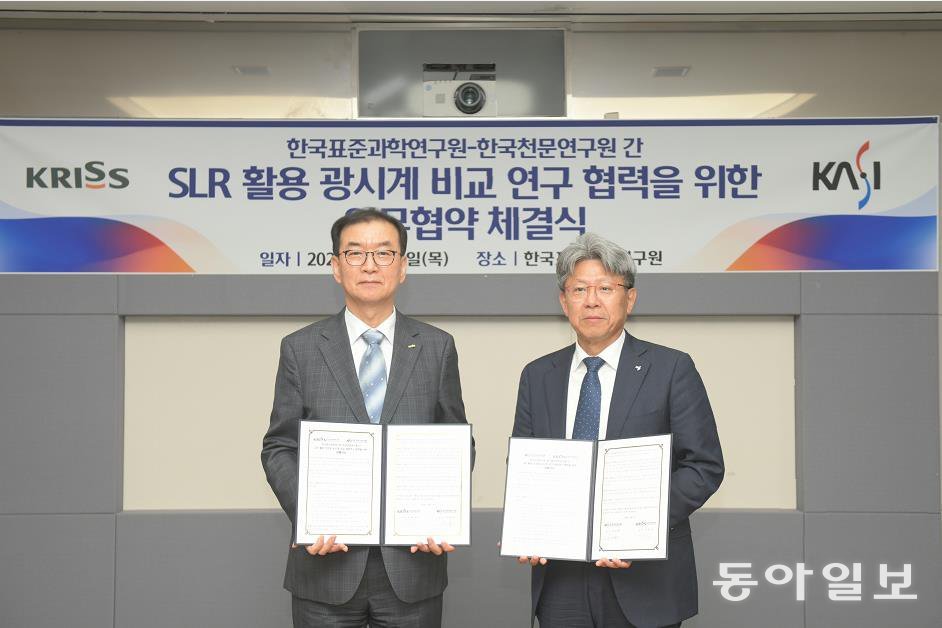
Lee Ho-seong, President of the Korea Research Institute of Standards and Science (KRISS) (left), and Park Jang-hyun, President of the Korea Astronomy and Space Science Institute (KASI), pose for a commemorative photo after signing a memorandum of understanding. Provided by the Korea Research Institute of Standards and Science
The Korea Research Institute of Standards and Science (KRISS) and the Korea Astronomy and Space Science Institute (KASI) announced on the 12th that they will cooperate to contribute to the planned redefinition of the time unit “second” around 2030.
The two institutes recently signed a memorandum of understanding for research cooperation and have begun in earnest an international joint project to precisely compare the atomic clock on the International Space Station (ISS) with Korea’s ytterbium optical clock. As “optical clocks,” which are more than 100 times more precise than the cesium atomic clocks currently used to realize the time unit “second,” gain attention as the next-generation time standard, comparing and verifying the performance of optical clocks worldwide has emerged as a core task for the redefinition of the “second.”
However, satellite-based methods such as GPS have low precision, and fiber-optic network methods face physical limitations that make intercontinental connections difficult, which has hindered precision comparison studies among optical clocks worldwide.
The European Space Agency (ESA)’s “ACES” mission has emerged as a solution to this challenge. Promoted since the 1990s, the project completed the installation of an ultra-precise atomic clock ensemble on the International Space Station (ISS) in April last year. ACES is an international space project that uses the atomic clock system mounted on the ISS to test Einstein’s theory of relativity and examine fundamental physical laws with high precision.
South Korea is participating in the ELT project within the ACES mission, which uses a laser-based time comparison method. ELT operates by firing a laser toward the manned facility of the International Space Station, and due to human safety concerns, it must undergo a stringent approval process by the European Space Agency (ESA).
To participate in ACES-ELT, KRISS and KASI last year connected KRISS’s “ytterbium optical clock (KRISS-Yb1)” and KASI’s “Sejong satellite laser ranging system (SLR)” via a dedicated fiber-optic network. Through this connection, KRISS’s precise time signals are delivered to the Sejong SLR, and the signal carried by the laser can be transmitted into space to be directly compared with the ISS atomic clock.
KRISS President Lee Ho-seong said, “We are now able to carry out verification of optical clock performance, which was difficult due to technical limitations, through international joint research,” adding, “We will establish a foundation to proactively contribute to the redefinition of the ‘second’ scheduled for 2030 by demonstrating the excellence of our measurement technology on the global stage.”
ⓒ dongA.com. All rights reserved. Reproduction, redistribution, or use for AI training prohibited.
Popular News