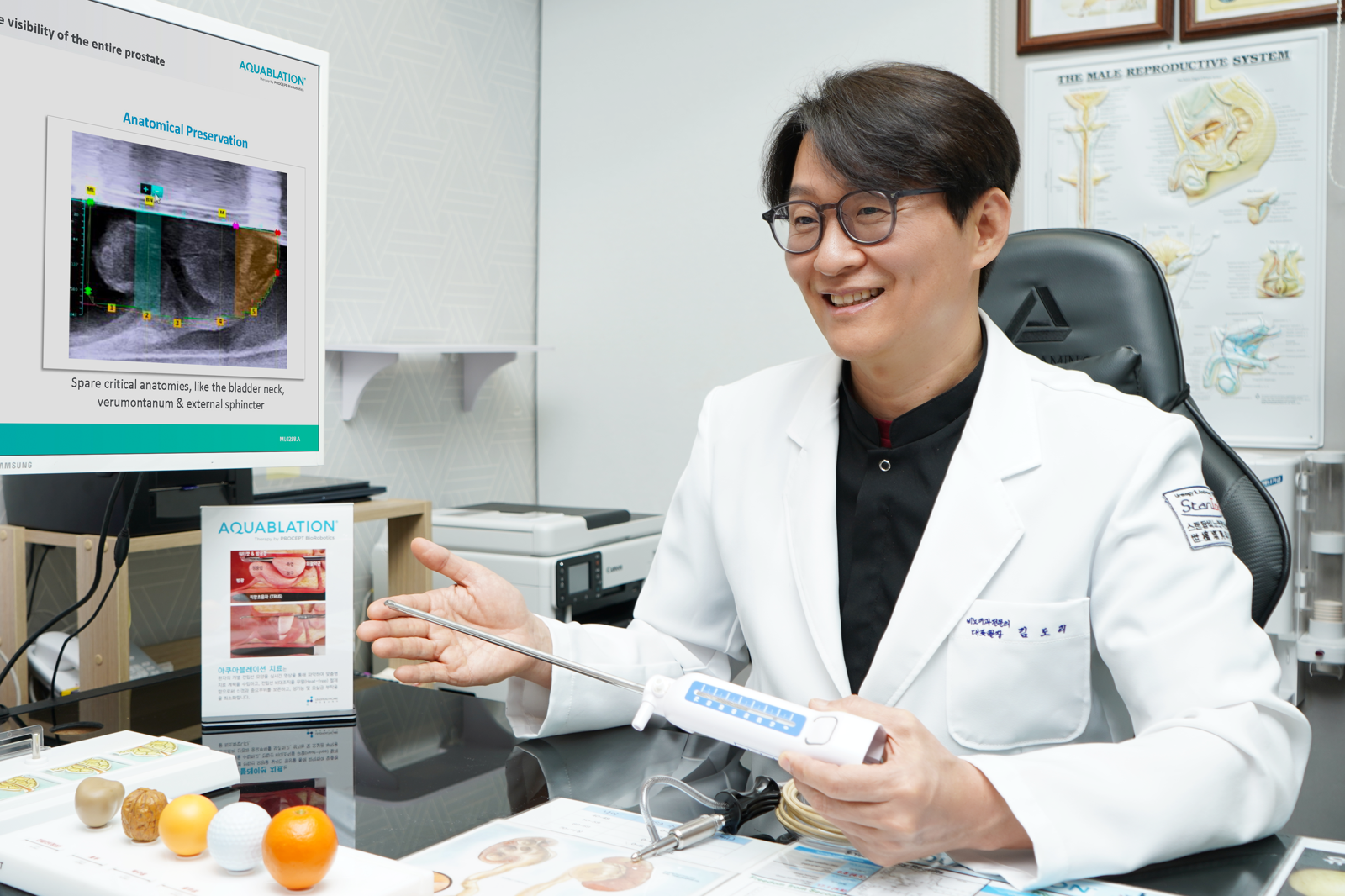
Director Kim Dori of Gangnam STANTOP Urology Clinic, who performs robotic surgery and multidimensional image-based precision mapping to preserve sexual function. Provided by Gangnam STANTOP Urology Clinic
A man in his 50s became afraid of going to the bathroom at some point. His urine stream became weaker and he constantly felt a sense of incomplete emptying. He woke up two to three times a night, and during daytime meetings he developed the habit of first checking where the restroom was. Even when he took medication, the effect was temporary and gradually diminished. This is a typical picture of a middle-aged man suffering from benign prostatic hyperplasia (BPH).
Benign prostatic hyperplasia is a representative urological disease that about half of men aged 50 and older experience. Symptoms such as delayed urination, frequent urination, nocturia and a feeling of residual urine go beyond simple discomfort and can undermine sleep quality and self-esteem in daily life. The problem is that patients who hit the limits of medication therapy often take a long time to finally decide on surgery. Fear of postoperative complications such as erectile dysfunction or retrograde ejaculation, and concerns about the burden of recovery, hold them back.
These symptoms may indicate the need for a BPH examination Benign prostatic hyperplasia may start as mild discomfort in the early stages, but if left untreated, it can lead to complications such as bladder dysfunction, urinary retention and kidney damage. If two or more of the following symptoms apply, it is advisable to undergo an examination at a urology clinic: △ The urine stream has become weak or starts and stops intermittently △ Urination is frequent (more than 8 times a day or more than twice at night) △ A sudden, strong urge to urinate that is difficult to hold △ A feeling of incomplete emptying after urination △ It takes time to start urinating or force is needed △ Medication is being used but symptom improvement is slow.
Prostate size and shape vary… ‘Tailored treatment’ is key The fundamental reason BPH treatment is challenging is that the size and shape of the prostate vary significantly from patient to patient. Some have small prostates, while others have large prostates of 150 cc or more, reaching 4–5 times the normal size. Anatomical variations are also diverse, including cases where the median lobe grows abnormally and protrudes into the bladder, or where the prostate grows asymmetrically to the left and right.
Existing surgical methods have had limitations in accommodating this diversity. Transurethral resection of the prostate (TURP) has become the standard for medium-sized prostates of 30–80 cc, but posed significant risks of bleeding and retrograde ejaculation. Holmium laser enucleation of the prostate (HoLEP) has strengths for large prostates, but is highly dependent on the surgeon’s experience. Minimally invasive procedures such as Rezum or Urolift allow faster recovery, but are limited to prostates of 30–80 g in size.
Aquablation covers small to ultra-large prostates Aquablation, also known as “waterjet robotic surgery,” is attracting attention as a surgical technique that overcomes these limitations. Using the Aquabeam robotic surgical system developed by PROCEPT BioRobotics in the United States, it precisely removes enlarged prostatic tissue with a high-pressure saline jet. It has received approval from the U.S. Food and Drug Administration (FDA) and has also been recognized by the Korean Ministry of Food and Drug Safety as a new medical technology for its safety and efficacy.
The greatest advantage of Aquablation is that it covers a wide range of prostate sizes. The normal adult prostate size is around 20 g, and Aquablation can handle much larger prostates that exceed this by far. Its safety and efficacy have been demonstrated through a series of international multicenter clinical trials conducted in the United States and Europe, including the “WATER” study comparing Aquablation with the conventional standard surgical method (TURP) in small to medium-sized prostates of 30–80 cc, the “WATER II” study on large prostates of 80–150 cc, and the “WATER III” study that included ultra-large prostates of 80–180 cc.
With conventional prostate surgeries, the larger the prostate became, the higher the risk of bleeding and the longer the operative time, making it difficult to apply to patients with large prostates. In contrast, Aquablation can be performed safely within a consistent time frame regardless of prostate size and is thus regarded as a robotic surgery applicable even to very large prostates.
Non-thermal waterjet + multidimensional image-based precision mapping = preservation of sexual function The second major strength of Aquablation is that it does not use heat. Conventional procedures using lasers or electrocautery burn or melt tissue, and in the process may damage surrounding nerves and sphincters, leading not infrequently to complications such as erectile dysfunction, urinary incontinence and retrograde ejaculation. Aquablation, on the other hand, resects tissue solely with a high-pressure saline waterjet, so there is no thermal damage. As a result, the incidence of retrograde ejaculation is as low as 0–7%, making it suitable for patients who wish to preserve sexual function.
Another key feature is the multidimensional image-based precision surgical guidance map. Before surgery, cystoscopic and transrectal ultrasound images are combined to secure a real-time multidimensional field of view, and the operating surgeon designs the resection range in accordance with the patient’s prostate shape. Structures that must be preserved and are directly related to erectile dysfunction, urinary incontinence and retrograde ejaculation—such as the external urethral sphincter, ejaculatory ducts and verumontanum—are precisely mapped so they are avoided, and then the robot automatically delivers the waterjet to remove the tissue. Instead of a human hand pushing and pulling with natural tremor, the robot performs precise execution according to the map drawn by the surgeon.
Who is it suitable for… indications and recovery process Aquablation is considered a suitable option for a broad range of patients: those with moderate or more severe BPH who have reached the limits of medication therapy, middle-aged patients for whom preservation of sexual function is important, elderly patients taking anticoagulants, and patients with large prostates who found conventional surgery burdensome. However, when prostate cancer is suspected, or in cases with urethral stricture or active urinary tract infection, additional tests and other treatment options need to be considered.
The surgery is usually performed under spinal or general anesthesia and typically takes about one hour. Hospitalization is generally 1–2 nights or 2–3 nights. After surgery, a urinary catheter is kept in place for about 1–3 days depending on the patient’s condition, and most patients can return to daily activities within about one week.
The strengths of STANTOP Urology Clinic: ‘experience’ and ‘individualization’ However precise a robotic surgery Aquablation may be, what ultimately determines the outcome is the operating surgeon’s experience and judgment in creating the surgical guidance map. With the same equipment, the resection range, structures preserved, and postoperative functional recovery can differ depending on who performs the mapping and how it is done.
In this respect, STANTOP Urology Clinic, located at Sinnonhyeon Station in Gangnam, can be a meaningful option for patients. Led by Director Kim Dori, STANTOP Urology Clinic has extensive clinical data, having performed more than 2,000 Aquablation procedures. Another strength is that the clinic can perform not only Aquablation but also all five major surgical treatments used for BPH: Rezum, TURP, HoLEP, and prostatic urethral lift procedures (Urolift, ProGrator). This enables selection of the surgical method most suitable to the patient’s condition.
Director Kim Dori of STANTOP Urology Clinic stated, “In benign prostatic hyperplasia, each patient differs in prostate size, shape, comorbidities and the level of quality of life they expect, so a uniform surgical method inevitably leads to lower satisfaction,” adding, “Aquablation may be more suitable for some patients, while for others Rezum, HoLEP, prostatic urethral lift, or TURP may be better. True personalized treatment is to have a wide range of surgical options available and design the optimal therapy that fits each patient’s anatomical characteristics and living circumstances.”
ⓒ dongA.com. All rights reserved. Reproduction, redistribution, or use for AI training prohibited.
Popular News