Interview with Han Sang-uk, Director of the KIST Quantum Technology Utilization Research Center Project
Sharing infrastructure, including large-scale equipment build-out
Operating 10 joint laboratory projects over four years
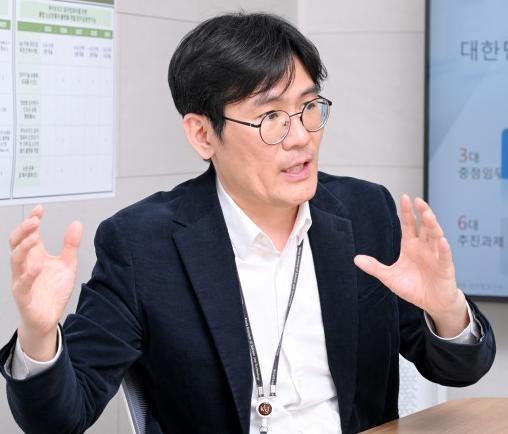
Han Sang-wook, head of the Quantum Technology Utilization Research Hub Project Group, met at the main campus of the Korea Institute of Science and Technology (KIST) in Seoul. Provided by KIST
“Now is the time when full-scale application-oriented research in quantum is needed. It is necessary to make active use of the infrastructure of government-funded research institutes and establish joint laboratories as well as hubs where people can interact closely. It will also serve as a talent reservoir for graduates from quantum graduate schools.”
In an interview last month at the main campus of the Korea Institute of Science and Technology (KIST) in Seongbuk-gu, Seoul, Han Sang-wook, head of the Quantum Technology Utilization Research Hub Project Group, stressed that as the quantum field—one of the strategic technologies of the future—rapidly advances, it is urgent to secure physical hubs that enable active joint research among industry, academia, and research institutes.
Han said, “Convergence technology sounds sophisticated in name, but it is a difficult domain,” adding, “Conferences and forums alone do not, in my view, actually create something.” He explained that in the quantum field, which is still in its early industrial stage, the most important process is bringing together people from diverse backgrounds to pool ideas.
Advanced economies such as the United States, Canada, the United Kingdom, and Germany have already activated quantum research hubs. The project group’s goal is to establish vibrant quantum research hubs domestically as well. He emphasized, “The most important thing is that people’s daily spheres overlap so that they have plenty of chances to naturally talk to each other—whether they are going out for coffee or just passing each other in the hallway.”
Sharing large-scale infrastructure is also a core value of the research hubs. Han said, “A strength of government-funded research institutes is that it is easy for them to build and maintain large-scale equipment,” adding, “The idea is to open up and share expensive infrastructure that is essential for early-stage research but difficult for individual research groups to secure.” He continued, “A distinguishing feature of the quantum field is the high proportion of junior researchers,” and added, “We will activate joint research so that students can stay on site and generate ideas.”
The project group will operate 10 Quantum Utilization Joint Laboratories (JQL) projects through 2029. Including those under the other lead government-funded research institute, the Korea Research Institute of Standards and Science, the total will be 20. The support scale is KRW 300 million per year per laboratory, and five KIST-affiliated JQLs were selected in November last year.
In quantum technology, implementing a light source that emits photons (light particles) one by one, with quantum properties controlled, is of paramount importance. Among the five KIST-affiliated JQLs, the Korea University research team aims to realize a room-temperature quantum light source that is portable to the level of a flashlight. The Kyung Hee University research team is taking on the challenge of developing a detector that can decompose not only the presence or absence of photons that detect the light source but also the number of photons.
Efforts are also under way to miniaturize quantum devices, develop quantum sensors that precisely measure the temperature of brain cells, and localize quantum computing cloud environments.
Every JQL must include at least one postdoctoral researcher. It is expected to serve as a “talent reservoir” so that PhD-level experts trained at the quantum graduate schools of Korea University, KAIST, and POSTECH can continue their research capabilities in the field once they graduate.
Han said, “The goal of all JQLs is to generate outcomes that lead to commercialization,” adding, “Researchers participating in JQLs can use KIST’s infrastructure on an equal footing with KIST researchers.” He went on, “We will select five additional JQLs this November, and the program is so popular that 39 teams submitted proposals.”
In addition, the project group holds the “Quantum Exchange Day” event twice a year to present and award outstanding students’ achievements and to create opportunities for joint research through international exchanges. Han said, “In the long term, there are plans to construct a nine-story building in Yangjae-dong, Seocho-gu, Seoul, to support quantum technology research and industrialization.”
ⓒ dongA.com. All rights reserved. Reproduction, redistribution, or use for AI training prohibited.
Popular News