Joint research team including KAIST First to identify the phase transition mechanism of the “double layer” Expected to enable ultra‑fast battery charging
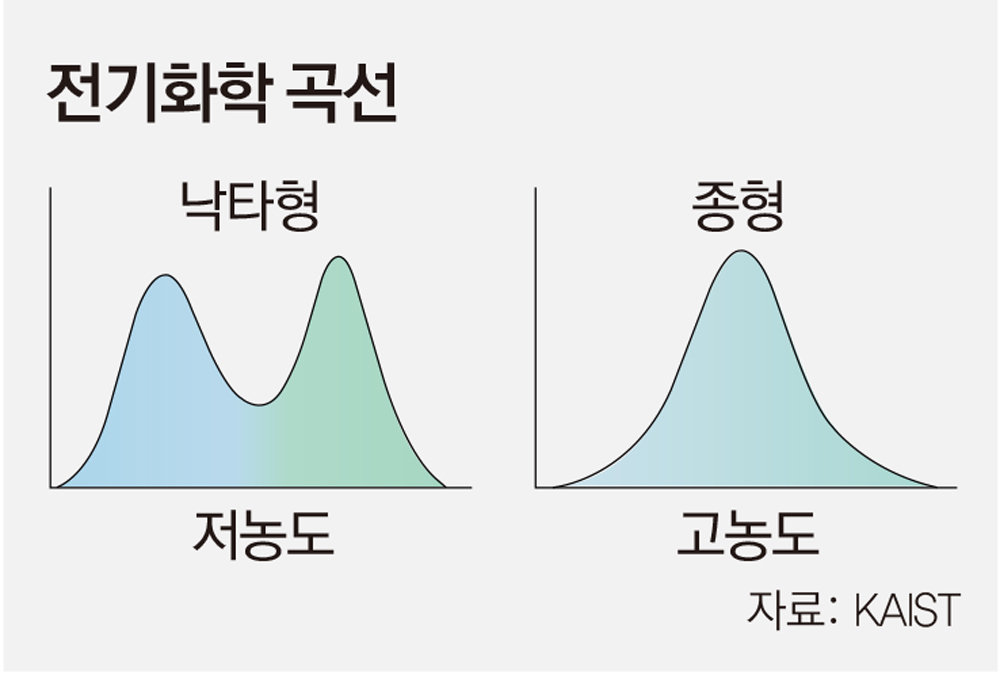
As the electrolyte concentration increased in the electric double layer, the capacitance graph transitioned from a camel-shaped curve to a bell-shaped curve.
When the electrolyte concentration increases in the electric double layer, which is the interfacial region where a battery’s electrode and electrolyte come into contact, the capacitance (electric charge storage capacity) graph changes from a “camel-shaped” curve with two peaks to a “bell-shaped” curve with a single peak. This phenomenon has been observed for the past 100 years, but its cause was unknown. A domestic research team has, for the first time in the world, identified the cause. The findings are expected to be applied to improving battery charging speed.
KAIST announced on the 3rd that a research team led by Professor Kim Hyungjun of the Department of Chemistry, in collaboration with Professor Choi Changhyeok of the Department of Chemistry at POSTECH and Professor Shin Seungjae of the Department of Energy and Chemical Engineering at Ulsan National Institute of Science and Technology (UNIST), combined atomistic electrochemical simulations, concentration control techniques, and real-time infrared spectroscopy experiments to analyze phase transitions occurring in the electric double layer, and published the results in the international journal Nature Communications. Phase transition refers to a phenomenon in which the state or arrangement of matter changes.
The research team confirmed that when the potential, i.e., the voltage applied to the electrode, changes, a phase transition occurs at the cathode in which water molecules are rearranged in one direction, and a condensation phase transition occurs at the anode in which anions densely pack to form a two-dimensional structure. Due to these two independently occurring phase transitions, two peaks appear in the capacitance graph. When the electrolyte concentration increases, the two phase transitions couple and merge into a single peak, causing the camel-shaped curve to transform into a bell-shaped curve.
Professor Kim said, “This has opened the way to understanding and designing the microscopic environment of electrochemical reactions for the first time,” adding, “If phase transitions in the electric double layer can be precisely controlled, it will be possible to finely enhance the performance of energy technologies, such as by increasing battery charging speed or maximizing hydrogen production efficiency.”
Moon Se-young
AI-translated with ChatGPT. Provided as is; original Korean text prevails.
ⓒ dongA.com. All rights reserved. Reproduction, redistribution, or use for AI training prohibited.