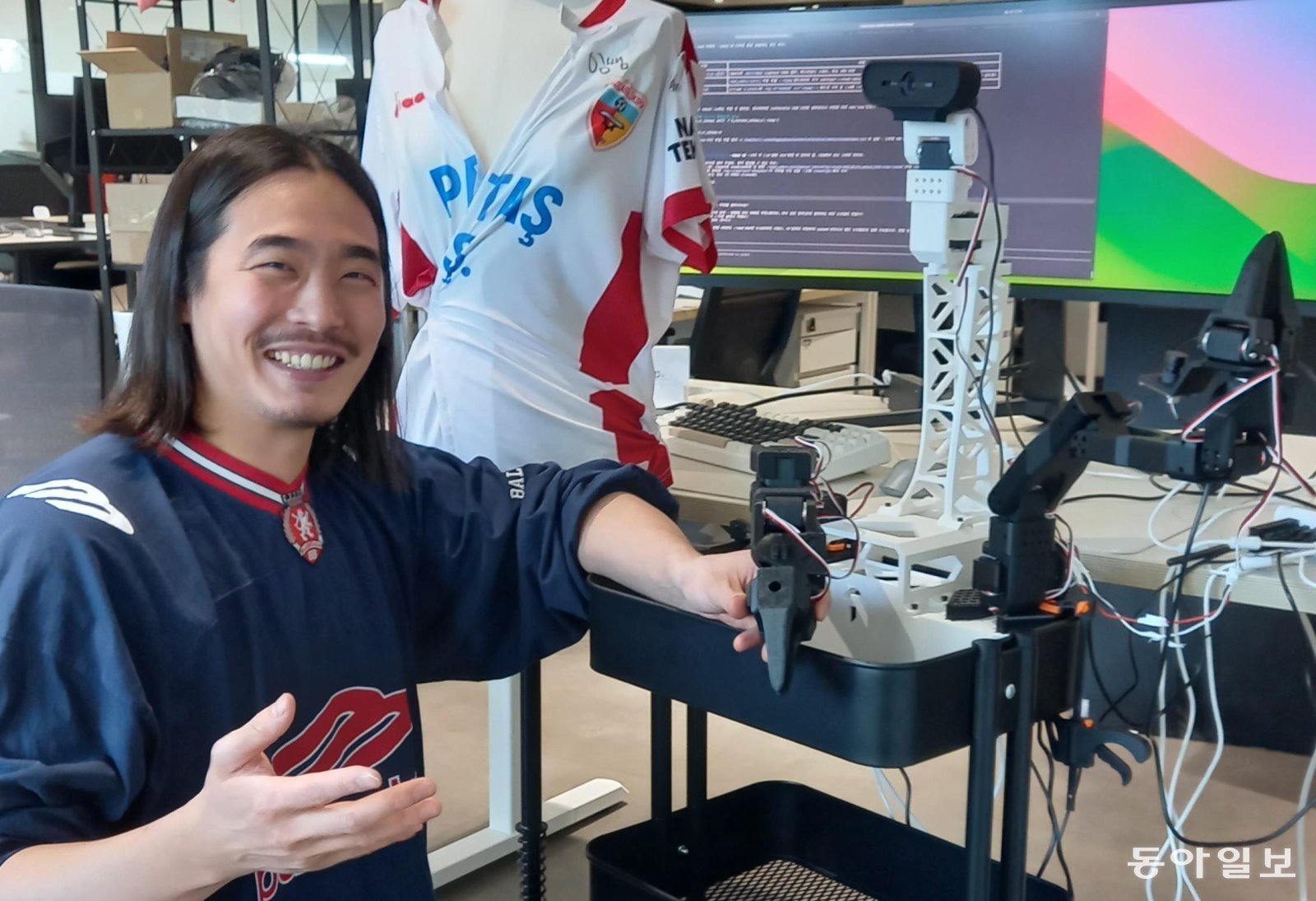
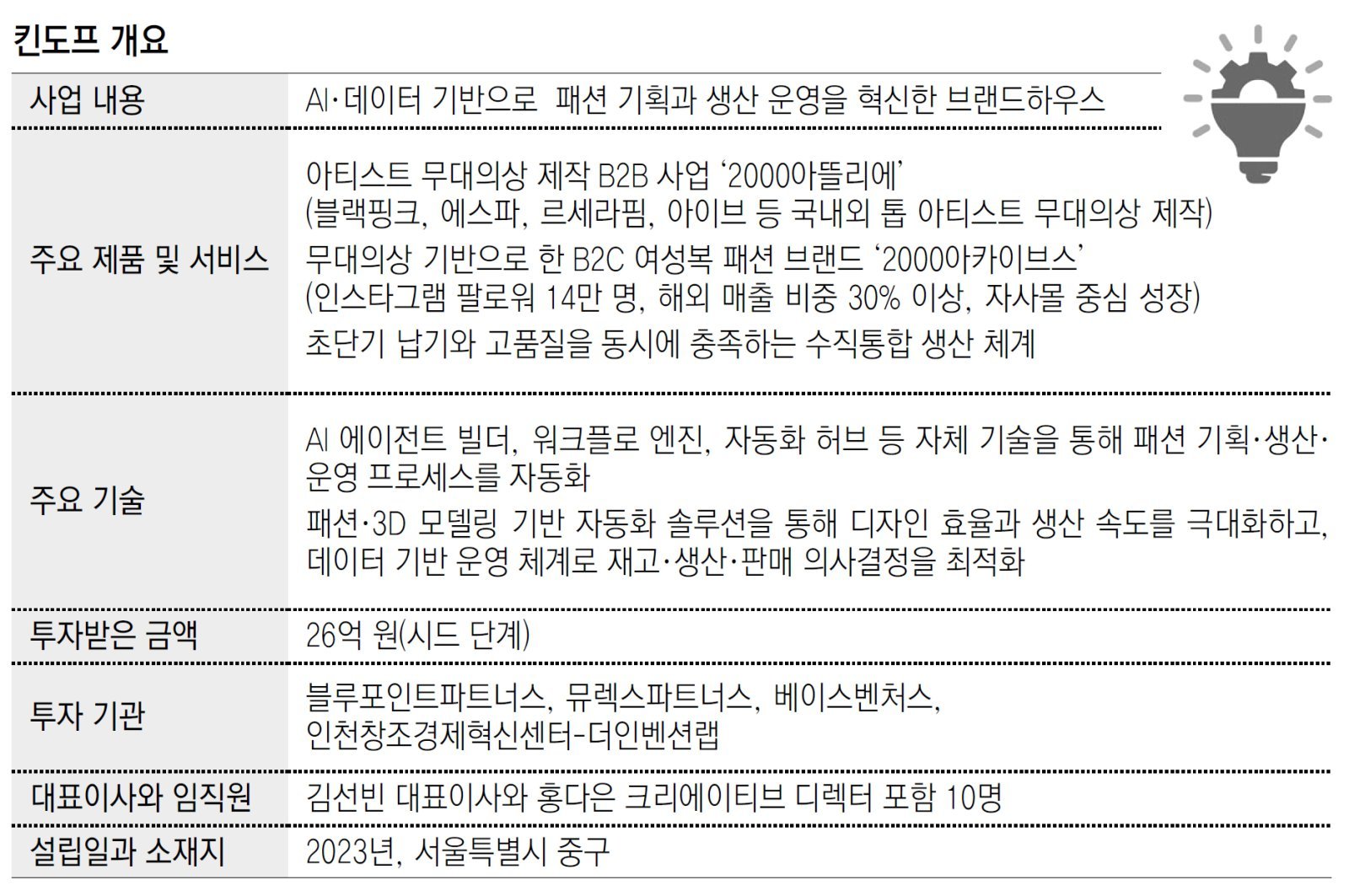
CEO Kim Sun-bin of KYNDOF explains the automation process of fashion production while holding a robotic gripper hand that will be used in the garment-making process. The company operates a B2B business supplying stage costumes and a B2C business that commercializes those costumes and sells them to consumers. Photo by reporter Heo Jin-seok = jameshur@donga.com
The office of KYNDOF on the 13th floor of Hyundai City Outlet in Dongdaemun-gu, Seoul. On the computer screens, artificial intelligence (AI) agents are constantly conversing among themselves and carrying out tasks. There are no people. No developers, no researchers. Yet 15 development projects are currently running, including brand operation and management. Each AI agent approves, revises, and sends feedback to others, allowing the work to proceed autonomously. “In a traditional development organization, this would be a project that requires dozens of people,” said KYNDOF CEO Kim Sun-bin (35), whom this reporter met at the office on April 29. KYNDOF is a company that supplies stage costumes for leading K-pop groups such as BLACKPINK, aespa, LE SSERAFIM, and IVE in high quality and in a short time. It does not end with stage costumes; the company also turns them into fashion products and targets the global market.
● When stage costumes become data
The problem KYNDOF is trying to solve is not simply “making good clothes.” It is attempting to transform the structure of the stage and drama costume industry itself. In a market where K-pop artists change outfits several times a day to perform concerts and music videos, the traditional method of taking over a month to tailor a single suit is fundamentally incompatible. “We get orders asking us to make everything within three days and provide 10 outfits per idol group member. It is only possible with a completely different approach from general bespoke clothing,” Kim said. Speed alone is not enough. Today’s fans complain even when stylists dress artists in luxury brands available in stores. “Why are they wearing off-the-rack clothes? They should be given proper bespoke outfits.” As fandom expectations rise, the difficulty of costume production increases, and deadlines become even tighter.
Until now, there have been almost no suppliers attempting to industrialize this field. According to Kim, many operate as small ateliers, deadlines are not kept as precisely as at large corporations, and cases where garments come out different from the design intent are often simply tolerated.
While automation has advanced to some degree in the mass-production apparel process, automation technology has not yet been applied to the field of high-end bespoke costume production. “This is an industry where people still write numbers by hand without even using Excel. In colloquial terms, nothing has changed since the Korean War, and KYNDOF is entering that space,” Kim said.
● AI instructs embroidery machines on 50,000 stitches
KYNDOF’s technology is already at a considerable level. It has integrated an “embroidery pattern digitizing AI” into its automated process. To embroider on garments, it is necessary to specify in which direction, along which grain, and how many tens of thousands of times the needle should move. KYNDOF’s AI bot “TommyTom” automatically creates a work instruction sheet for, for example, 50,000 stitches and sends it directly to the embroidery machine. “Once the rendering work that makes the design appear like a real object is completed, the digitizing file is automatically generated and instructions are sent to the embroidery machine. The entire process is handled at once without human involvement,” Kim said.
The design stage works in the same way. Previously, when 2D flat drawings were sent to stylists, interpretive conflicts like “this is not the shade of red I had in mind” occurred constantly. KYNDOF uses AI to provide 3D rendering images that reflect the physical properties of materials from the pre-production phase. This technology aims to minimize the gap between design intent and the final garment. For a single outfit for one idol, the AI automatically generates the work instruction sheet (patterns, measurements, positions of trims, embroidery designs, etc.). Tasks that previously took people several hours to divide and complete are now finished almost instantly. Furthermore, the company is standardizing measurement methods so that identical body measurements are obtained regardless of who takes them, and is building a system that enables virtual fitting using digital dummies without physical samples.
● Connecting the digital and physical worlds
For automation of high-end bespoke production, it is necessary to photograph each stage of the garment-making process and accumulate this as data. To produce the final product perfectly in one go, production must be supervised in real time through images. For example, the AI monitors whether the position and color of a logo are correct by comparing the original design with process photos.
KYNDOF is developing a physical robot named “James,” which transports fabrics between processes and records the production steps. James does not yet have legs. Only his upper body and “brain” are functional. Therefore, if he wants to connect with an embroidery machine, he contacts a person via the internal network and asks them to photograph the embroidery machine. This scene—an AI robot requesting human cooperation, the human accepting the request and collecting data in the physical world, then feeding it back to the robot—illustrates how seriously KYNDOF pursues digital–physical integration. KYNDOF is actively using Google’s AI foundation models and open-source tools to build legs for James.
● Multiple startup attempts since university Kim, who graduated from Korea University with a degree in statistics, worked as a quantitative analyst (quant) at a U.S.-based hedge fund, developing investment strategies using mathematical models. Having always had a strong desire to start a business, Kim had already launched and later folded a movie recommendation engine startup and an SNS bio-link service similar to Linktree during university.
The current collaboration with Kim’s spouse, creative director of KYNDOF Hong Da-eun, arose naturally when photographs of vintage outfits she posted on social media gained popularity and Kim began advising and supporting her with cash-flow forecasting and similar tasks. The corporation was founded in 2023.
Kim is transplanting the experience as a quant at a hedge fund into KYNDOF. The method of collecting fashion market data, running predictive models, and making decisions based on the results is similar to the way hedge funds search for excess returns. AI agents crawl price and inventory data every day from 1,623 fashion brands and track market positioning. They also use proprietary predictive models to estimate each brand’s sales and unit volumes. By observing how quickly competitors’ inventories on Musinsa decrease, KYNDOF calculates price elasticity, and by combining temperature data with sales data, it determines the optimal timing for campaigns.
● Beyond commercializing BLACKPINK’s costumes
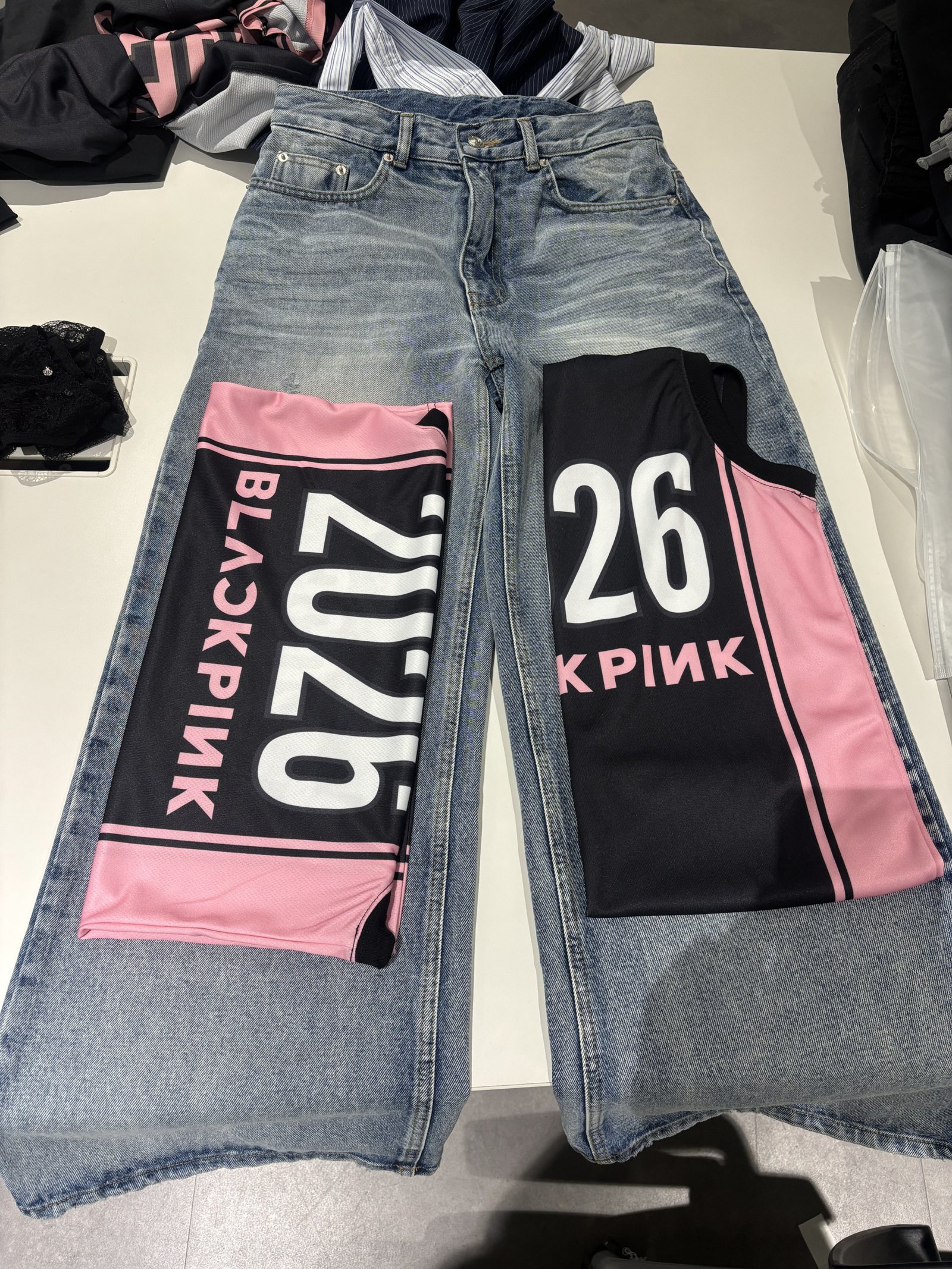
Outfits that KYNDOF created as stage costumes for BLACKPINK member Lisa and later commercialized. The upper photo shows Lisa wearing a short-sleeved top and shorts set, and the lower photo shows the commercialized jeans. Provided by KYNDOF.
The most representative achievement of KYNDOF’s business model is BLACKPINK’s stage costumes. The ripped jeans worn by BLACKPINK member Lisa during a performance are a case in point. KYNDOF converted the concept of this outfit into the “2000archives” brand and launched denim pants for general consumers priced at KRW 230,000. The product ranked first in women’s denim pants sales on Musinsa in January this year. The “Geek Chic” glasses from KYNDOF worn by aespa’s Karina at the airport followed the same model. Based on a close collaborative relationship with aespa, KYNDOF proposed that Karina wear the product before its release, creating a structure in which that exposure directly translated into sales.
Just two years after its founding, KYNDOF achieved annual sales of KRW 4 billion last year with a staff of five. The company raised KRW 2.6 billion in investment, more than double its initial target of KRW 1.2 billion. In addition, it secured KRW 1.2 billion in research and development funds by being selected for the TIPS Global Track, bringing total funds raised to KRW 3.8 billion.
KYNDOF also plans to enter the U.S. entertainment market, including Hollywood. The goal is to go beyond K-pop and secure Hollywood actors and musicians at the top tier of entertainment, then turn their looks into global fashion products. “Overseas consumers perceive the fashion worn by K-pop stars as ‘K-fashion,’ and we intend to build the brand that precisely occupies that position,” Kim said.
ⓒ dongA.com. All rights reserved. Reproduction, redistribution, or use for AI training prohibited.
Popular News