Hanmi Pharm to participate in AACR 2026 in the U.S.
To present new drug research results in mRNA, TPD, ADC, bispecific antibodies, and more
Revealing 9 results from 8 new drug candidates… the highest among Korean companies
Demonstrating next-generation modality–based anticancer technologies and capabilities
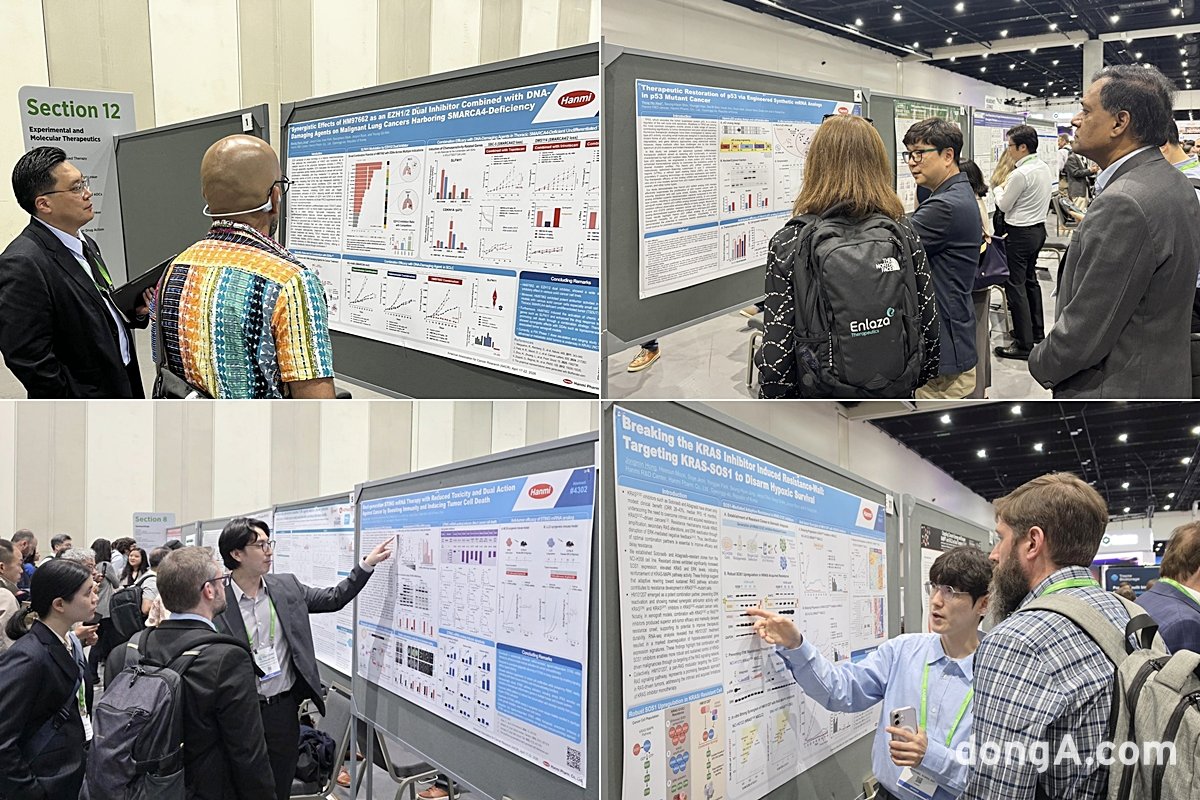
Researchers at Hanmi Pharmaceutical’s R&D Center explain poster presentations on research results for next-generation modality‑based innovative anticancer drugs to participants at the American Association for Cancer Research (AACR 2026) held in San Diego, USA. Courtesy of Hanmi Pharmaceutical
Hanmi Pharmaceutical has unveiled an extensive anticancer new drug pipeline integrating next-generation modalities.
Hanmi Pharmaceutical announced on the 28th that it presented nine research results on eight new drug candidates at the American Association for Cancer Research (AACR 2026) held in San Diego, USA. By deriving a large number of new projects using diverse approaches such as messenger ribonucleic acid (mRNA), targeted protein degradation (TPD), antibody‑drug conjugates (ADCs), and bispecific antibodies—technologies that have emerged as core in the oncology market—the company is seen as securing future growth engines.
The number of presentations in particular is noteworthy. Among domestic pharmaceutical and biotech companies, Hanmi reportedly presented the largest number of research outcomes for the fourth consecutive year, which is being evaluated as renewed proof of Hanmi’s distinctive commitment to and capabilities in new drug development.
At this year’s congress, Hanmi Pharmaceutical presented anticancer treatments largely classified into three categories: targeted anticancer therapies that selectively modulate specific proteins highly expressed only in cancer cells; next-generation modality‑based targeted therapies; and immuno‑oncology therapies that activate immune cells in the body to induce antitumor responses.
In the targeted therapy area, Hanmi disclosed research results on a range of candidates with differentiated targets and mechanisms of action, including HM97662, a dual inhibitor of EZH (Enhancer of Zeste Homolog)1 and 2 (two proteins that act as switches regulating gene expression); HM100714, a selective inhibitor of HER2 (human epidermal growth factor receptor 2, a protein that regulates cell proliferation and division); and HM101207, an inhibitor of the SOS1 (Son of Sevenless homolog 1, a protein that activates RAS proteins that control cell growth and division)-KRAS (a factor that promotes cell growth and drives cancer cell proliferation when mutated) interaction.
HM97662 is being developed as an innovative targeted therapy that, through the dual inhibitory mechanism blocking both EZH1 and EZH2 proteins, offers superior anticancer efficacy and potential to overcome resistance compared with existing EZH2‑selective inhibitors. In this presentation, Hanmi showcased results confirming that this candidate demonstrated synergistic antitumor efficacy when combined with a DNA‑damaging agent in solid tumor animal models harboring specific genetic alterations such as “SMARCA4 deficiency” (a factor that controls chromatin, which wraps DNA, thereby regulating gene expression). The company particularly noted that repeated combination dosing of HM97662 and a DNA‑damaging agent showed potential to overcome resistance to existing drugs. Based on this research, Hanmi also announced plans to refine indications and expand into subsequent combination clinical trials.
HM100714 reportedly demonstrated strong anticancer efficacy in HER2‑mutant cancers along with low EGFR‑ (epidermal growth factor receptor‑) related toxicity, with antitumor activity confirmed in an Enhertu‑resistant xenograft mouse model and excellent efficacy and a favorable safety profile observed in brain and leptomeningeal metastasis models. Hanmi stated that, through bioinformatics and machine‑learning‑based analyses, it predicted drug sensitivity across a panel of 75 cell lines and, on that basis, derived optimal indications and secured the rationale for clinical development of this oral new drug candidate.
The SOS1‑KRAS interaction inhibitor HM101207 is a novel‑mechanism drug candidate designed to block the binding between SOS1 and KRAS, which play a key role in the signaling cascade, in order to inhibit activation of oncogenic KRAS mutations. At this congress, Hanmi presented data indicating the potential for treating KRAS‑dependent cancers by suppressing KRAS signaling and modulating hypoxia‑related gene expression. In particular, HM101207 produced synergistic antitumor effects in KRAS G12C‑mutant (a mutation where the 12th amino acid glycine G in the KRAS protein is replaced by cysteine C) cancer cell lines when combined with various inhibitors of the RAS/MAPK signaling pathway (the cellular signaling system involving SOS1 and KRAS). Hanmi added that, in KRAS‑mutant xenograft mouse models, combination dosing with a KRAS G12C inhibitor or a RAS inhibitor significantly delayed the onset of resistance compared with monotherapy, while delivering antitumor efficacy.
In the next‑generation modality‑based targeted therapy segment, research results were presented for an oral new drug “EP300 selective degrader,” developed using Hanmi’s novel modality “targeted protein degradation (TPD)” platform technology. For this EP300 selective degrader, Hanmi’s researchers optimized the compound through structural design based on molecular dynamics simulation data and used a bioinformatics framework and machine‑learning models to identify solid tumor indications most sensitive to EP300 degradation.
Hanmi reported that, in xenograft solid tumor mouse models, this new drug candidate exhibited superior anticancer efficacy with lower toxicity than existing “EP300/CBP (a complex that acts as a transcriptional co‑regulator by acetylating histones surrounding genes to switch gene expression on) dual inhibitors.” Through this, the company elucidated a mechanism of “synthetic lethality.” Synthetic lethality is regarded as a strategy that has transformed the cancer treatment paradigm, based on the principle that a cell can survive when only one of two factors is impaired, but dies when both are damaged.
In the next‑generation modality‑based immuno‑oncology segment, Hanmi presented research outcomes for a next‑generation multispecific antibody‑based pipeline including a “STING (Stimulator of Interferon Genes, a gene that activates the innate immune system) mRNA anticancer drug”; a “p53 (a protein that repairs damaged cellular DNA or induces apoptosis, known as the guardian of the genome) mRNA anticancer drug”; BH3120, a “4‑1BB (a receptor that promotes T‑cell proliferation to drive attacks on cancer cells) x PD‑L1 (a defensive factor expressed by cancer cells that suppresses immune cells) bispecific antibody” whose development is led by Beijing Hanmi Pharmaceutical; and BH4601, a “B7H3 (an immune checkpoint protein, a defensive factor similar to PD‑L1 and a target receiving much attention in oncology) x PD‑L1 bispecific antibody ADC.”
The STING mRNA anticancer drug is a therapeutic approach that directly activates the STING pathway without ligand binding to induce antitumor immune responses. Hanmi noted that its design enabling systemic administration is a key differentiating feature. The company explained that, in animal models, both intravenous and intramuscular administration achieved significant tumor growth inhibition, and that increased immune cell infiltration and anticancer efficacy were demonstrated even in “immune‑cold” tumors that do not respond to conventional immunotherapies. In particular, Hanmi reported clarifying a “dual mechanism” in which the drug directly suppresses cancer cell proliferation while maintaining normal cell viability alongside immune activation.
The p53 mRNA anticancer drug restores normal intracellular expression of the tumor suppressor protein p53 to induce apoptosis of cancer cells, and two sets of research results on this mechanism were presented at the congress.
Hanmi announced that, in an ovarian cancer animal model, the candidate demonstrated superior anticancer efficacy and favorable safety compared with existing drugs. Through transcriptome‑based analysis, the company proposed a strategy to predict responsiveness to p53 restoration therapy in advance and to select tumor types with high potential for application. This is being evaluated as evidence that p53 restoration therapy can be applied in a precision‑medicine context and that combination strategies with DNA damage‑based anticancer agents can be expanded.
BH3120 is an anticancer drug developed using “Pentambody,” a bispecific antibody platform technology in which a single antibody binds simultaneously to two different targets. It enables both targeted therapy that attacks only cancer cells and immunotherapy that activates immune cells. At this congress, Hanmi presented research results on the immune mechanism by which combination therapy using a CD3 T‑cell (T‑cell attack switch) engager (TCE, T cell engager) and BH3120 produced amplified anticancer effects through complementary action of the two mechanisms. TCEs, which directly activate T cells in the body, are a key approach in immuno‑oncology and are attracting attention as a next‑generation anticancer technology as U.S. Food and Drug Administration (FDA) approvals have increased in recent years.
BH4601 is a next‑generation anticancer project based on a bispecific ADC (antibody‑drug conjugate) that simultaneously targets B7H3 and PD‑L1. At this congress, Hanmi presented a differentiated mechanism whereby simultaneously targeting these two proteins, which are expressed across a range of solid tumors, reduces drug resistance compared with existing ADCs, activates immune function, and achieves enhanced antitumor activity.
Choi In‑young, head of Hanmi Pharmaceutical’s R&D Center, said, “At this year’s AACR, Hanmi once again validated the competitiveness of its R&D technologies by presenting an anticancer pipeline centered on next‑generation modalities that lead global new drug development trends, grounded in scientific evidence,” adding, “Hanmi will continue to secure innovative growth engines through differentiated technological convergence and strategic R&D, and will apply new technologies across its research activities to expand Hanmi’s future value.”
ⓒ dongA.com. All rights reserved. Reproduction, redistribution, or use for AI training prohibited.
Popular News