KBRI–Seoul National University joint research team “Hopes for developing a new drug to overcome cognitive decline”
Exercise is an effective way to activate brain cells and enhance cognitive function, but it is not easy to practice for those with limited mobility due to aging or disease. A Korean research team has, for the first time in the world, identified the principle by which the brain can be kept young without exercise, paving the way for new drug development.
A joint research team led by Dr. Park Hyung-ju of the Neurovascular Unit Group at the Korea Brain Research Institute (KBRI) and Professor Kim Jong-seo of the School of Biological Sciences at Seoul National University announced on the 27th that it had identified the protein “Serpina1e,” which is secreted from muscles during exercise and delivered to the brain, as well as its mechanism for improving cognitive function.
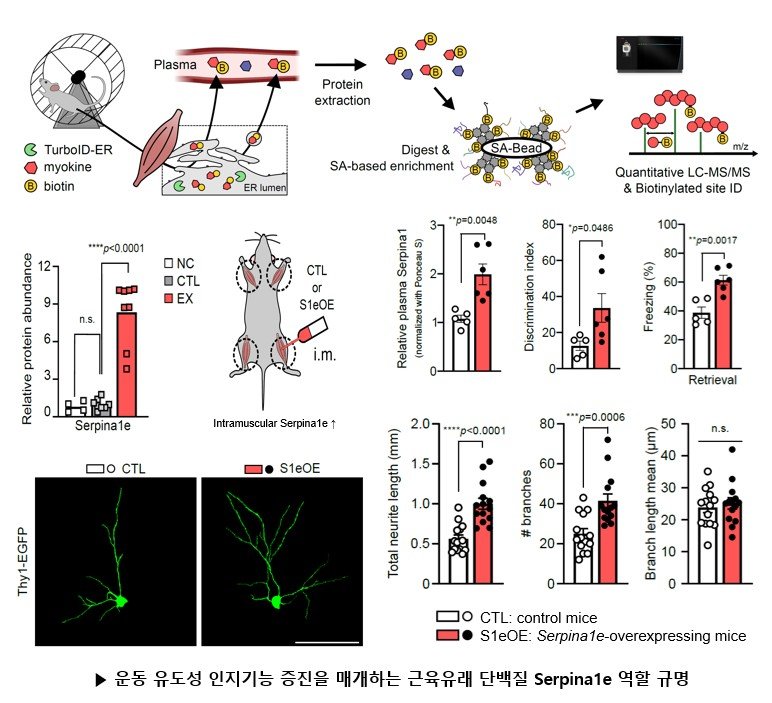
Focusing on “muscle–brain interaction,” in which muscles and the brain exchange signals, the team conducted a detailed analysis of secreted substances using advanced mass spectrometry technology capable of measuring at the molecular level. As a result, they confirmed a clear increase in the muscle-derived protein Serpina1e in the blood of mice that had exercised for four weeks.
In particular, this protein was found to directly pass through the blood–brain barrier (BBB), the brain’s protective shield that blocks the entry of external substances. After crossing the barrier and reaching the hippocampus, which governs memory, Serpina1e increased the expression of brain-derived neurotrophic factor (BDNF) and promoted neuronal regeneration, thereby enhancing cognitive ability.
In experiments, when this protein was injected into mice that had not exercised, the number of neurons in the hippocampus increased and cognitive function improved, similar to mice that had exercised. Conversely, when the protein was suppressed through genetic manipulation, no improvement in cognitive function was observed regardless of the amount of exercise.
Dr. Park stated, “This clearly demonstrates a pathway by which a specific muscle-derived protein crosses the blood–brain barrier via the bloodstream and acts directly on the hippocampus,” adding, “It is expected to lead to the development of new drugs to overcome cognitive decline.” The findings were published in the internationally renowned journal “Nature Communications.”
Kim Jae-hyung
AI-translated with ChatGPT. Provided as is; original Korean text prevails.
ⓒ dongA.com. All rights reserved. Reproduction, redistribution, or use for AI training prohibited.