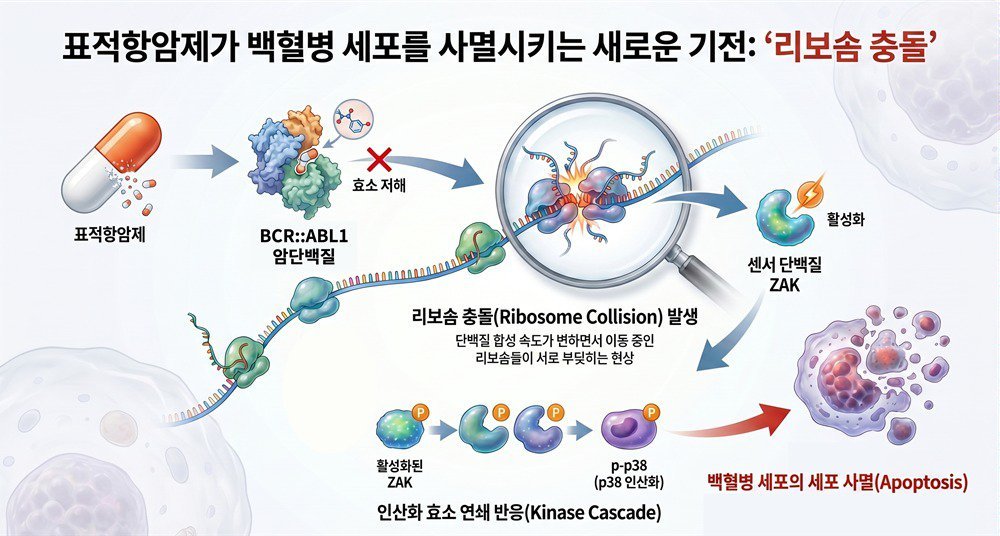
Research image illustrating the dual role of a leukemia anticancer drug (AI-generated, provided by KAIST) / News1
A Korean research team has identified a new mechanism by which an anticancer drug kills cancer cells.
KAIST announced on the 23rd that a joint research team led by Professor Lim Jeong-hoon of the Department of Biological Sciences at KAIST, Professor Kim Dong-wook of the Hematologic Malignancy Center at Uijeongbu Eulji Medical Center, and Professor Kim Hongtae of the Department of Biological Sciences at Ulsan National Institute of Science and Technology (UNIST) has identified a new molecular mechanism that regulates the response to a chronic myeloid leukemia anticancer drug.
Chronic myeloid leukemia is a disease that begins with problems in hematopoietic stem cells. When abnormalities occur in the genes of hematopoietic stem cells, an abnormal protein called “BCR::ABL1” is produced. This protein functions like a broken switch that continuously sends growth signals to cancer cells without stopping. Currently, “targeted anticancer drugs” that inhibit the activity of this protein are used for treatment. However, in some patients, drug resistance develops over time, reducing therapeutic efficacy, which has been a limitation.
The core of this study is an “alternative mode of cancer cell death” that differs from existing mechanisms. Until now, targeted anticancer drugs were known to act by inhibiting the function of specific proteins that cause cancer. The research team found, in addition, that the drug induces strong cellular stress by causing “ribosome collision” during intracellular protein production, ultimately leading cancer cells to self-destruct. Ribosomes are molecular machines that function as “protein factories,” producing proteins. During protein synthesis, multiple ribosomes operate in sequence along the same mRNA; if a leading ribosome stops or slows, trailing ribosomes can collide with it, causing ribosome collision.
The research team discovered that “ZAK protein” plays a key role in this process. Under normal conditions, ZAK protein promotes cancer cell growth, but under anticancer treatment it was shown to perform a dual role by sensing ribosome collisions and inducing cell death. In experiments using cancer cells derived from leukemia patients, artificially increasing ribosome collisions markedly enhanced the anticancer effect, while impairment of ZAK function led to reduced drug response.
The researchers stressed that these findings provide evidence that drug resistance may be explained by “ZAK dysfunction” and “ribosome stress response.” They added that the results are expected to offer important clues for the development of personalized treatment strategies and combination therapies tailored to individual patient characteristics in the future.
Han Chae-yeon
AI-translated with ChatGPT. Provided as is; original Korean text prevails.
ⓒ dongA.com. All rights reserved. Reproduction, redistribution, or use for AI training prohibited.