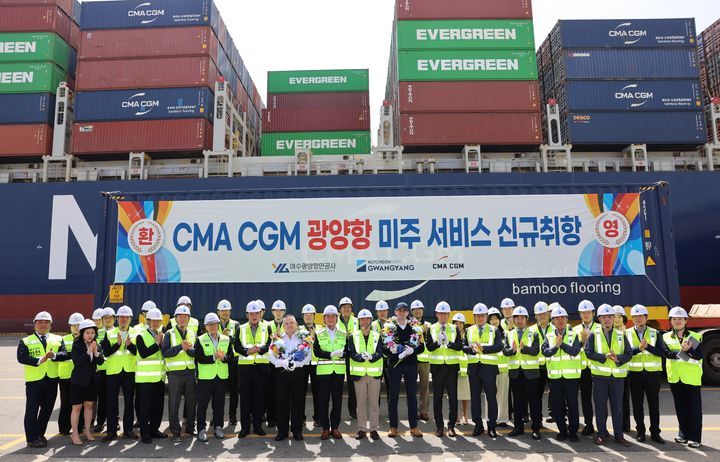
On the 21st, a ceremony was held at Gwangyang Port Container Terminal in South Jeolla Province to mark the launch of a new ocean route by France’s CMA CGM. Provided by Yeosu Gwangyang Port Authority
Yeosu Gwangyang Port Authority is accelerating efforts to strengthen Gwangyang Port’s global logistics competitiveness by attracting a new ocean route from France’s CMA CGM, the world’s third-largest shipping company.
Yeosu Gwangyang Port Authority announced on the 22nd that it has newly attracted CMA CGM’s “PEARL AS1 Pendulum Service.” This service is a key long-distance route connecting Asia and North America, with 8,000 TEU-class vessels (1 TEU is one 20-foot container) calling at Gwangyang Port Container Terminal once a week. Through this, the authority expects to generate new cargo volume of about 100,000 TEU annually.
Yeosu Gwangyang Port Authority explained that the attraction of this route is significant in that it can partially resolve the issues Gwangyang Port has faced, such as a shortage of regular liner calls and insufficient ocean services. Previously, some shippers had to use other ports, such as Busan Port, to secure stable ocean transport networks, but with the launch of this service, they will now be able to use a direct North American route from Gwangyang Port as well.
In addition, due to the pendulum-type route structure, a multilayered network will be established that links major Asian ports with India, the Middle East, South Asia and on to North America, thereby strengthening Gwangyang Port’s transshipment function and network expandability. Ports of call start from Gwangyang and proceed through major ports in China, Singapore, India (Nhava Sheva and Mundra), Karachi in Pakistan, Colombo in Sri Lanka, and Haiphong in Vietnam, then pass through China again before reaching Los Angeles (LA) in the United States.
Positive changes are also expected on the logistics side. Once sailings are regularized, shippers will benefit from greater predictability of shipping schedules and shorter transportation lead times. This can lead to reduced logistics costs and enhanced supply chain stability for importers and exporters. In particular, in a situation where uncertainty in the global shipping market persists, securing direct-call services by major shipping lines is regarded as a key factor in port competitiveness.
The ripple effect on the regional economy is also drawing attention. The inflow of new cargo volumes is expected to boost related industries such as port stevedoring, transportation and storage, and is highly likely to serve as a positive signal for attracting investment in hinterland complexes.
President Choi Gwan-ho stated, “CMA CGM’s selection of Gwangyang Port as a key port of call is a recognition of Gwangyang Port’s global competitiveness,” adding, “The authority will continue to diversify ocean routes and expand cargo volume to leap forward as a hub port in the global supply chain.”
ⓒ dongA.com. All rights reserved. Reproduction, redistribution, or use for AI training prohibited.
Popular News