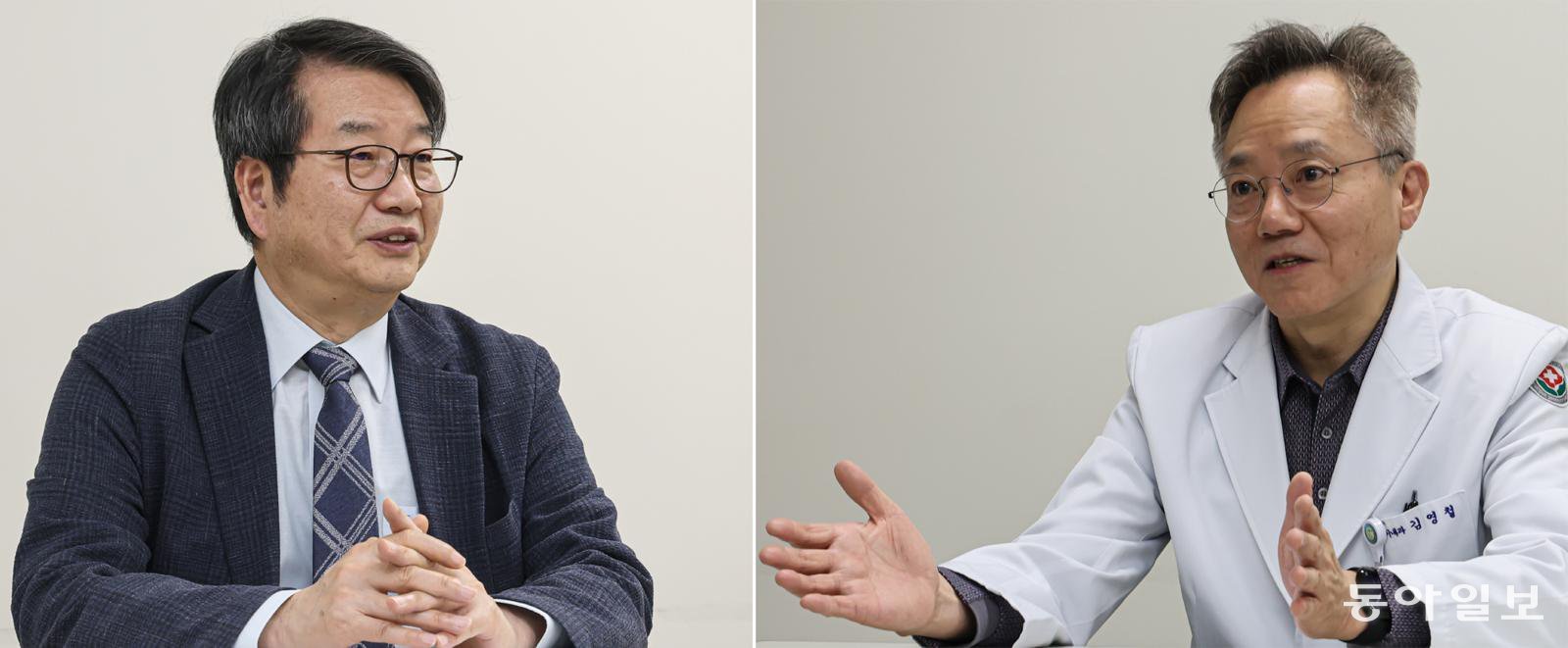
Interview with Prof. Kim Young-chul, Chonnam National University Medical School, and Distinguished Prof. Bae Seok-chul, Chungbuk National University Medical School
Stage IV lung cancer patients with ‘EGFR mutations’
Combined use of targeted anticancer drugs and vitamin B3
Longer survival in women and non-smokers… shows potential as an adjunct cancer treatment strategy
Professors Bae Seok-cheol (left) and Kim Young-chul during an interview at the Chonnam National University Medical School Cancer Center in Hwasun, South Jeolla Province, on the 13th. Reporter Han-gyeol Lee always@donga.com
“The possibility has been confirmed that treatment efficacy can be enhanced not with a highly toxic new drug, but with a vitamin whose safety has already been verified.”
Although the advent of targeted anticancer drugs and immunotherapy has greatly improved survival rates for cancer patients, the barrier of resistance to anticancer drugs remains a difficult challenge. Against this backdrop, an adjuvant treatment strategy using vitamin B3 (niacinamide) is attracting attention as a new approach. The research team led by Professor Kim Young-chul of Chonnam National University Medical School, Professor Park Il-yeong of Chungbuk National University College of Pharmacy, and Professor Bae Seok-cheol of Chungbuk National University College of Medicine conducted a clinical trial on 110 patients with stage IV lung cancer. They announced clinical trial results showing that oral administration of 1 g of vitamin B3 per day could extend the survival period of female lung cancer patients or non-smoking lung cancer patients receiving targeted anticancer therapy by more than one additional year, and reduce the risk of death by nearly half. The Dong-A Ilbo met with Professor Bae, who led the basic research, and Professor Kim, who oversaw the clinical trial, to hear about the significance and limitations of the study.
―What led the two of you to start joint research?Professor Bae Seok-cheol=“While conducting basic research on lung cancer, I came to know Professor Kim Young-chul through academic society activities. Because the final stage of basic research is clinical validation, collaboration with clinicians is essential.”
Professor Kim Young-chul=“As we worked together in the Korean Association for Lung Cancer, a cooperative relationship naturally formed. The connection made through the association led to research collaboration.”
―How did the research on vitamin B3 begin?Professor Kim=“In the mid-1990s, the average survival period for patients with stage IV lung cancer was only six months. Since then, with the advent of targeted therapies and immunotherapy, treatment outcomes have greatly improved, but over time resistance eventually developed and patients were repeatedly lost. From a clinician’s perspective, the most pressing need was a ‘way to delay resistance.’ Basic research presented results that restoring the tumor suppressor gene RUNX3 could inhibit cancer progression, and attention was drawn to the fact that vitamin B3 could activate this gene. There was an expectation that if a substance with already verified safety was used, it could complement treatment efficacy without placing a significant burden on patients.”
Professor Bae=“Cancer cells survive by constantly altering their genes. Reactivating inactivated tumor suppressor genes was the starting point of the research.”
―What were the clinical results?Professor Kim=“We compared a combination group receiving targeted anticancer drugs plus vitamin B3 against a control group in 110 patients with EGFR mutation-positive stage IV lung cancer. In the overall patient population, statistical significance was not achieved for the primary endpoint of progression-free survival. However, meaningful results were obtained for overall survival. In particular, the risk of death decreased by about 52% in women and about 42% in non-smokers, and the median survival was 43 months, more than one year longer than in the placebo group. These results suggest that vitamin B3 may have acted not by directly eliminating cancer, but by slowing cancer progression or sustaining treatment response for a longer period. However, caution is needed in overgeneralizing these results as applicable to all patients.”
Professor Bae=“It was a better-than-expected result in that a survival extension signal was observed with a substance that has no adverse effects.”
―Why was the effect more pronounced in specific patient groups?Professor Kim=“In smokers, the genetic mutations associated with cancer are extremely complex. Even if a single genetic pathway is regulated, the efficacy is inevitably diluted. By contrast, in non-smokers, especially female lung cancer patients, genetic mutations are relatively simple. It is a structure in which reactivating tumor suppressor genes such as RUNX3 can produce more direct effects. The patient group in which the effect was confirmed in this study is precisely such a population.”
―What is the mechanism of action of vitamin B3?Professor Bae=“In about 70% of lung cancer patients, RUNX3 function is inactivated. This gene plays an important role in stopping abnormally proliferating cells. Vitamin B3 acts to reactivate this ‘dormant gene.’ As a result, it suppresses processes by which cancer cells become more aggressive or acquire resistance to anticancer drugs. It is closer to a concept of controlling disease progression rather than completely curing it.”
―Why was it used in combination with targeted anticancer drugs?Professor Kim=“Targeted anticancer drugs are treatments that correct genetic abnormalities that have already occurred. Vitamin B3, on the other hand, plays a role in preventing new abnormalities from arising. In other words, one can be viewed as a ‘treatment that repairs broken parts,’ and the other as a ‘device that prevents additional breakdowns.’ Rather than conflicting, they are complementary in structure.”
―How was safety evaluated in the clinical trial?Professor Kim=“In clinical practice, adverse effects are the most critical consideration. From the outset of this study, concerns in that regard were not great. This is because vitamin B3 is a substance whose safety has already been verified through various studies. In fact, even with a daily dose of 1 g, there was no difference in adverse effects compared with the placebo group, and patients’ quality of life was maintained. Generally, when a treatment is added, quality of life tends to decline, but in this study that was not the case, which is significant.”
―From a clinician’s perspective, what is the significance of this study?Professor Kim=“In treating stage IV lung cancer patients, it is common to see patients whose treatment has been going well suddenly deteriorate due to resistance. At those moments, there is always the thought that it would be better to have even one more option to offer patients. This study showed the possibility of complementing treatment efficacy with a relatively safe and low-burden method, rather than with a new, high-priced drug. It is meaningful in that it may serve as a strategy for extending survival without greatly increasing patients’ physical and economic burdens.”
―Can preventive effects also be expected?Professor Bae=“In a study on high-risk groups for skin cancer, vitamin B3 intake reduced cancer incidence by 25–30%. However, it is difficult to apply this directly to the general population, and further research is needed.”
―What are the future research tasks?Professor Kim=“The current results alone are not sufficient to establish a treatment method. A large-scale clinical trial with overall survival as the primary endpoint is needed. The problem is practical constraints. Because vitamin B3 is not a patent-based pharmaceutical, it is difficult to secure investment from pharmaceutical companies. Unless the funds and time required to conduct large-scale clinical trials are secured, it will not be easy to expand the research. Even so, this study is meaningful in that it has confirmed the ‘possibility.’ It has provided a clue that, for particular patient groups, it may be considered as one of the treatment strategies.”
Professor Bae=“Research on gene therapy that directly restores RUNX3 is also underway. There is potential for expansion to various types of cancer in the future.”
This study is noteworthy in that it has shown that a familiar substance, a vitamin, can be used as an adjuvant strategy in cancer treatment.
The two professors stated that “vitamin B3 is, after all, an adjuvant strategy and cannot be applied to all patients,” but also assessed that “it is a study that suggests a new direction for cancer treatment in that it can complement therapeutic effects with a substance that is almost non-toxic.”
ⓒ dongA.com. All rights reserved. Reproduction, redistribution, or use for AI training prohibited.
Popular News