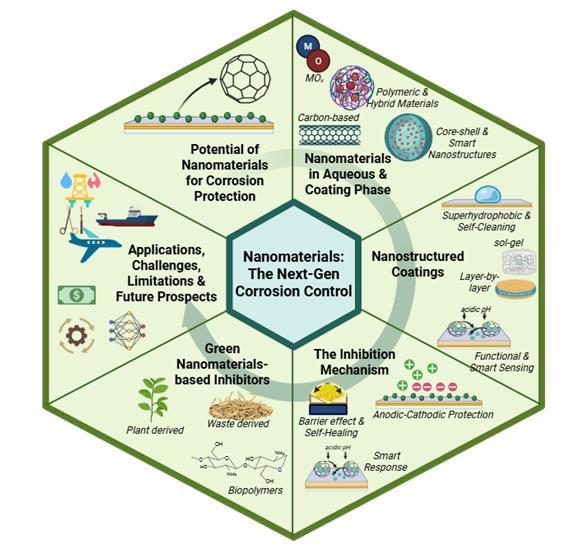
Conceptual diagram of ‘Nanomaterials: The Next-Gen Corrosion Control’ developed by Professor Kim Sang-yeon’s research team in the Department of Computer Engineering at Korea University of Technology and Education. Provided by Korea University of Technology and Education
Professor Kim Sang-yeon. Provided by Korea University of Technology and Education
The research team led by Professor Kim Sang-yeon at Korea University of Technology and Education has systematically established an innovative corrosion inhibition technology using metal oxides, carbon-based nanomaterials, and polymer nanocomposites.
This study aims to enhance the durability of core components used in the marine, aerospace, and information technology (IT) industries, and the related results have been published in the international journal Advanced Composites and Hybrid Materials.
Key components such as actuators and sensors are exposed to harsh environments, including high temperature and humidity, and have long faced issues of performance degradation and reduced lifespan due to corrosion. Existing prevention technologies have limitations in ensuring long-term stability, and some inhibitors pose potential burdens on the environment and human health, which has also been noted as a challenge.
The research team advanced the design methodology for corrosion-inhibiting materials by combining eco-friendly nanoparticle synthesis using plant extracts with AI-based analysis. Based on extensive materials data, the team analyzed the relationships among the structure, composition, and performance of nanomaterials and applied a design approach that derives materials backward from the target performance.
Through this, the team explained that it has established a framework that enables rapid exploration of promising materials in a data-driven manner, moving away from conventional experiment-centered approaches.
Professor Kim Sang-yeon, who led the study, emphasized, “This research demonstrates the potential for realizing active functions such as self-healing and shows that the paradigm of materials design is shifting to a data-driven model.”
He added, “Convergent technologies will play an important role in the future development of sustainable, high-performance corrosion prevention technologies.”
This study was conducted with support from the National Research Foundation of Korea.
ⓒ dongA.com. All rights reserved. Reproduction, redistribution, or use for AI training prohibited.
Popular News