Lee Jae-yong, Chey Tae-won and others embark on back-to-back business trips
Land of opportunity with 1.5 billion people and Korea’s No. 3 trading partner
200-member business delegation pursues “sales diplomacy”
Also seeking cooperation on energy, infrastructure and supply chains
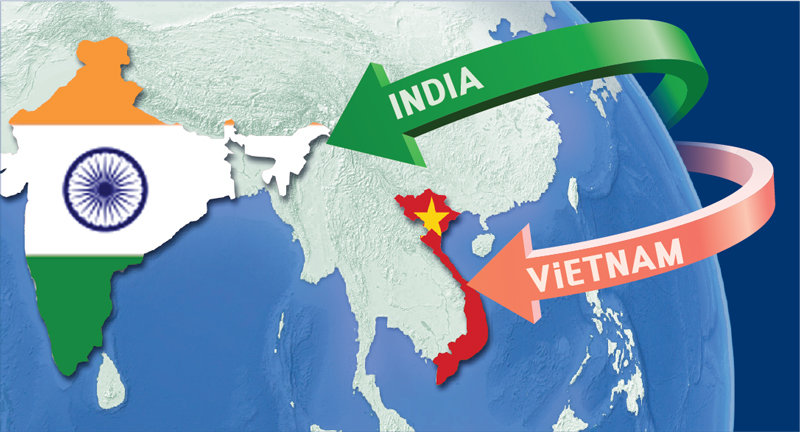
As Korean business leaders accompany President Lee Jae-myung on his state visits to India and Vietnam, attention is focusing on the current state of economic cooperation between Korea and these countries. Both nations are key states in the so‑called “Global South” of low-latitude emerging economies, noted for abundant resources and labor and attracting attention for their future growth potential.
● India, the ‘land of opportunity’ with 1.5 billion people
According to business circles on the 19th, this visit to India and Vietnam by President Lee will be joined by the heads of the five major business groups—Samsung Electronics Chairman Lee Jae-yong, SK Chairman Chey Tae-won, Hyundai Motor Chairman Chung Euisun, LG Chairman Koo Kwang-mo, and Lotte Chairman Shin Dong-bin—along with many other top conglomerate leaders including POSCO Chairman Jang In-hwa, HD Hyundai Chairman Chung Ki-sun, GS Chairman Huh Tae-soo, Hyosung Chairman Cho Hyun-joon, and CJ Chairman Sohn Kyung-shik. The five‑night, six‑day itinerary runs from India from the 19th to 21st, followed by Vietnam from the 21st to 24th.
On this day, Lee and other top business leaders departed one after another on their business trip via the Seoul Gimpo Business Aviation Center. The economic delegation visiting India and Vietnam is reported to number around 200 people. Considering that a similarly sized 200‑member economic delegation, including group heads, accompanied then President Yoon Suk Yeol on his state visit to Vietnam in 2023, it indicates sustained interest in the Global South among Korean conglomerates.
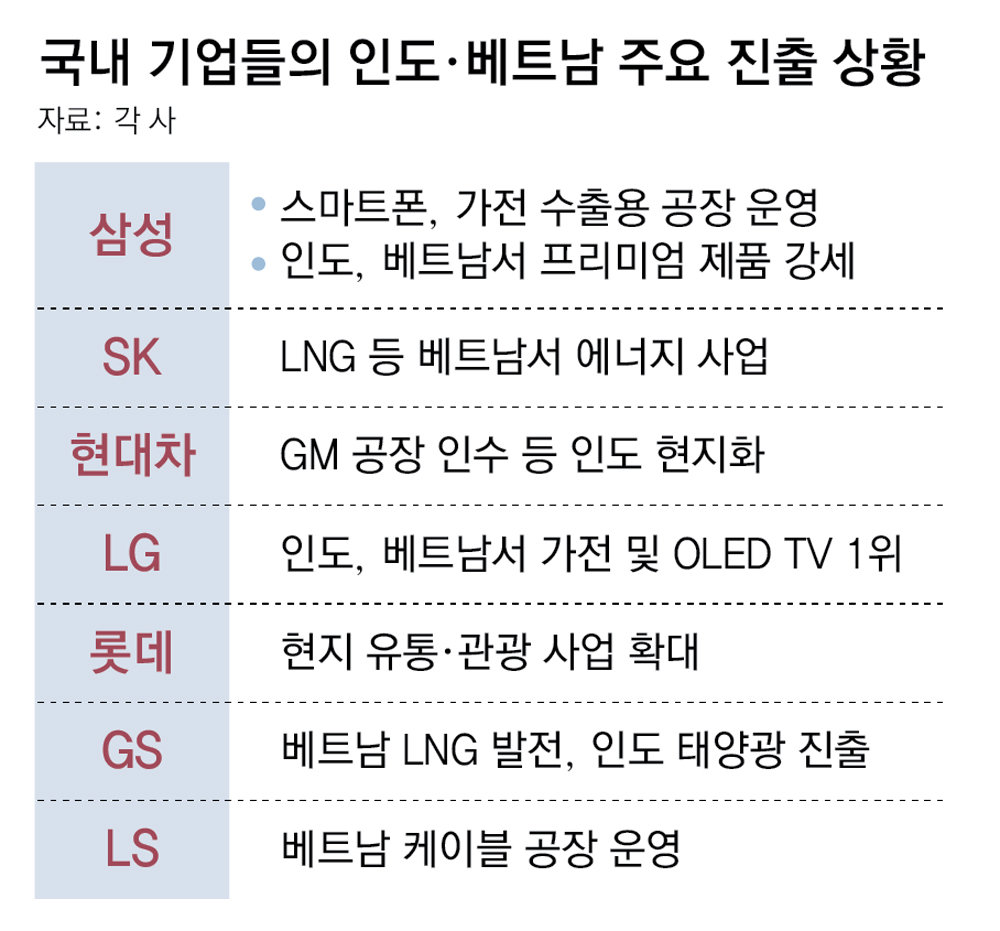
India is regarded as a “land of opportunity,” with the world’s largest population of 1.5 billion, the world’s fourth‑largest economy, and annual economic growth of 7%. It is a core demand base for Korea’s electronics sector, including Samsung Electronics and LG Electronics, as well as automotive firms Hyundai Motor and Kia. Korean companies hold a combined 50% share in major home appliances such as refrigerators and washing machines in India, and are also expanding in televisions, driven by premium demand. In particular, according to market research firm IDC, in the premium smartphone market priced at 70,000 rupees (about KRW 1.1 million) or more in the first half of last year (January–June), Samsung and Apple posted market shares of 49% and 48%, respectively, reflecting a tight race.
Localization strategies targeting the Indian market are also accelerating. Hyundai Motor Group Chairman Chung has emphasized that the group “must be reborn as India’s national company.” For Hyundai Motor and Kia, India currently represents their third‑largest market after the United States and Europe. Once the Pune plant acquired from General Motors (GM) last year begins full‑scale operations in the second half of this year (July–December), annual production capacity will grow to 1.5 million units, making India the group’s largest overseas production base on a single‑country basis.
● Vietnam, Korea’s third‑largest trading partner
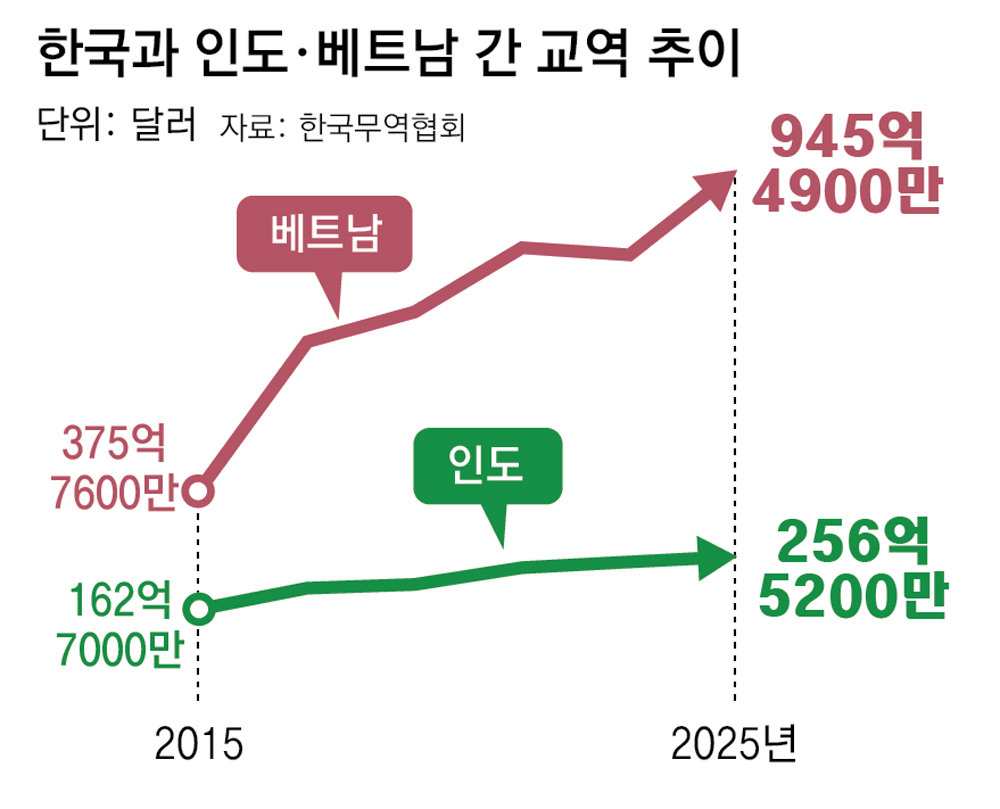
Vietnam, the next stop, has long maintained close cooperation with Korean companies. Last year, trade between Korea and Vietnam reached USD 94.5 billion (around KRW 138.7 trillion), up 9% from the previous year. Since overtaking Japan in 2022, Vietnam has remained for four consecutive years Korea’s third‑largest trading partner after China and the United States.
Vietnam mainly serves as an export base, receiving semiconductors and other parts and materials from Korea and then assembling them into finished products for shipment abroad. For example, Samsung Electronics produces more than 50% of its global smartphone output in Vietnam.
During this visit, accelerated government‑led investment in energy and infrastructure in each country is also expected to create opportunities for Korean companies. In February this year, SK Innovation won an LNG (liquefied natural gas) power generation project in Vietnam worth KRW 3.3 trillion through a consortium with local companies. The project has a capacity of 1.5 GW (gigawatts), making it a mega‑scale development comparable to one or two nuclear power units. GS is expanding solar and LNG power generation projects in both India and Vietnam.
ⓒ dongA.com. All rights reserved. Reproduction, redistribution, or use for AI training prohibited.
Popular News