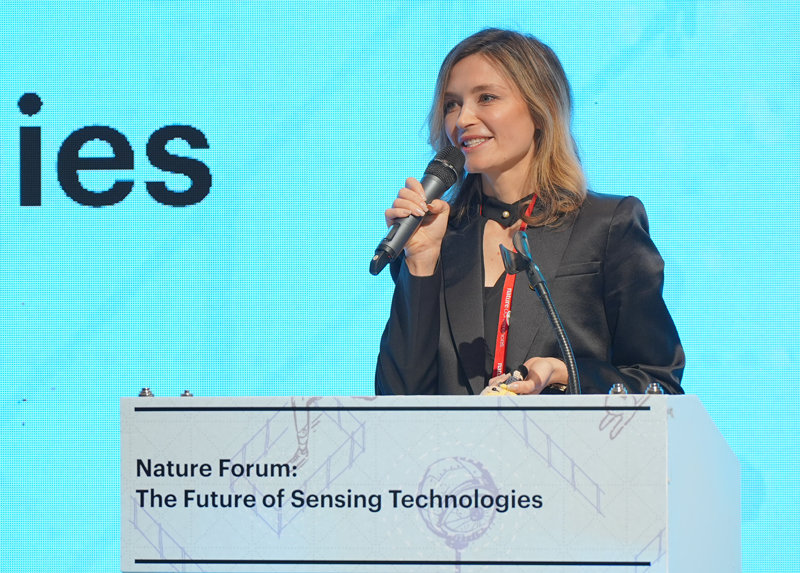
Olga Bubnova, Editor-in-Chief of Nature Sensing, announces the official launch of the international journal Nature Sensing at the “2026 Nature Conference” held at Yonsei University’s Sinchon Campus on the 13th. Provided by Springer Nature
“With the advent of artificial intelligence (AI), there is no longer a need for the highest-performance sensors. Even with the same sensors, AI now makes it possible to interpret data that previously could not be understood.”
At the “2026 Nature Conference” held at Yonsei University’s Sinchon Campus on the 13th, Olga Bubnova, Editor-in-Chief of Nature Sensing, explained recent research trends in the sensor field in these terms. Springer Nature, the publisher of the international journal Nature, announced the official launch of “Nature Sensing” on this day. As the importance of sensors has grown in diverse areas such as robotics, healthcare, and quantum technologies, the journal was launched in January this year as a sister title to Nature.
According to Editor-in-Chief Bubnova, earlier sensor research focused simply on detecting something, which often prevented it from being published in journals. However, the situation has changed completely with the emergence of AI. “Even when using the same type of sensor, applying AI yields completely different data analysis results,” she said, adding, “This has opened up numerous application areas that were previously impossible.”
The field where sensors are being most actively applied is robotics. “Robots now use various sensors not only to acquire visual information but also to perceive a wide range of external environmental information, enabling them to understand obstacles and make decisions autonomously,” Bubnova said. She noted that this has brought robots to the stage of “embodied intelligence,” where they independently explore their surroundings and exhibit intelligence much like humans.
“The core of embodied intelligence is ‘multimodal sensing’—a technology that uses multiple senses simultaneously to recognize situations, just like the human body,” she said. “Combining the various sensory inputs that come through sensors is emerging as a new research field.”
Recently, “in-sensor computing,” which enables computation directly inside the sensor, has also emerged. It is now possible to perform computation at the level of preprocessing the data collected by the sensor. As the development of physical AI accelerates and a wide variety of data beyond visual information is input, even handling this level of computation at the sensor stage can greatly increase processing speed.
Editor-in-Chief Bubnova stressed that Korea is strong in engineering-centered research. “Korea has long been known for its applied research. In the past, when only basic science was emphasized, this might have been seen as a weakness, but circumstances have changed,” she said. “This is now a ‘golden age’ for the Korean research community.” She added that the recent academic trend of emphasizing applied research, as seen in the growing number of engineering-focused journals like Nature Sensing, aligns well with the strengths of Korean research.
Bubnova also noted that the political environment is important for the advancement of science. “From experience, good research emerges when governments are willing to invest in research,” she said, emphasizing, “No matter how abundant a country’s resources are, without technology it cannot become a modern, high–value-added nation.”
ⓒ dongA.com. All rights reserved. Reproduction, redistribution, or use for AI training prohibited.
Popular News