Although the Special Integration Act Failed to Clear the National Assembly
Daegu–Gyeongbuk Keep TF in Place to Accelerate Projects
Attracting Universities and Institutions to the New Provincial Government City
Plans for a National Museum of Modern Art and Performance Venues
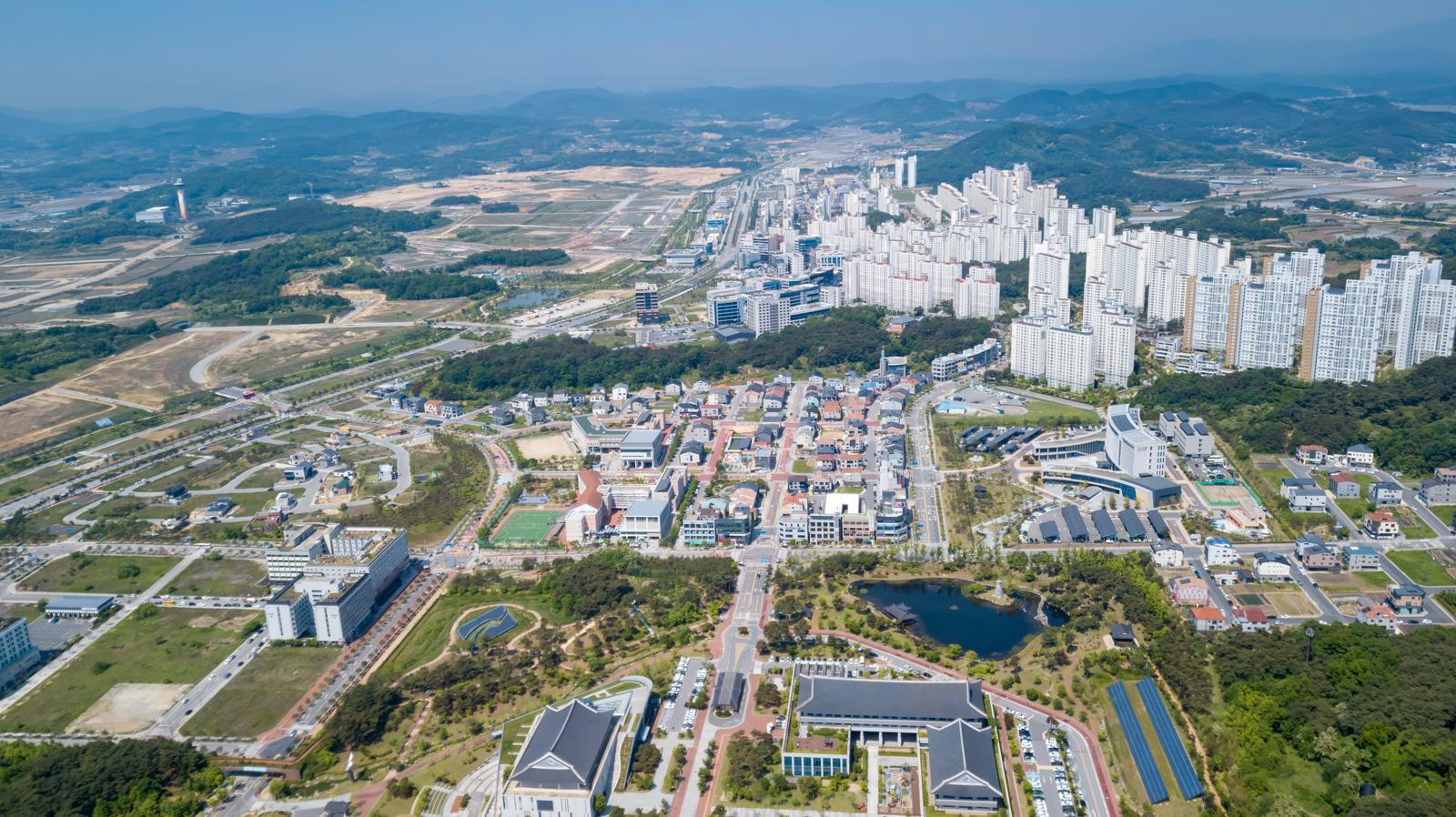
A view of the new provincial government town in Pungcheon-myeon, Andong-si, North Gyeongsang Province. If the Daegu–Gyeongbuk Integrated Special City is launched, it is expected to be developed as the practical administrative center. Provided by North Gyeongsang Province
The National Artificial Intelligence Strategy Committee on the 6th visited Alpha City in Suseong-gu, Daegu, to review the progress of the regional hub Artificial Intelligence (AI) Great Transformation (AX) innovative technology development project. The visit aimed to gather on-site opinions on the creation of an AX innovation belt based on the “5 Poles, 3 Specials” (“5극 3특”) framework, a core task of the “Republic of Korea AI Action Plan” announced by the government in February this year, and to strengthen policy implementation.
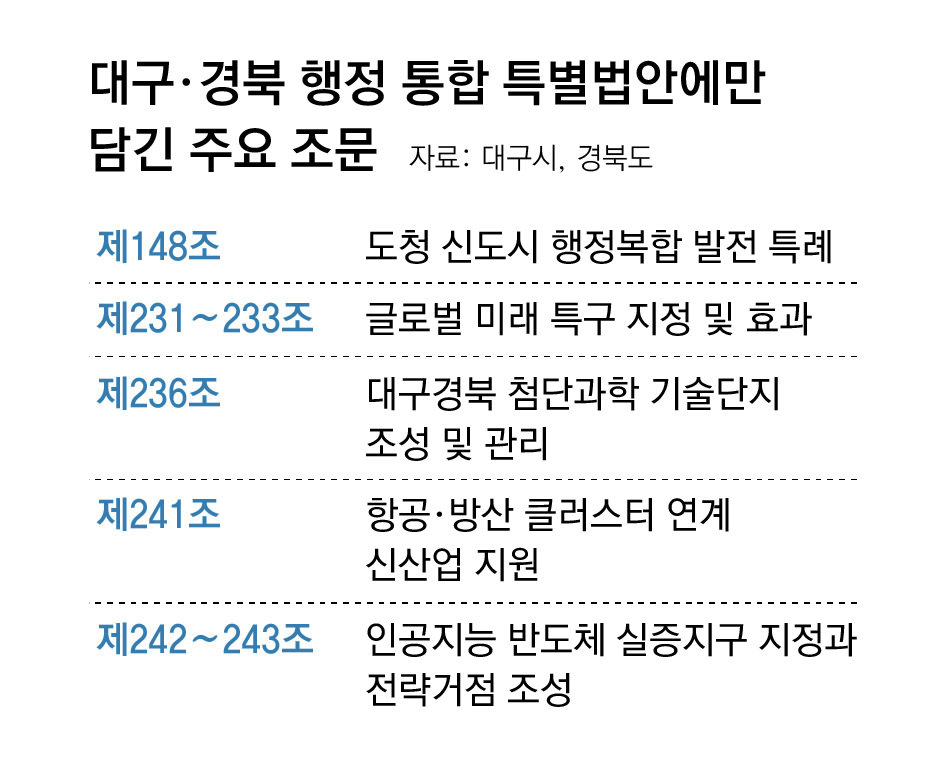
Daegu City will invest a total project budget of KRW 551 billion over five years starting this year to build a region-led AX innovation ecosystem centered on Alpha City. The goal is to develop it into a research and development and industrial demonstration hub that integrates AI, robotics, and semiconductors. This project is also a key task included in the Daegu–Gyeongbuk Administrative Integration Special Act bill.
Im Moon-young, Standing Vice Chair of the National Artificial Intelligence Strategy Committee, said, “From the AX demonstration stage, the government will support public infrastructure so that costs and risks can be shared, and will establish a framework for training specialized talent centered on Daegu Gyeongbuk Institute of Science and Technology (DGIST).”
● ‘Pre-execution’ strategy for core administrative integration projects
Although the Daegu–Gyeongbuk Administrative Integration Special Act bill failed to pass the National Assembly, Daegu City and North Gyeongsang Province have adopted a “pre-execution” strategy, maintaining a dedicated task force (TF) and moving ahead first with core projects without waiting for the law to pass.
Despite political variables delaying discussions on integration, the intention is to continue pushing ahead with projects related to regional growth. If the Special Act passes, the projects will be immediately expanded; if passage is delayed, projects feasible under the current system will be implemented preemptively to build the foundation for integration.
North Gyeongsang Province has maintained its organizational structure centered on the Integration Promotion Team even after the bill was put on hold, and shifted to a “two-track” system combining renewed efforts to pass the Special Act with the promotion of practically implementable projects. One track focuses on re-pursuing the Special Act and reinforcing the rationale for it, while the other focuses on sequentially implementing, starting this year, those development strategies contained in the bill that can be executed immediately.
This stance is seen as influenced by the prior passage of the Gwangju–South Jeolla Integration Special Act. The Jeonnam–Gwangju Integrated Special City is accelerating toward its launch in July, backed by financial incentives of up to KRW 5 trillion per year and up to KRW 20 trillion over four years, special city-level authority, preferential relocation of public institutions, and regulatory exceptions for industrial promotion. In contrast, Daegu–Gyeongbuk has gone through seven years of public debate and deliberation since 2019, and in January this year secured the consent of the North Gyeongsang Provincial Council, which was the final hurdle at the local level, but failed to pass the National Assembly Legislation and Judiciary Committee. There is considerable frustration in the region that “Daegu–Gyeongbuk drew up the blueprint first, but another region is reaping the results.”
The move by Daegu City and North Gyeongsang Province toward pre-execution is also driven by concerns that delays will widen development gaps. Kim Ho-jin, Director General for Policy and Planning of North Gyeongsang Province, said, “If we fall behind in competition for the relocation of public institutions, national fiscal projects, and the attraction of strategic industries, we could lose growth opportunities, not just face a simple postponement of the bill,” adding, “The key is to fill the gap with administrative efforts and maintain a state of readiness so that once the Special Act takes effect, outcomes can follow immediately.”
● Northern-region hub development, new airport, and industrial clustersNorth Gyeongsang Province plans to first address, through concrete projects, the concerns of the northern region, which were the biggest point of contention during integration discussions. The foremost task is to turn the new provincial government town into an “integrated administrative hub.” Marking the 10th anniversary of the provincial government’s relocation this year, the plan is to develop the new town not just as an administrative complex but as the practical administrative center of the Integrated Special City. By combining a joint university campus, relocation of affiliated institutions, and expansion of advanced bio-research infrastructure, the province aims to nurture it into a self-sustaining city and ease fears of “northern-region marginalization.”
The Daegu–Gyeongbuk integrated new airport and the creation of an aviation and defense cluster will also be accelerated independently of the Special Act. As the new airport is already being pursued as a national project under a separate Special Act, the plan is to proceed without disruption in establishing industrial complexes linked to relocation in sectors such as maintenance, repair and overhaul (MRO), defense, and future mobility, thereby laying the foundation for long-term growth. Strengthening the East Coast logistics belt centered on Yeongilman Port in Pohang is being pursued in the same context. With an eye on the era of Arctic shipping routes, port strategies will be supplemented and the East Sea will be developed as a forward base for the industrial expansion of Daegu–Gyeongbuk.
Daegu City will move forward as planned with the establishment of a National Musical Complex and the construction of the National Museum of Modern and Contemporary Art on the former site of the North Gyeongsang Provincial Government in Sangyeok-dong, Buk-gu. The city plans to build national hub infrastructure dedicated to musicals, create a growth platform for K-musicals, and at the same time solidify its identity as the birthplace of modern art.
Oh Joon-hyuk, Director General for Policy and Planning of Daegu City, said, “We will first accumulate regulatory easing and demonstration projects for regional strategic industries such as AI, robotics, bio, future mobility, aviation, and defense within existing individual systems, so that once the Special Act is operational, a ‘one-stop’ response will be immediately possible.”
In addition, projects such as the construction of the Daegu–Gyeongbuk metropolitan railway, the creation of Daegu Urban Railway Line 4, diversification of Nakdong River water intake sources, and the North Gyeongsang agricultural great transformation project will continue. The region is also refining plans for a “Global Future Special Zone” that consolidates the benefits of nine existing special zones, including free economic zones and regulatory-free special zones. While prioritizing recovery from forest fire damage, it is also promoting a northern-region economic regeneration strategy that links Baekdudaegan forest healing industries, leading forest investment districts, historical and cultural belts, and tourism industries based on “5 Han (Korean): Hansik (Korean food), Hanbok (traditional clothing), Hanok (traditional housing), Hanji (traditional paper), and Hangeul (Korean alphabet) contents.”
The concept of building a “global K-wave historical and cultural hub” brand will also be pushed ahead within budgetary limits, independently of the Special Act, by connecting Confucian culture centered on Andong, Silla and Gaya heritage assets, and post-APEC (Asia-Pacific Economic Cooperation) tourism demand.
With discussions in the National Assembly delayed, the driving force behind the Daegu–Gyeongbuk administrative integration has weakened. Observers note that it is now being tested whether local governments can maintain momentum by preemptively promoting core projects. Lee Yoon-seok, President of the Korean Association for Government Studies and professor of public administration at Keimyung University, said, “The Daegu–Gyeongbuk administrative integration must be prepared through sufficient public debate and deliberation on issues such as the allocation of administrative authority between metropolitan city districts and provincial cities and counties, the structure of local taxation, and the distribution of central government grants.”
ⓒ dongA.com. All rights reserved. Reproduction, redistribution, or use for AI training prohibited.
Popular News