Required memory cut to one-sixth, data processing speed boosted eightfold
Forecasts of “falling memory demand” rattle investors… SK shares down 6.2%, Samsung 4.7%
Counterargument: “Semiconductor demand will actually increase”
After Google unveiled a new algorithm technology that can process large language model (LLM) data faster with fewer resources than before, share prices of major global memory semiconductor companies fell across the board. Investor sentiment appears to have been affected by concerns that demand for memory semiconductors could decline.
The KOSPI, in which Samsung Electronics and SK hynix have a high market capitalization weighting, fell more than 3% on the 26th and dropped below 5,500. Industry insiders believe it is premature to predict a contraction in memory semiconductor demand, given that it will take a long time for this technology to be applied and that artificial intelligence (AI) is rapidly advancing.
The KOSPI closed the day at 5,460.46, down 3.22% (181.75 points) from the previous trading session. Foreign investors led the index decline by recording net selling of KRW 3,098.0 billion. The KOSDAQ Index ended at 1,136.64, down 1.98% (22.91 points) from the previous session.
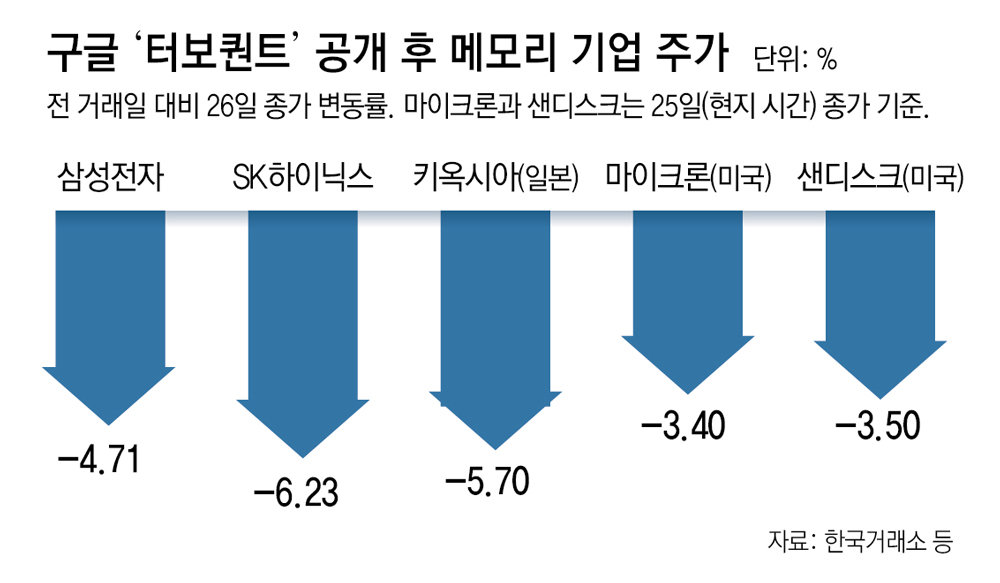
On the KOSPI that day, declines were steep for the “semiconductor top two,” Samsung Electronics (including preferred shares) and SK hynix, which together account for 40.76% of the total market capitalization. Samsung Electronics fell 4.71%, and SK hynix declined 6.23%.
The sharp drop in the share prices of Samsung Electronics and SK hynix was largely attributed to “TurboQuant,” a new algorithm technology unveiled by Google in the United States. TurboQuant, announced by Google Research on the 25th (local time), is a technology that enhances AI efficiency.
In general, AI models must use an enormous amount of memory (storage devices) to process complex information. In contrast, according to Google Research’s findings, using TurboQuant reduces the required memory volume to one-sixth of the existing level. Processing speed was found to be up to eight times faster than “H100,” Nvidia’s flagship graphics processing unit (GPU). This is thanks to the application of a technology that compresses and processes data with virtually no loss.
As concerns grew that algorithm technologies like TurboQuant could reduce demand for memory semiconductors, the New York stock market reacted first. On the 25th (local time), shares of Micron Technology, the world’s third-largest memory semiconductor company, fell 3.4% from the previous trading day. Other memory makers, including SanDisk (–3.5%) and Western Digital (–1.63%), also saw their share prices decline. Shares of Japanese memory semiconductor company Kioxia dropped 5.7% on the 26th from the previous session. U.S. IT-specialized media outlet TechCrunch noted, “Through TurboQuant, there is a possibility that AI models will increase efficiency compared with the past and create a structure that reduces memory demand.”
In the domestic securities industry, some analysts view the share price declines of Samsung Electronics and SK hynix following the release of the TurboQuant research results as excessive. This is because Google has only published the results in an academic paper so far, and it may take a long time before actual commercialization. Kim Il-hyuk, a researcher at KB Securities, analyzed, “As data processing efficiency improves, companies will invest more in developing new AI devices and agents, and consequently demand for memory semiconductors will inevitably increase again.”
ⓒ dongA.com. All rights reserved. Reproduction, redistribution, or use for AI training prohibited.
Popular News