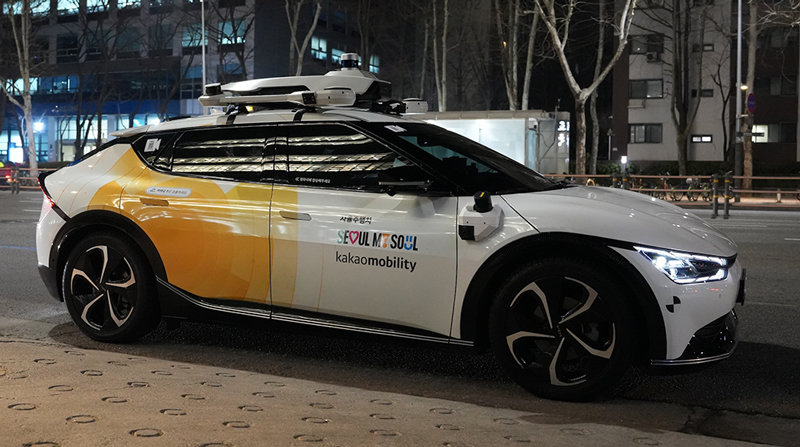
On the 23rd at 10 p.m., a test ride was taken in Kakao Mobility’s robo‑taxi “Gangnam Late-Night Autonomous Taxi” near Maebong Station in Gangnam-gu, Seoul. Provided by Kakao Mobility.
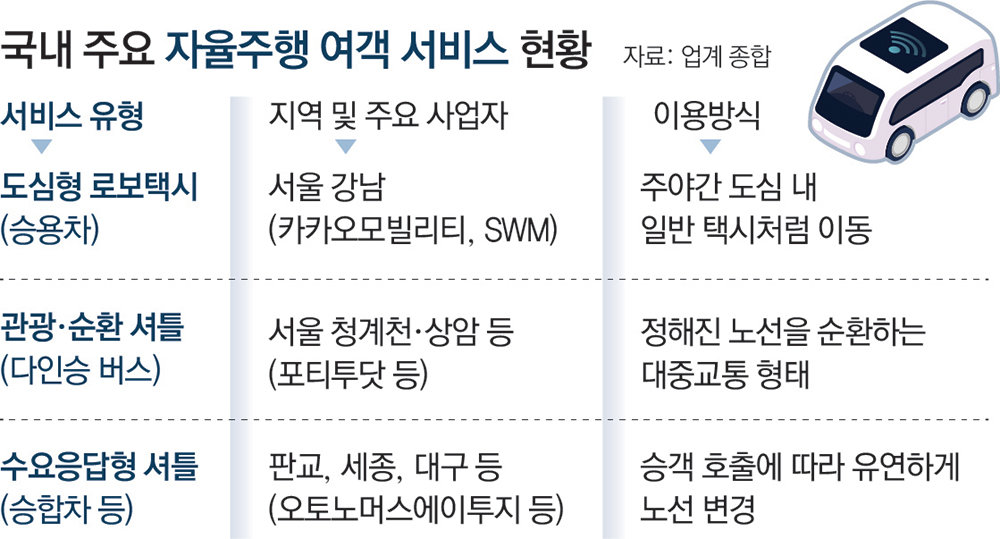
At 10 p.m. on the 23rd near Maebong Station in Gangnam-gu, Seoul, a “Seoul Autonomous Vehicle” was hailed via the Kakao T app. A Kia “EV6” robo‑taxi approached and stopped in the middle of the late‑night city center. The words “Autonomous Vehicle” were clearly printed on the side of the car. In the driver’s seat sat not a “driver,” but only a safety agent to respond to emergencies. It was a “Level 3” autonomous driving vehicle (conditional automation, with the system in charge of driving except in emergencies) that had received the Seoul Metropolitan Government’s “permission for paid passenger transport with autonomous vehicles.”
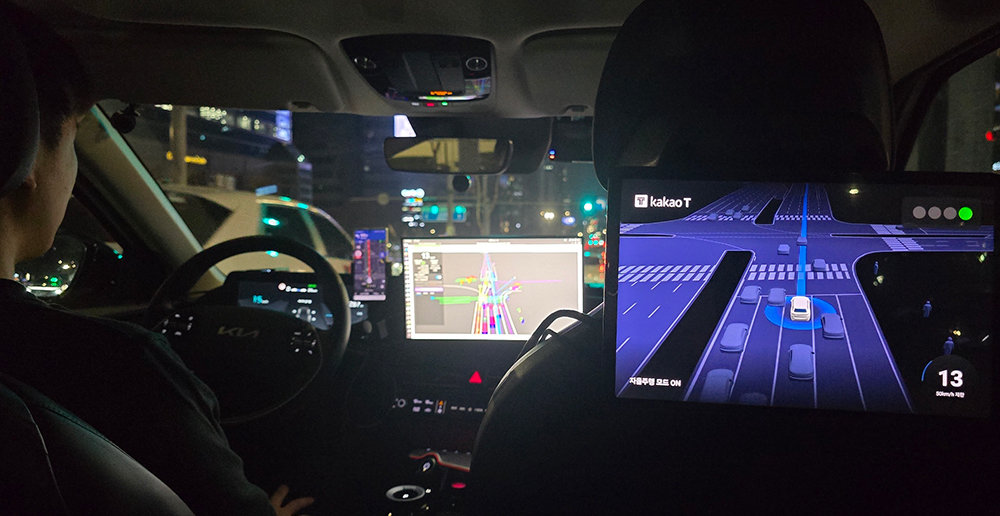
Departing from Maebong Station, the steering wheel turned on its own as the vehicle smoothly passed through an intersection. On the display in front of the seat, the autonomous driving artificial intelligence (AI) captured surrounding vehicles and pedestrians in three dimensions (3D) in real time, predicted their trajectories, and plotted the driving route. Immediately after making a right turn, when the vehicle attempted to change lanes, it suddenly stopped on its own, having detected a fast-approaching vehicle from behind. Seven cameras, five LiDARs, and five radars read the surroundings in place of the driver’s eyes, and the AI applied the brakes instantaneously. Although it occasionally hesitated near pedestrians on the sidewalk, overall driving was uneventful.
● ICT companies strike back, reshaping the autonomous driving landscape
The main actor in this late‑night drive was not a finished vehicle manufacturer, but Kakao Mobility. After launching late‑night robo‑taxi operations in the Gangnam area of Seoul on the 16th of this month, full‑scale paid services will begin on April 6. The Seoul Metropolitan Government has decided to charge only the base fare, including the late‑night surcharge. With Tesla’s supervised Full Self‑Driving (FSD) service set to be introduced in Korea, competition to secure an early lead in the market is expected to intensify further.
The global autonomous driving market is divided into Tesla’s “end-to-end (E2E)” approach, in which AI learns sensor data in its entirety to operate the vehicle, and Google Waymo’s “modular” approach, in which operation is based on pre‑programmed “rules.” Recently, E2E, which has the advantage of flexible situational judgment, has become the dominant trend, but it requires vast capital and driving data, resulting in high entry barriers.
Inside the vehicle, an AVV (autonomous driving visualization device) was installed to show surrounding obstacles and route planning in real time, allowing passengers to directly check the driving situation.
Kakao Mobility has chosen a compromise. It is pursuing E2E centered on an “AI Planner,” the equivalent of the vehicle’s brain, while simultaneously targeting a niche with a “hybrid design” that layers a rule‑based safety system just before final control. Kim Min-seon, head of the Autonomous Driving Business Team, explained, “It is a stepping stone toward full E2E while maintaining safety in urban environments.”
● Data gap with leading countries reaches 10,000‑foldRecent developments in the autonomous driving industry have been brisk. 42dot, under Hyundai Motor Group, has brought in Vice President Park Min-woo, formerly of Nvidia, to upgrade its technology, while promising startups such as Autonomous a2z are preparing for initial public offerings (IPOs).
However, the gap with global leaders remains significant. In some U.S. cities, fully unmanned Level 4 robo‑taxis have already become part of daily life, and the entry of players such as Google Waymo and China’s BYD into the Korean market has also been signaled. Above all, the most painful barrier is the “data gap.” While the total cumulative driving distance of all domestic autonomous driving companies is only about 13 million km, Waymo alone has surpassed 200 million miles (about 320 million km) in unmanned driving. Tesla has collected 7 billion miles (about 11.2 billion km) of data worldwide, and China’s Baidu surpassed 100 million km early on.
Unlike the United States and China, which greatly open test operation zones at the city level or beyond to facilitate real‑road data accumulation, Korea suffers from a severe shortage of available data due to narrow pilot zones and various safety regulations. Currently, designated pilot operation districts in Seoul are limited to areas such as parts of Gangnam and Seocho districts and Sangam-dong. In a recent report, Samjong KPMG stressed the need for active efforts to build the ecosystem, noting that “policy development and deregulation for autonomous vehicles will drive market activation.”
ⓒ dongA.com. All rights reserved. Reproduction, redistribution, or use for AI training prohibited.
Popular News