Fairy Tech delivers hyper-personalized benefits while protecting personal data
Real-time alerts on discounts and promotions so you don’t miss out on card benefits
Detects user behavior and processes only on the phone… blocking personal data leaks to external servers
Built on Google’s on-device AI research
“Robust privacy is an irreversible trend… will evolve into a personal assistant and boost productivity”
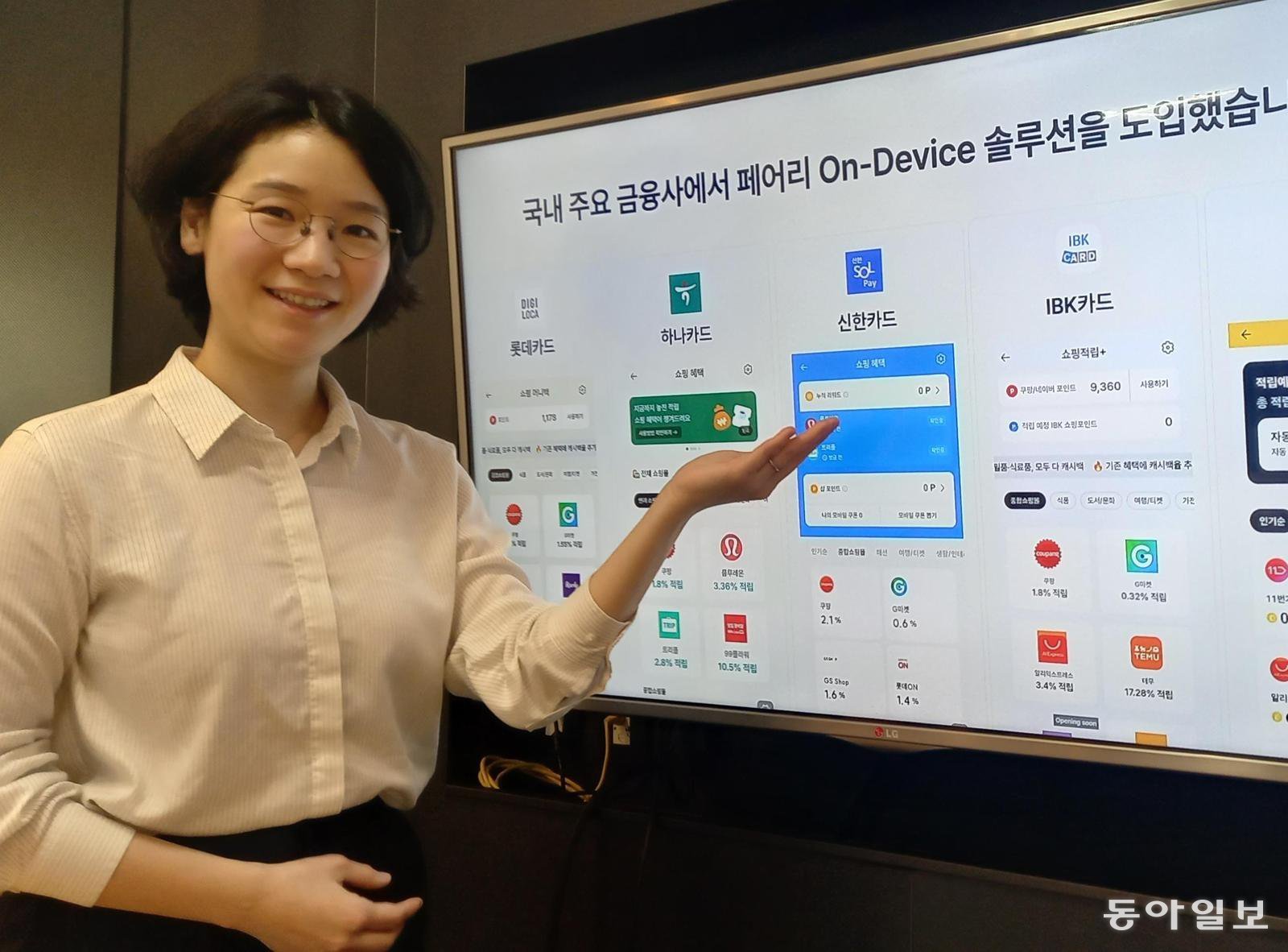
Fairytech CEO Jang In-sun explains a service that identifies customer behavior without the risk of personal data leakage, at the company’s office in Gangnam District, Seoul, on the 16th. The company’s technology is embedded in 10 million mobile phones, mainly through card issuers. Photo by reporter Heo Jin-seok, jameshur@donga.com
Credit cards on which users spend several hundred thousand to several million KRW every month. Yet how many people actually know what benefits they can receive when they use their cards? When buying groceries on an online shopping mall or booking a hotel through a travel app, almost no one knows in advance how much they can save by paying with their own card. To find out, they have to install and open the card issuer’s app separately and search for the benefits tab. Because of this inconvenience, cashback and rewards that could amount to several hundred thousand KRW a year are disappearing into thin air.
A startup that closely examined this loss and came up with a serious solution is Fairytech.
“Users do not receive the benefits because it is too cumbersome, too complex, and takes extra time. So I thought, then why not improve convenience and notify them at exactly the right moment?”
This was according to Fairytech CEO Jang In-sun (37), whom this reporter met at the company’s office in Gangnam District, Seoul, on the 16th.
Digital advertising distributed based on user demand is not something that must always be rejected. If it reaches the right user at the right time, it can be beneficial for the user as well. Until now, there have been clear limitations with the text-message advertising that card companies send. When a flood of advertisements for unsold apartments or loans is pushed out based solely on payment history, consumers grow weary and turn off marketing notifications. In that process, even “benefit notifications” such as discounts and events are often reduced together. Because of poorly designed targeted advertising and bundled marketing-consent structures, information on benefits that are actually needed fails to reach users, resulting in losses for both consumers and companies.
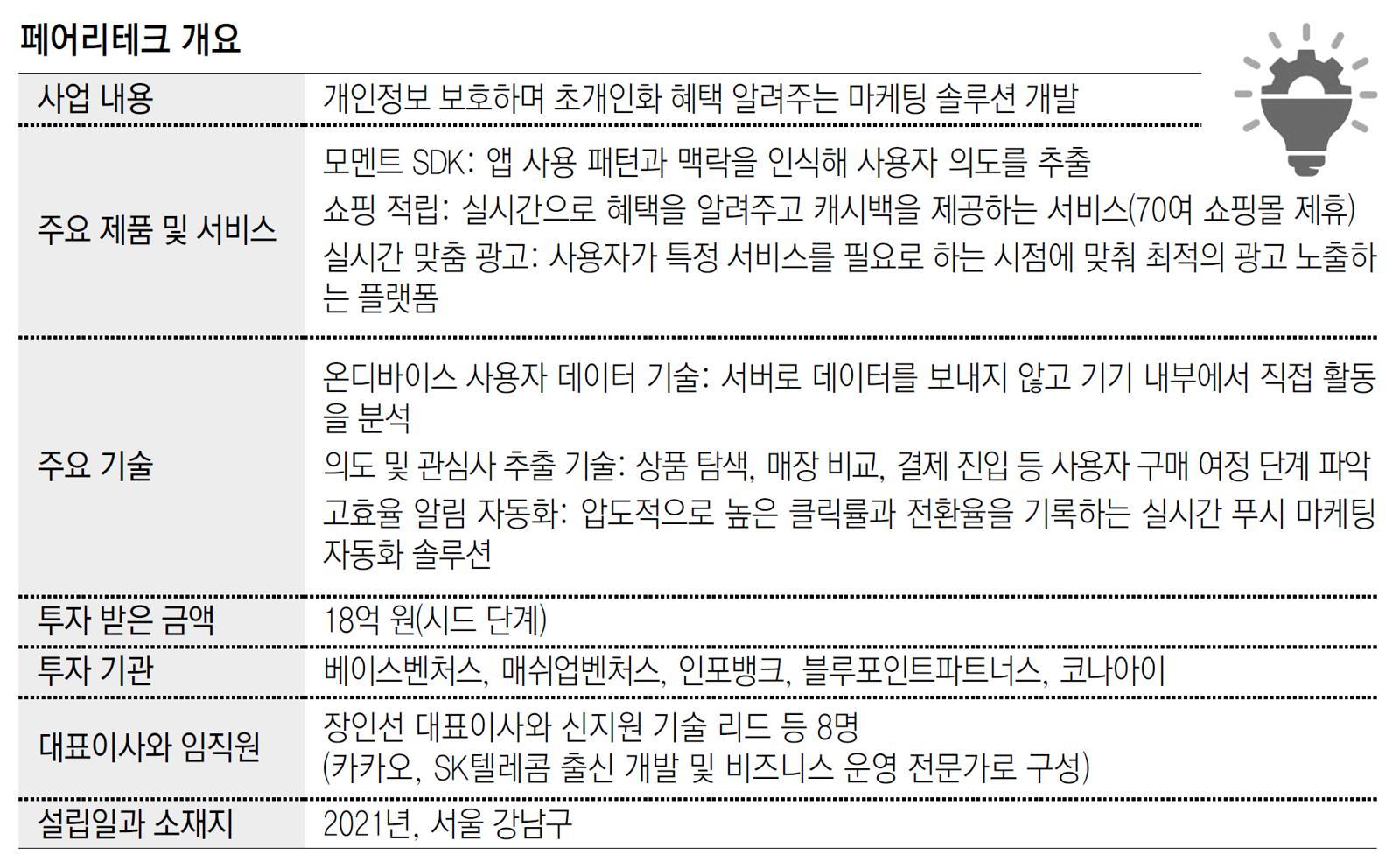
Jang has set out to resolve such inefficiencies in the domestic online (digital) advertising market, which is worth KRW 10 trillion, using on-device technology. The method delivers precisely tailored benefits to users at precisely the right moment without taking personal data outside the device to external servers.
● Processing inside the user’s phone… technology like magic Fairytech’s core technology is implemented through a software development kit (SDK) of about 2MB, as small as a single photo. Fairytech calls it the “Moment SDK.” Its decisive differentiator is that it is “privacy-first.” Because all data is processed only within the user’s mobile phone, there is no risk of personal information being leaked to servers. The SDK observes and processes whether the user runs a particular app on the smartphone, is only browsing, or has entered the payment stage, but does not transmit this information to any external server.
As of last year, it had been introduced into major financial apps such as Lotte Card, Hana Card, IBK Card, and Cashwalk, and is capable of running on 10 million devices (including overlaps). By June, Shinhan Card will join, increasing the number of operable devices to 20 million. Once users give their consent, it operates quietly in the background. Financial institutions do not pay usage fees; instead, they can actually generate revenue.
For example, when a user opens the Trip.com travel app, searches for a hotel, and reaches the step just before payment, Fairytech’s proprietary algorithm detects this behavior in real time within the phone. It then displays a notification such as, “If you pay with Card Company A’s card, you can receive 5% reward points.” The user no longer has to open the card issuer’s app to search for benefits. When the user opens the Coupang app, a notification automatically pops up saying, “We found a 2.1% cashback benefit.” If the user clicks on that notification and proceeds to payment, the benefit is automatically credited. Part of the marketing fees that online shopping malls pay is returned to financial institutions and other partners that have embedded the SDK. Fairytech also generates revenue from this. Jang said, “In the past, individuals would simply miss these benefits because they did not know about them or found it too troublesome, but now they can easily receive them; and corporate clients can monetize their data without worrying about personal data regulations.” The company provides its corporate clients with annual revenue in the range of several to several tens of KRW billions, while Fairytech itself, though still in its early stages, is already posting monthly sales of KRW 100 million.
Fairytech has formed partnerships with around 70 domestic and overseas shopping malls, including Agoda (up to 4.9% rewards), AliExpress (6.3%), Farfetch (7.7%), Yanolja (2.8%), Coupang (2.1%), and Emart Mall (1%).
The effectiveness of identifying the context of user behavior and providing benefit notifications at the right time has been greater than expected. In an experiment with one card company, when Fairytech deactivated real-time benefit notifications, the average number of clicks fell by 70%, and the related transaction amount decreased by nearly half. The fact that simply turning notifications on or off produced such a large difference in clicks and sales demonstrates the value of real-time, personalized notifications.
Notably, Fairytech’s benefit notifications achieve a click-through rate (CTR) of 28%, about 19 times the industry average of 1.5%. In a membership sign-up campaign conducted with Naver Pay, the results were particularly striking: a CTR of 27% and a conversion rate of 78% from click to actual membership registration.
● Co-founding with a colleague from Google After completing a master’s degree in computer science at Stanford University, Jang joined Google in 2013 for her first job. She spent three years at the headquarters in the United States and five years at Google’s Korea office, for a total of eight years working in Android and on-device artificial intelligence (AI). TensorFlow Lite, which she led, is a core on-device AI technology that enables deep learning models, originally run on servers, to operate directly on devices such as smartphones.
Her eight years at Google were rewarding in many ways. The company offered growth opportunities, allowed her to change teams, and supported her transfer from the United States to the Korea office. Nonetheless, she decided to leave in 2021. It took just one month from decision to action.
The decision to start a business was made possible because she saw an opportunity in shifting market structures. As personal data protection regulations tightened, small and mid-sized ad-tech and online advertising companies that had relied on “third-party data” such as cookies and advertising IDs to conduct highly targeted marketing could not withstand the regulations and went out of business one after another. In contrast, large platforms grew even stronger by leveraging their own data and infrastructure. The desire to change this concentration of power using on-device technology became the trigger for her startup. She also judged that due to stronger personal data regulations, financial institutions and telecom operators were unable to properly turn user data into revenue.
Jang proposed co-founding a startup to her engineer colleagues at Google, but no one stepped up. She alone announced her resignation. After she left and began building the business, Shin Ji-won, a tech lead with whom she had worked at Google, joined. Shin, who has registered three patents in on-device AI, is Fairytech’s co-founder and Chief Technology Officer.
● “Adoption by a major telecom operator is imminent”
CEO Jang explains the company’s service at Mobile World Congress (MWC), held in Spain earlier this month. “Because it is such a unique technology, we are receiving so many collaboration requests that we have to prioritize countries,” she said. Courtesy of Fairytech
Fairytech is currently focusing on enterprise sales. After investing four years in stabilizing its technology, it has established a foothold of 10 million devices. Jang said, “A major domestic telecommunications company is considering adoption in the second quarter of this year,” adding, “Once a telecom operator joins, the user base will expand to tens of millions.”
The next step is a “time-point targeting advertising platform.” The idea is to expose financial advertisements the moment a user browses loan-related apps, or show travel insurance or duty-free shop advertisements when the user opens a travel app. Jang stated, “We have already concluded contracts with several payment companies, life insurers, and online shopping malls.”
There are, of course, risks. If Google or Apple strengthen their operating system (OS) policies, the range of in-device app detection could be restricted, and changes in the interpretation of personal data protection laws may force repeated redesigns of the service.
However, Jang is convinced that keeping personal data solely within the device is precisely in line with the direction of the times. She believes Fairytech is at the forefront of three converging trends: consumer demand for hyper-personalized experiences that still protect personal data, the desire of domestic companies to reduce dependence on large global tech firms, and the rapid advancement of on-device AI technologies. “I want to dramatically improve social productivity while protecting personal data,” she said. “By evolving into on-device AI that understands users well, we want to make not only advertising but also personal assistants and productivity tools much smarter.”
ⓒ dongA.com. All rights reserved. Reproduction, redistribution, or use for AI training prohibited.
Popular News