90 AI robots now handle 10% of indoor welding… Trained on “A‑grade veteran” data to minimize errors
Less grinding work to remove defects… Outdoor welding robots to be deployed within the first half of the year
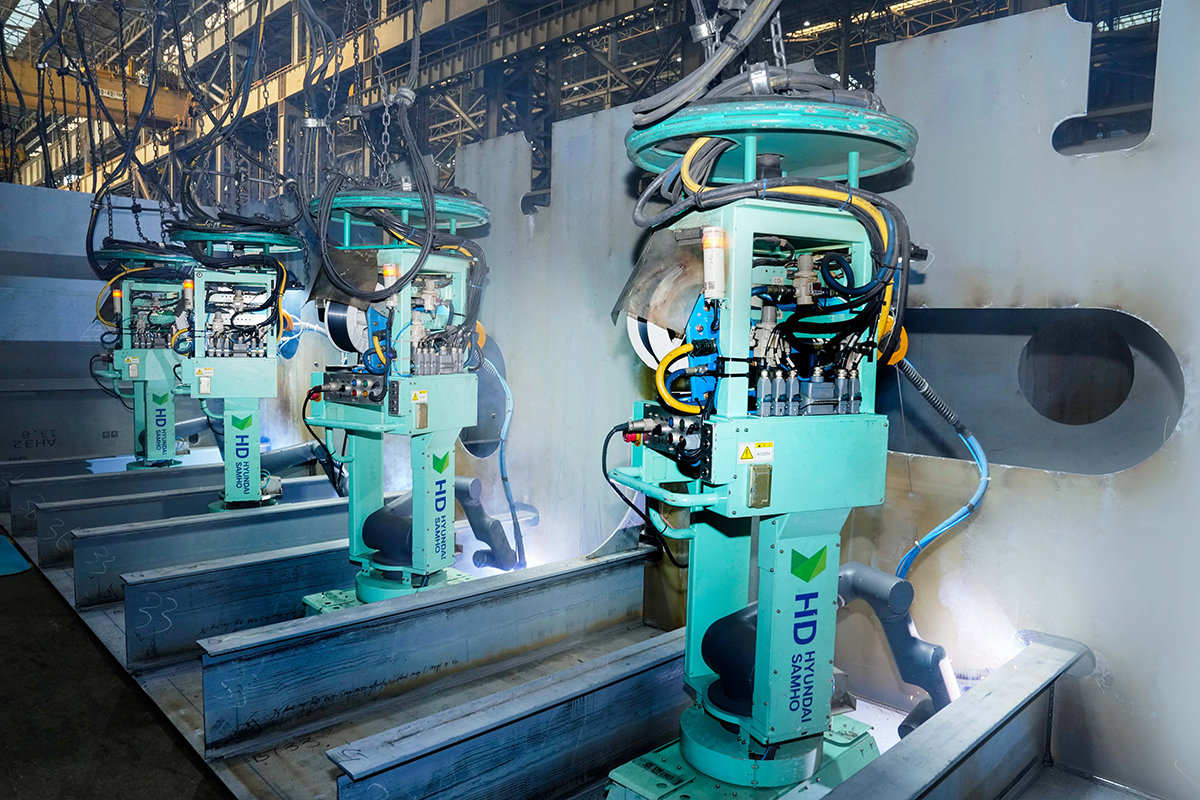
A view of AI welding robots welding steel plates for ships at the indoor worksite of the panel plant at HD Hyundai Samho Heavy Industries’ shipyard in Yeongam-gun, South Jeolla Province. After the introduction of a total of 90 of these robots, welding defects at the company have fallen to one-tenth, while production efficiency has risen by 15–20%. Provided by HD Hyundai Samho Heavy Industries
At the panel plant of HD Hyundai Samho Heavy Industries’ shipyard in Yeongam-gun, South Jeolla Province, recently visited, sparks were flying everywhere from steel plate welding. When moving closer to the steel plates to observe the process in detail, there were no workers. Instead, six robotic arms traveling along ceiling structures had taken their place. With welding torches attached to their ends, these robots were continuously throwing sparks as they fused large steel plates for ships into single units.
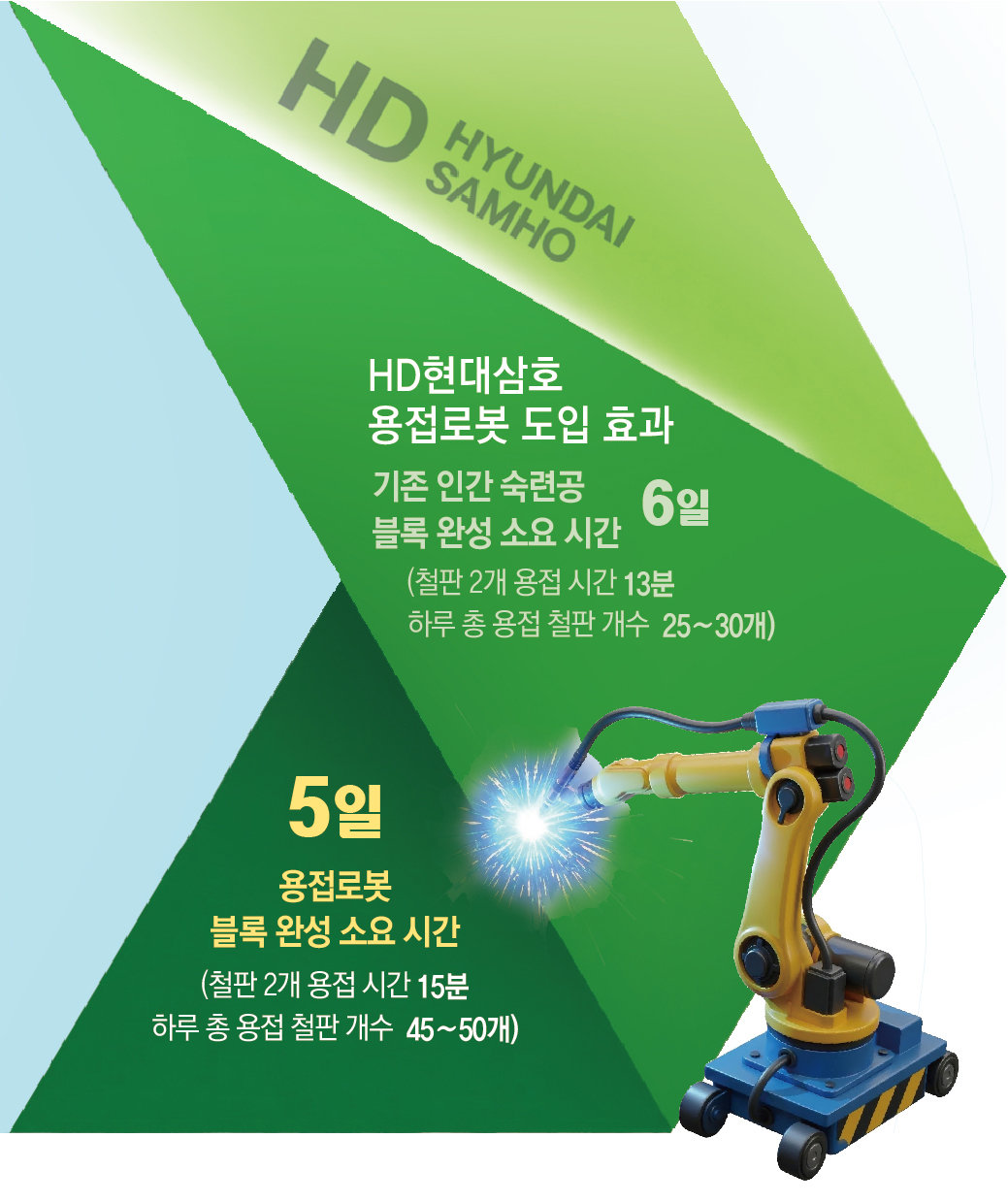
The time required for this type of “robot foreman” to weld two steel plates into one is about 15 minutes. This is slightly slower than a veteran human welder (13 minutes), but because robots work without rest, the total amount of work completed in a day can reach up to twice that of a person (50 plates). In particular, the ability to weld difficult corners (where horizontal and vertical surfaces meet) in addition to flat sections is a capability that, among global shipbuilders, only this company’s AI welding robots can claim.
The worker, called an “operator,” appeared only after the robot had completed one round of welding work up to the corners. When he entered work-related data into a game console-like control panel, the welding robot moved to the next location and descended. The operator then pressed the start button and left to oversee another production line. The welding robot, “without taking a break,” immediately began welding again as before.
● Welding robots take root in the shipbuilding industry
The reason worker intervention can be minimized in this way is that these are artificial intelligence (AI)-based robots. Drawing on vast training data, they “autonomously determine” and execute the entire welding process. Conventional, non-AI simple welding robots are machines that only follow pre-input up–down and left–right movement values, requiring constant human intervention and commands during operation.
HD Hyundai Samho Heavy Industries has assigned 10% of its indoor welding work to a total of 90 such AI-based welding robots introduced since 2023. As a result, production efficiency has increased by an average of 15–20%. Executive Director Seo Jeong-hun, head of In-house Work Division 1, said, “It normally takes six days to complete a single block (a steel plate unit that becomes part of a ship during assembly) through various processes, but since the introduction of welding robots, it takes five days.”
Welding has been regarded as the “domain of skilled workers” among the many demanding processes in shipbuilding. This is because each block has a different shape and weld lines are not uniform. Unlike the finished automobile industry, where processes are standardized and robot introduction is relatively easy, shipbuilding has industry-specific obstacles to automation, such as outdoor work. Nevertheless, in order to resolve chronic shortages of skilled workers and prevent serious industrial accidents, the introduction of robots has emerged as an essential task for the industry.
HD Hyundai Samho Heavy Industries, a shipbuilding affiliate of HD Hyundai that builds large commercial vessels and other ships, is at the forefront of introducing AI-based robots as it lays out its “shipbuilding automation” blueprint. Ultimately, the company plans to integrate AI robots across all indoor and outdoor work areas.
● “Eliminating worker-averse tasks with consistent quality”What HD Hyundai Samho Heavy Industries particularly emphasizes is not workforce replacement through robots, but the overall enhancement and equalization of quality. The company explains that its welding robots almost never make mistakes because they have been programmed with data on the welding speed, operating methods, and designs of “S-grade veterans” with the best on-site know-how. The robots also use backhand welding, the prevailing welding technique. The company began to clearly experience the effects of high quality from last year. Executive Director Ryu Sang-hun of the Automation Innovation Center added, “The effect of robot introduction is also a matter of ‘economies of scale,’ and stabilization was achieved once we began operating more than 50 units,” and “Inspection results show that quality has become consistently better.”
According to HD Hyundai Samho Heavy Industries, the welding quality of these robots, which surpasses that of most people, is improving not only the company’s performance but also employees’ working conditions. This is because defect occurrences have decreased to one-tenth of the level seen when humans did the welding. When a defect occurs, a worker must grind down the area and re-weld it, and this “grinding” work is so physically demanding that welders’ bodies shake, making it a task they avoid. Ryu said, “As defect situations have been greatly reduced, welders’ labor intensity has decreased and satisfaction has risen,” adding, “This is why we call these robots ‘collaborative robots’ inside the company.”
HD Hyundai Samho Heavy Industries builds 30–40 ships per year. Although it ranks second in business scale among HD Hyundai’s shipbuilding affiliates, it is playing a pioneering role within the group in robot adoption. The company is currently testing and plans to deploy robots for outdoor welding within the first half of this year (January–June). Based on HD Hyundai Samho Heavy Industries’ portfolio, HD Hyundai plans to build an AI- and robot-based intelligent autonomous shipyard by 2030.
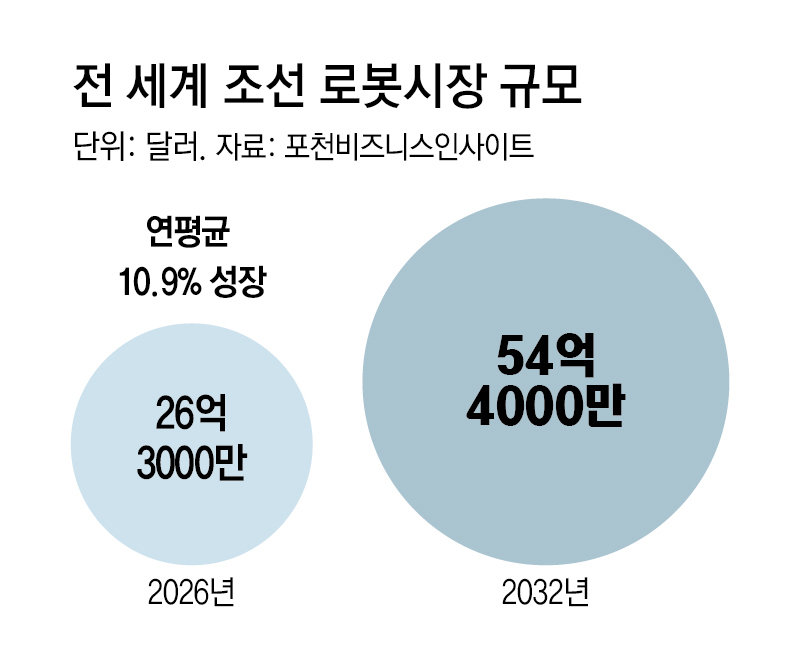
Other domestic shipbuilders are joining this trend. Hanwha Ocean aims to achieve 100% automation of welding work in the panel process at its Okpo Shipyard in Geoje, South Gyeongsang Province, by 2030. Samsung Heavy Industries is also developing AI welding robots and other systems in cooperation with Rainbow Robotics. According to global market research firm Fortune Business Insights, the size of the global shipbuilding robot market is projected to grow at a compound annual rate of 10.9%, from USD 2.63 billion this year to USD 5.44 billion in 2032.
ⓒ dongA.com. All rights reserved. Reproduction, redistribution, or use for AI training prohibited.
Popular News