As the age of marriage and childbirth continues to rise, the number of older infertility patients who experience multiple failed IVF procedures is increasing. As a result, not only the medical staff who treat infertility patients, but also the role of the IVF center researchers who directly fertilize and culture embryos has become crucial.
Against this backdrop, recent research outcomes from IVF centers at domestic infertility hospitals are drawing attention. By applying “PRP (platelet-rich plasma)” extracted from patients’ blood to the embryo culture process, researchers increased the pregnancy success rate of patients who had experienced multiple implantation failures by 1.8 times. The Dong-A Ilbo met with Heo Yong-soo, Director of Research at Seoul Maria Hospital, Hyun Chang-sub, Director of Research at Pyeongchon Maria IVF Center, and Yang Sung-ho, Director of Research at Songpa Maria, who led this study, to examine in detail the role of researchers in infertility treatment and the clinical results.
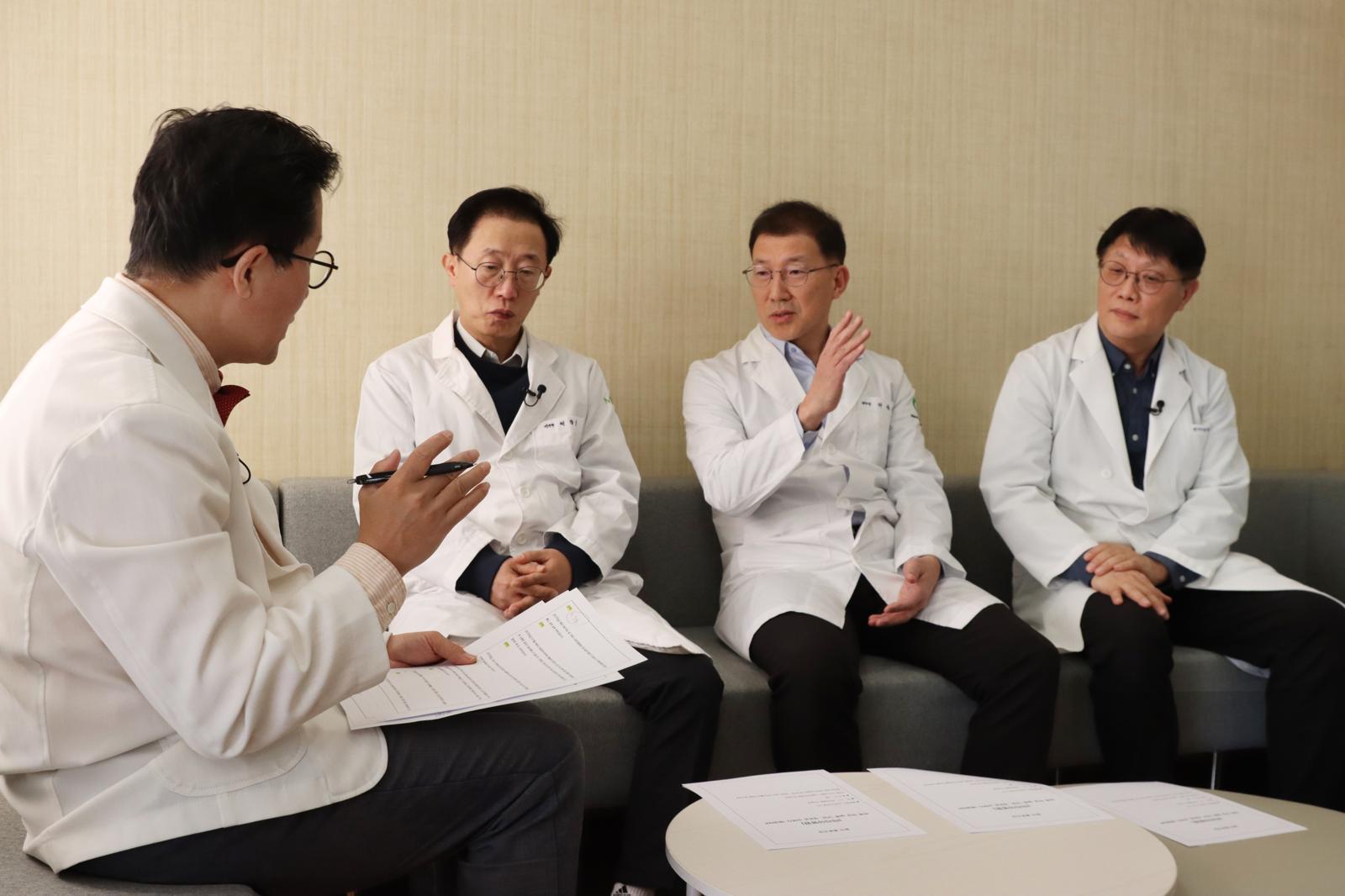
Medical news reporter Lee Jin-han of this newspaper (left) discusses research achievements with officials from Maria Hospital who are at the forefront of improving pregnancy success rates for infertility patients. From second left, Hyun Chang-sub, Director of Research at Pyeongchon Maria IVF Center; Heo Yong-soo, Director of Research at Seoul Maria; and Yang Sung-ho, Director of Research at Songpa Maria. Provided by Maria Hospital.
―What is the role of researchers in the field of infertility treatment?
▽Director Hyun=Researchers do not directly treat infertility patients, but in the hospital laboratory they fertilize sperm and eggs and culture embryos. How well an embryo grows has a major impact on pregnancy success, and researchers are the ones who observe the condition of embryos at the closest range.
―What has changed the most recently in the infertility treatment setting? ▽Director Heo=The age at which people attempt pregnancy has clearly increased compared with the past. Generally, people over 65 are called elderly, but in the infertility field, those aged 35 and older are considered advanced maternal age. In practice, there are many patients in their late 30s to early 40s. As age increases, both the number and quality of oocytes decline, so even if fertilization occurs, it is common for embryos not to grow well or for implantation to fail.
―Did this reality become the starting point for the study? ▽Director Hyun=On the ground, there are quite a number of patients who experience repeated IVF failures. There was even a patient who tried 23 times but failed. From the researchers’ perspective, as the embryo culture process is repeated, there is constant concern about whether “there might be a way to provide even a little more support at the stage of culturing the fertilized egg.” Out of such concerns came the idea of changing the very environment in which the fertilized egg grows, which became the starting point of this research.
―What is PRP, and how was it used in embryo culture? ▽Director Heo=PRP stands for “platelet-rich plasma.” Platelets contain many substances necessary for cell growth and recovery, and PRP is already used in other regenerative medicine fields. In this study, for patients with particularly difficult cases who had experienced multiple implantation failures, a small amount of PRP obtained from the patient’s own blood was added to the culture medium used to grow embryos, and its effects were evaluated.
―What were the actual clinical research results? ▽Director Hyun=In patients who had experienced implantation failure three or more times, the application of culture PRP resulted in a 1.8-fold higher pregnancy success rate compared with the use of standard culture medium. There were cases in which the condition of the embryos improved markedly, and meaningful differences were also observed in implantation and pregnancy maintenance. Safety was also a critical aspect, so the study was conducted after fully explaining it to and obtaining consent from participating patients. The babies born were followed up for one year. All children confirmed to date are healthy.
―For which patients can culture PRP be beneficial? ▽Director Yang=It does not apply to all patients, but for some it can provide an additional opportunity to increase implantation probability. Although this study focused on older patients who had experienced repeated implantation failure, it can be extended to other cases. It can be attempted in cases where oocytes do not develop well, fertilization does not occur readily, or immature oocytes are retrieved—cases that have traditionally been difficult to treat. For patients whose options are gradually narrowing in the course of attempting pregnancy, this represents a new approach at the culture stage that is meaningful.
―What are the future research plans? ▽Director Heo=Culture PRP is not a universal solution that can be applied to all infertility patients. However, it can offer another possibility to patients whose options are limited due to repeated pregnancy failures. Going forward, the team plans to continue research to identify which components within PRP affect embryo growth and to elucidate the specific mechanisms of action.
▽Director Yang=To date, the research team has focused on improving the culture environment, based on the judgment that it is important to make the environment in which the fertilized egg grows as similar as possible to the mother’s body. Building on our culture experience and know-how, we plan to closely examine in which patient groups the effects are more pronounced and how improvements in the culture environment influence pregnancy outcomes. Through this, we hope to contribute to expanding the range of treatment options.
ⓒ dongA.com. All rights reserved. Reproduction, redistribution, or use for AI training prohibited.
Popular News