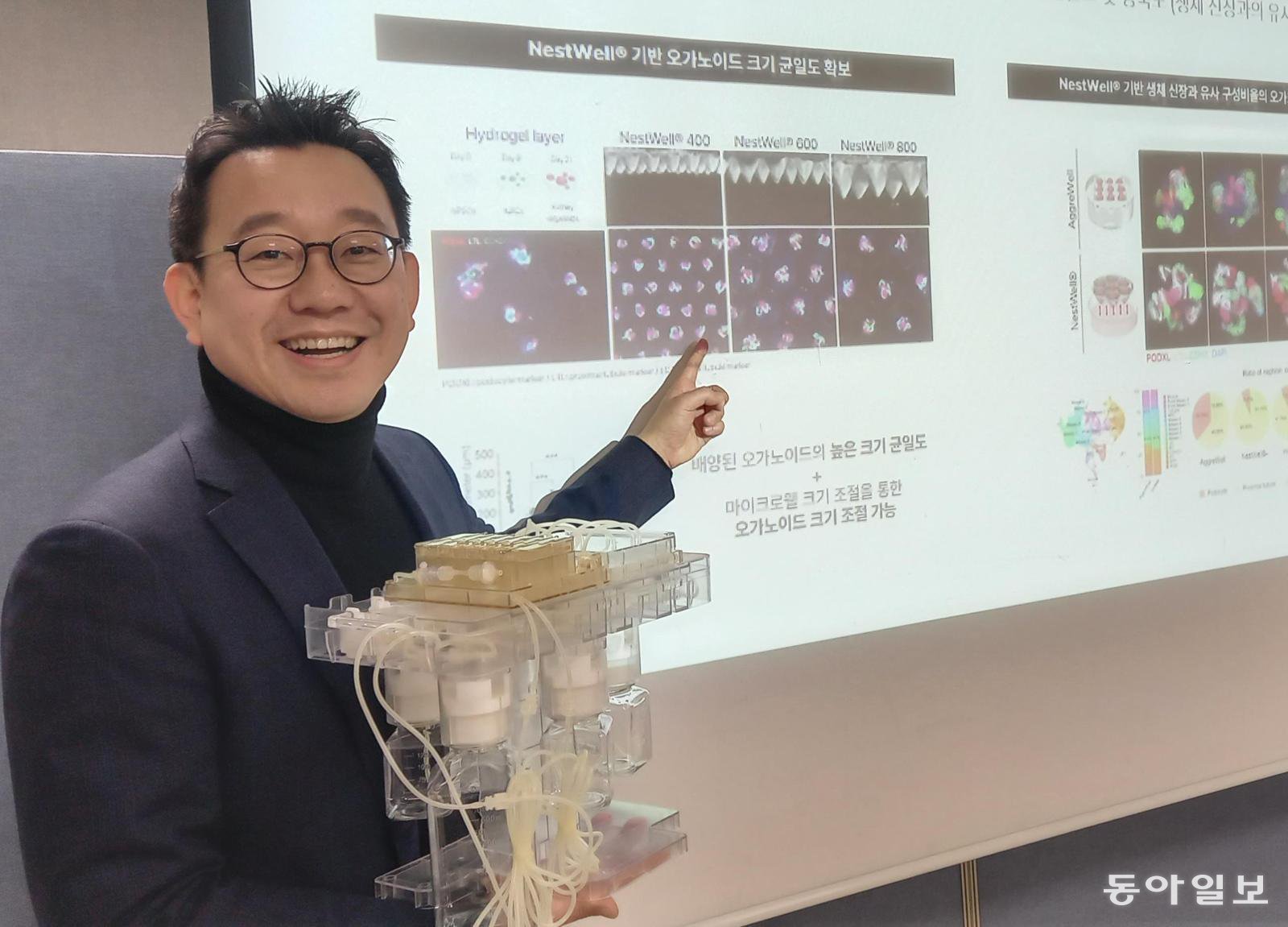
On 9 January, Celloid CEO Kim Dong-sung explains well-cultivated mini organs while holding a three-dimensional culture automation system at the company’s research lab in Seocho-gu, Seoul. Mini organs grown in this system show better maturation of vasculature and tissue function compared with conventional methods, and exhibit less variability between samples.
“At first, we ourselves did not know whether to use this membrane to make a better water-filtration filter or to make functional textiles. What we did have for sure was a single technology: making a ‘membrane that is both highly permeable and strong’.” This is how nano-manufacturing mechanical engineer Kim Dong-sung, CEO of Celloid (49, professor at POSTECH), described the starting point of the business. What Kim initially focused on was not cells, but a nano-fiber membrane—more precisely, a permeable membrane woven from fine fibers. This technology was selected in 2016 as one of the Top 100 Excellent National R&D Outcomes.
The direction was set by the reality faced in the bio research lab with which he was collaborating. When cells were mixed into Matrigel, an animal-derived gel, to grow organoids (organ-like structures or mini organs), their size and level of maturation were all different, and the outcomes of culture varied depending on who performed the work. Meeting at the research lab in Seocho-gu, Seoul, on 9 January, Kim said, “It was a challenge worth taking on, because solving it could accelerate the production of organoids that can replace animal experiments.”
● A “breathing well” that did not exist in the world
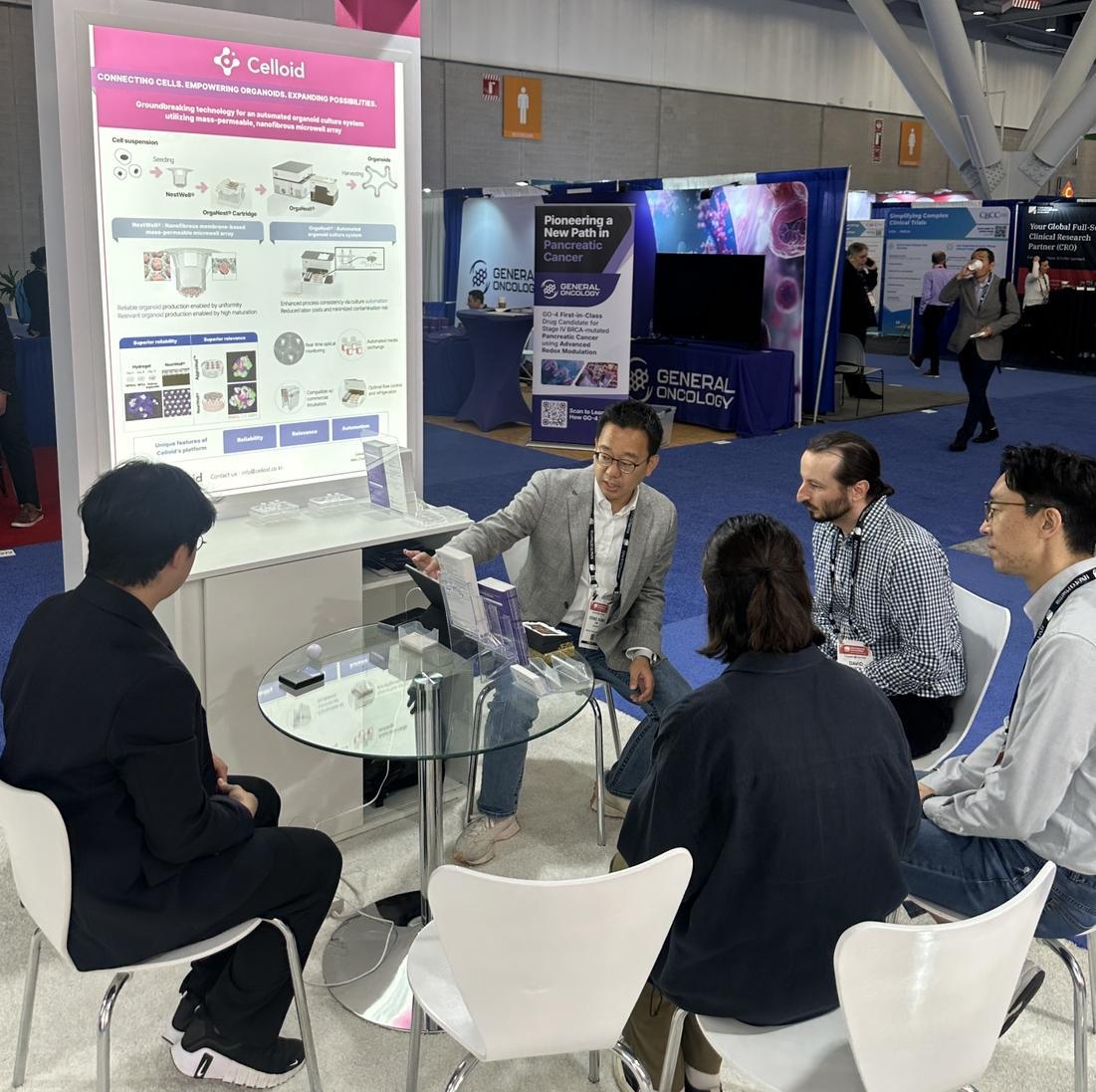
Celloid CEO Kim Dong-sung and employees explain the performance of the company’s three-dimensional culture system at the BIO USA exhibition held in Boston, United States, in June last year. Provided by Celloid
The problem that Celloid aims to solve is simple yet difficult. Organoids themselves are already widespread in research labs worldwide. However, there is no technology that can mass-produce high-quality organoids uniformly. In most cases, three-dimensional (3D) culture, which enables cells to grow in three dimensions through differentiation and self-organization, relies on hydrogels (polymer networks filled with water) or micro-wells (small well-shaped containers) with closed bottoms. Organoids cultured in this way exhibit large variations in size and maturation.
Kim’s first answer to this was a product called NestWell, a permeable micro-well made of nano-fiber membrane. It has micro-pores that allow oxygen, nutrients, and waste products to pass through, while preventing cells from escaping. Cells can aggregate three-dimensionally without suffocating. Here, Kim’s specialty—precision nano-manufacturing technology—comes into play. By designing the well (pit) opening diameters at 500, 800, and 2,000 micrometers (㎛), respectively, the system helps produce organoids whose size is effectively stamped out according to the design specification.
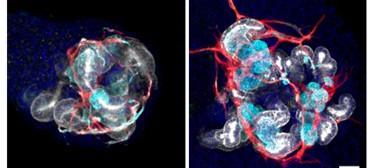
Comparison of kidney mini organs. On the right is the one cultured by Celloid, in which blood vessels and micro-tissues are visibly much more subdivided. Provided by Celloid
This structure demonstrated its performance in a kidney organoid research paper published in 2024 in Nature Communications, a leading multidisciplinary science journal. Kidney organoids made from human induced pluripotent stem cells (hiPSC) grew remarkably well in NestWell. The ratio of cell types present in human kidneys and the nephron structure (the functional unit of the kidney) were reproduced in a similar manner. The organoids were grown to a level of maturity where each cell type could perform its function. The study also showed that changing the well size allowed the organoid size to be adjusted as desired. The fluorescent images in the paper, showing neatly arrayed mini kidneys, visually represented, in Kim’s words, “mini organs produced on an assembly line.”
● Creating a 3D culture automation systemKim’s second answer is a product called OrgaNest, a perfusion-based automatic culture system. In this system, NestWell is mounted inside a cartridge, and culture medium is continuously infused and withdrawn through micro-tubes about 1 mm in diameter, allowing long-term automatic operation. The task of manually removing plates and changing culture media with pipettes, previously performed by researchers, is handled instead by motors and sensors within a closed circuit. This reduces the risk of contamination and cell loss, and eliminates variability between operators.
The difference from conventional methods is evident in the numbers. In the case of liver organoids, the effective yield from a 12-day culture process is 10–25% using the conventional Matrigel method, whereas using NestWell and OrgaNest increases it to 90%. This improvement in organoid production yield directly translates into lower production costs. “For liver organoids, production costs can be cut by about 62%, and for the pancreas, by 52%,” Kim said.
The development of automated 3D organoid culture platforms is increasing, mainly among global equipment manufacturers and startups. However, Celloid is the first to offer a commercial solution that combines micro-wells lined with a permeable membrane and closed perfusion culture to mass-produce highly uniform organoids.
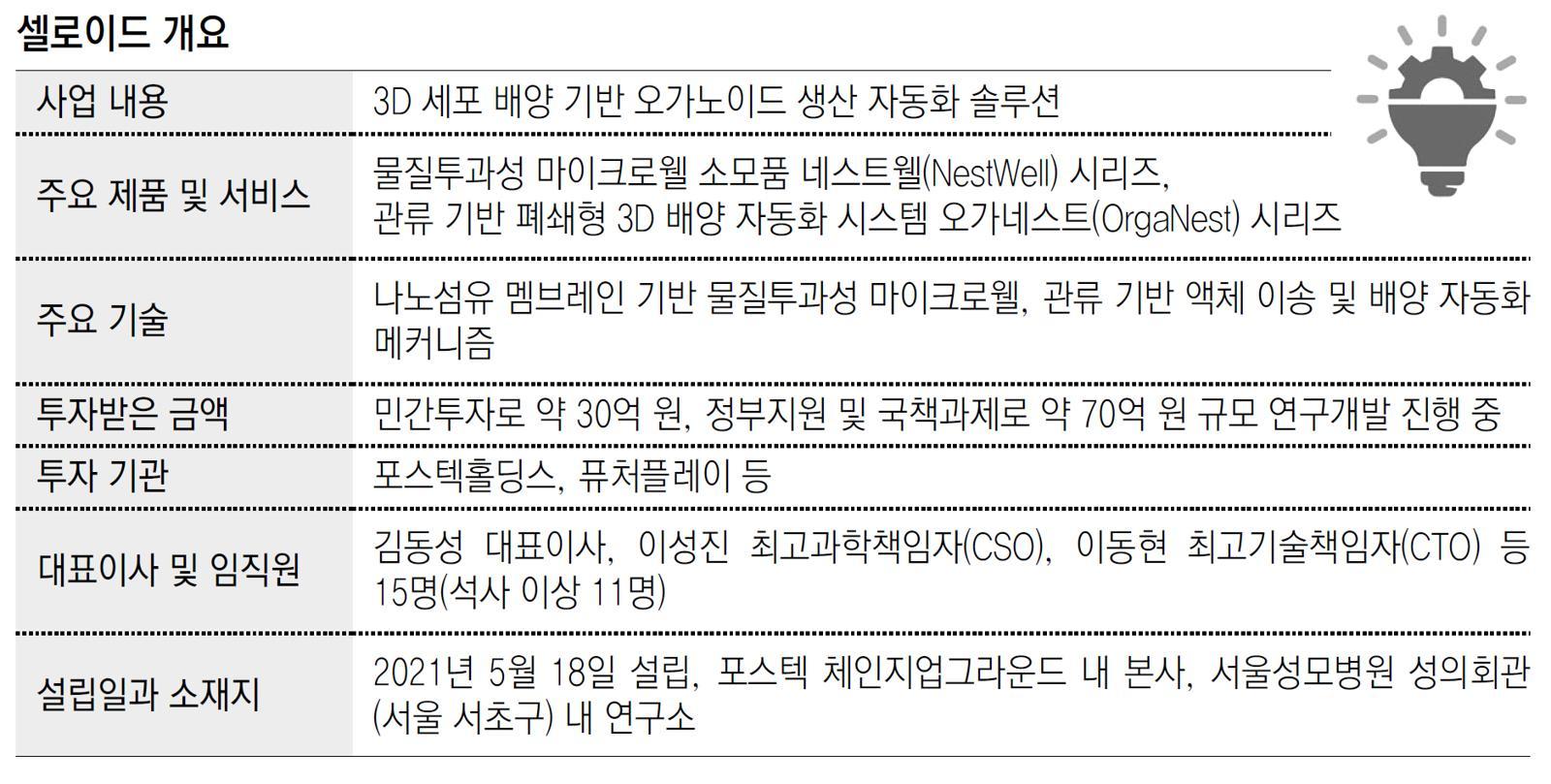
● From paper to startupCelloid was spun off on 18 May 2021 from the Materials Processing and Integrated Bio-Systems Lab at POSTECH. Kim is a Mu-Eun-Jae Distinguished Professor in the Department of Mechanical Engineering and the Graduate School of Convergence Science and Technology (Medical Science major) at POSTECH, and a member of the Young Korean Academy of Science and Technology. He is an engineer who has linked nano materials and forming technologies, such as nano-fiber membranes, with biohealth systems.
After securing core technologies in nano-fiber membranes and permeable micro-well forming, he chose organoid and cell therapy manufacturing processes as the fields where these technologies could be used most effectively. “We decided not to stop at a few papers, but to create a standard process for the market,” Kim said.
Following this decision, his student, Chief Science Officer (CSO) Lee Sung-jin, took charge of developing the 3D cell culture platform, while Chief Technology Officer (CTO) Lee Dong-hyun, who specializes in automation and robotics, took responsibility for automation solutions and joined the effort. Engineering specialists in nano-manufacturing, robots and motors, and sensors and tubing formed a team with biologists who handle cells, jointly designing the “breathing micro-well” and the “incubator that matures cells.” The Celloid corporate research institute ranked in the top 10% of domestic corporate research labs in an R&D capability assessment by the Korea Industrial Technology Association. Of the company’s 15 employees, 11 hold a master’s degree or higher, and experts in 3D cell culture, automation, AI, and material synthesis are evenly distributed across the organization.
● Preparing, with St. Mary’s Hospital, for a world “after animal testing”Celloid’s current base is the POSTECH–Catholic University Bio-Medical Institute of Technology, located in the Clinical Research Building at Seoul St. Mary’s Hospital. There, the company cultivates organoids, one of the key raw materials used in a global research-driven hospital where advanced medical techniques are applied and new drug candidates are discovered.
Seoul St. Mary’s Hospital has clinical capabilities in advanced regenerative medicine and cell and gene therapies. Together with hospital researchers, Celloid conducts experiments on drug response, toxicity evaluation, and the potential for regenerative treatment. The reason Celloid chose this location is clear. To credibly say that animal testing can be reduced, the company believes it must be embedded in a field setting that handles human cells and patient data.
Celloid is conducting joint research and commercialization of cardiac organoids with a startup spun off from the Stanford University School of Medicine in the United States. It also supports the culture of organoids for companies such as IppCell, Organoid Science, and EdmicBio, which are developing animal alternatives and advanced regenerative medical technologies using stem cells and organoids.
In Korea, the “Act on the Development, Dissemination and Promotion of the Use of Alternative Methods to Animal Testing” has been proposed, and institutionalization is gaining momentum with the launch of bodies such as the K-Organoid Consortium, involving the Ministry of Food and Drug Safety and the Korea Biomedicine Industry Association, and the Organoid Standards Initiative (OSI). Kim stands at the center of these new standard-setting discussions as head of the OSI Technology Infrastructure Subcommittee under the National Institute of Toxicological Research of the Ministry of Food and Drug Safety, and as the inaugural director of the K-Organoid Consortium. “Rather than chasing regulations, I hope that the culture protocols we develop will someday become the regulatory standard,” he said.
The company is still in the red, and systems related to organoids and animal alternative testing have yet to be fully established. Competition will also become more intense. Nonetheless, Kim said, “To eliminate animal testing from the drug development process, it must be possible to economically produce reliable organoids that can be used in experiments instead of animals,” adding, “We want to be the first to open that era.”
ⓒ dongA.com. All rights reserved. Reproduction, redistribution, or use for AI training prohibited.
Popular News