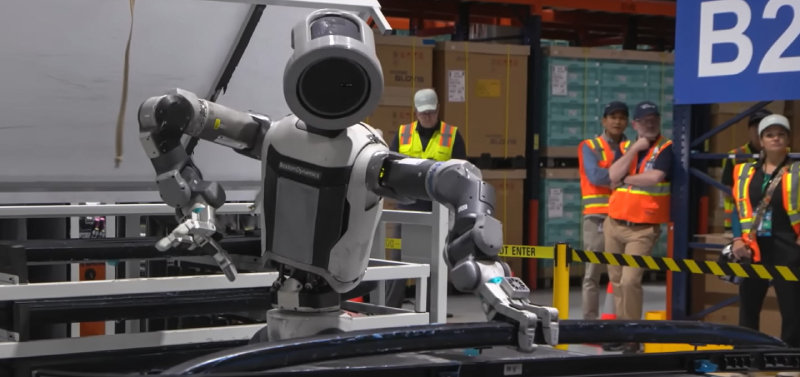
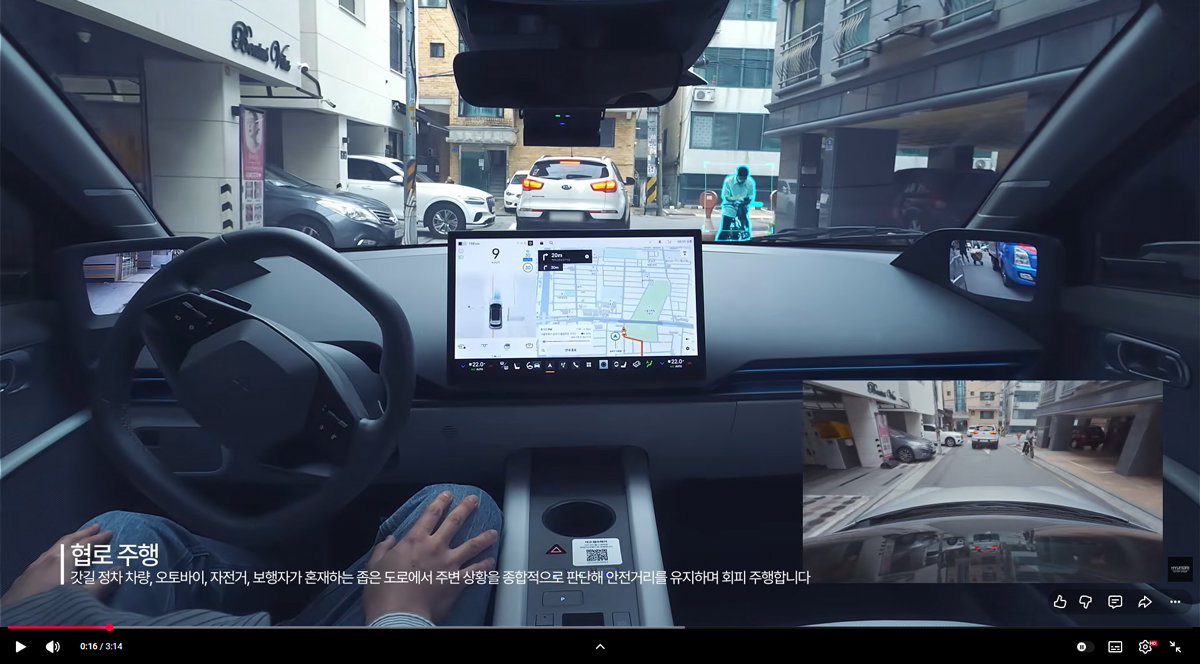
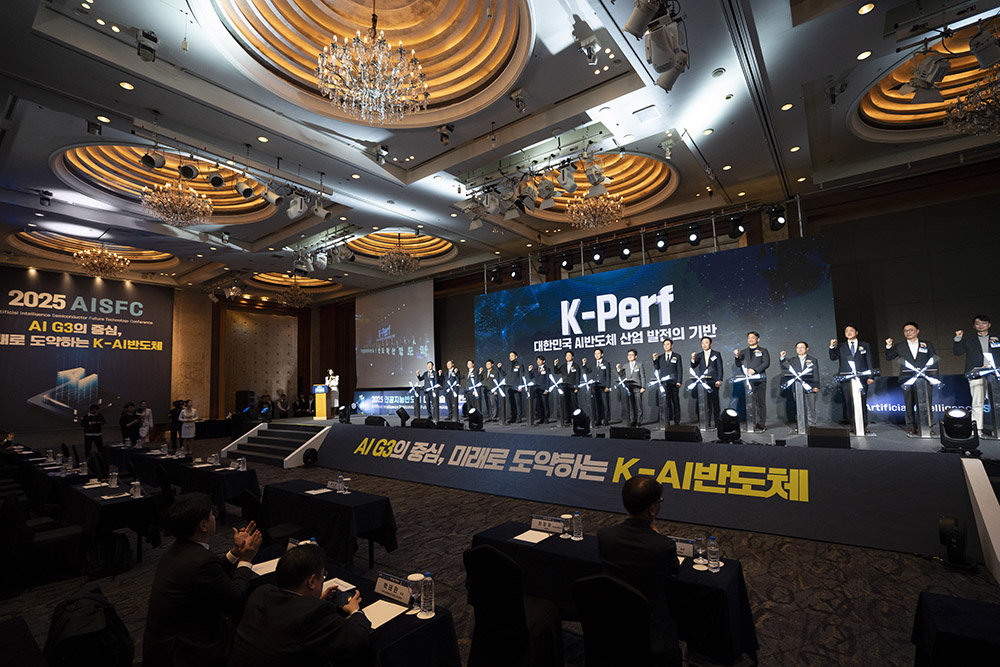
Artificial intelligence (AI) robots are transforming production sites in South Korea. There is a projection that this year will mark the first year in which AI robots go beyond simple tasks and take on high-difficulty work. The photo shows “Atlas,” a humanoid robot developed by Boston Dynamics, the Hyundai Motor Group’s robotics subsidiary, being test-operated at a logistics warehouse in Savannah, Georgia, United States. Provided by Hyundai Motor Group
“Robots will make working environments safer, faster, and more scalable.”
This was the point emphasized when Hyundai Motor Company unveiled the humanoid robot “Atlas” at the Consumer Electronics Show (CES) 2026, the world’s largest information technology (IT) and home appliance trade fair, held in Las Vegas, United States, on the 5th (local time). Hyundai Motor Group plans to deploy this robot at its Metaplant America (HMGMA) in the state of Georgia in 2028. A quadruped walking robot, “Spot,” is already working alongside people there to conduct quality inspections. Two years from now, a future factory in which Atlas, Spot, and human workers collaborate in tandem will move into full swing.
On the 8th, a Dong-A Ilbo reporting team visited 10 major manufacturing sites in South Korea and found that AI robots were already transforming the country’s manufacturing sites. Traditional smokestack factories are being turned into battlegrounds for cutting-edge AI robots.
Domestic shipbuilders have introduced AI welding robots, raising productivity by more than 20% and more than doubling work speed compared with conventional simple robots. Samsung, LG, and SK are using AI machines in product development and production stages to virtually manufacture finished products and then predict potential problems such as design defects and faults.
Overseas, Germany’s BMW Group has introduced AI robots that collaborate with humans on tasks such as body assembly and precision parts installation, boosting work speed by up to 400%. China has already entered the stage of mass-producing humanoids. The International Federation of Robotics (IFR) has analyzed that the number of AI robots deployed on-site has doubled over the past 10 years. Ito Takayuki, president of IFR, projected that “2026 will be the first year in which the robotics industry enters a very dynamic phase.”
Global market research firm Market US forecast that “AI factories,” where AI and robots are combined, will grow to USD 1.0215 trillion (about KRW 1,475.7 trillion) by 2032. In last year’s economic growth strategy, the government stated that “physical AI (such as AI robots) will leap to become number one in the world.” It projected even greater growth than for AI, for which it has set the target of becoming third globally.
At present, “factory-type AI robots” that have only arms or move on wheels dominate domestic manufacturing sites, but humanoids such as Atlas are expected to roam AI factories in the future. Jensen Huang, CEO of NVIDIA, recently said at CES that “the ChatGPT moment for physical AI has arrived.” Tesla CEO Elon Musk said at a forum last year that AI robots will be deployed across all areas and that “in 10–20 years, work will be nothing more than a choice.”
ⓒ dongA.com. All rights reserved. Reproduction, redistribution, or use for AI training prohibited.
Popular News