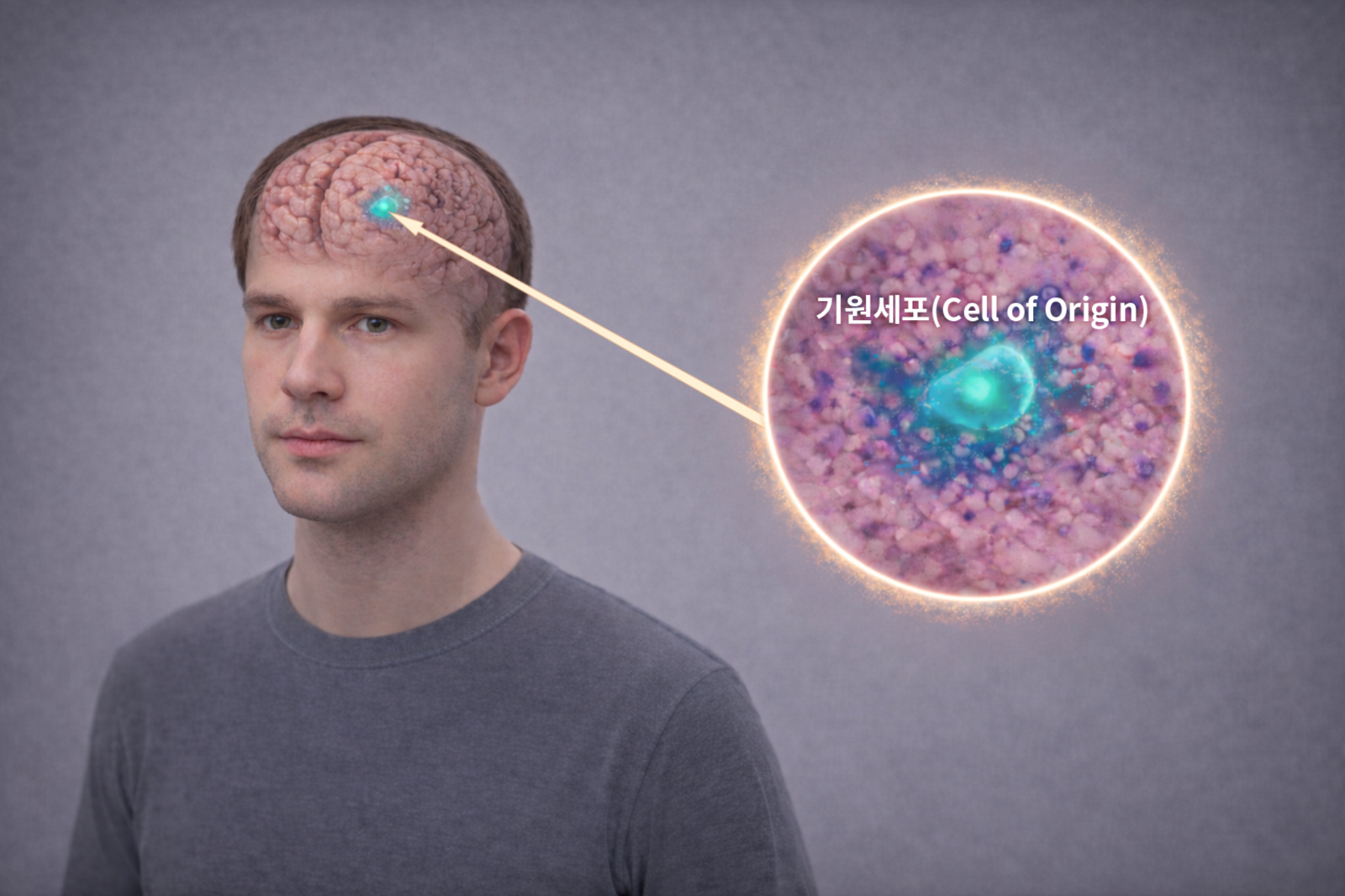
A research team from KAIST and Yonsei University Severance Hospital has for the first time shown that intractable brain tumors common in younger people originate from “founder cells” in the brain that appear normal. Image created with generative AI. Provided by KAIST
A domestic research team has, for the first time worldwide, identified that an intractable brain tumor common among young adults begins within brain tissue that appears normal. The finding is expected to open a new path for early diagnosis of brain tumors and treatments that suppress recurrence.
A joint research team led by Professor Lee Jung-ho of the Graduate School of Medical Science and Engineering at KAIST and Professor Kang Seok-Gu of the Department of Neurosurgery at Yonsei University Severance Hospital revealed that IDH-mutant glioma originates from “glial progenitor cells (GPCs)” present in normal brain tissue. Glial progenitor cells are precursor cells that differentiate into glial cells of the brain; they are also present in the adult brain and are involved in neural regeneration and recovery from demyelinating diseases. The research results were published on 8 January (local time) in the international journal Science.
IDH-mutant glioma is the most common malignant brain tumor in young adults under 50 years of age. It is a refractory brain cancer that is difficult to treat due to its high recurrence rate. Until now, treatment has focused on removing visible tumor masses, but the precise origin of the tumor had not been identified.
The research team conducted a detailed analysis of tumor tissue and the surrounding normal cerebral cortex obtained through extensive resection surgery. They confirmed that brain tissue that appears normal already harbors “founder cells” carrying IDH mutations. This is the first evidence that malignant brain tumors do not suddenly arise at a specific point in time, but instead have already begun within normal brain tissue and progress slowly over a long period.
The team considered that the discovery of founder cells could provide a clue to explaining the cause of recurrence. Previously, recurrence was thought to result from residual tumor tissue that had not been completely removed during surgery and subsequently regrew.
In some patients, the recurrent tumor was analyzed to have arisen from a lineage closer to the founder cells in the normal brain than to the initial tumor. This implies that in order to reduce recurrence, it is necessary to consider not only the tumor mass but also the root where the tumor originated.
Using “spatial transcriptomics,” a technique that visualizes where genes are active, the research team confirmed that the founder cells are glial progenitor cells in the cerebral cortex. They also succeeded in reproducing the process of brain tumor development in an animal model by introducing the same genetic mutations as in patients into glial progenitor cells in mice. By demonstrating that “glioblastoma” and “IDH-mutant glioma,” though both brain cancers, have completely different cells of origin and starting locations, they showed that the developmental processes of brain tumors differ by tumor type.
Professor Kang stated, “A brain tumor may not necessarily start at the site where the tumor mass becomes visible,” adding, “An approach that directly targets the founder cells and sites of origin according to the subtype (type) of brain tumor will provide crucial clues that can change the paradigm of early diagnosis and treatments to suppress recurrence.”
Postdoctoral researcher Park Jung-won of the KAIST Graduate School of Medical Science and Engineering said, “Even if this study does not immediately change treatment strategies, it is hoped that it will serve as an opportunity to view recurrence not as an ‘inevitable fate’ but as a phenomenon that can be understood and addressed.”
Christopher Mount, a professor at Harvard Medical School in the United States, wrote in a commentary in Science that “this study will enhance understanding of IDH-mutant glioma and contribute to improving therapies.” KAIST faculty start-up company Sovagen is developing RNA-based drugs to suppress the evolution and recurrence of IDH-mutant brain tumors based on these research findings. Severance Hospital is also pursuing the development of technologies for detecting and controlling early mutant cells.
ⓒ dongA.com. All rights reserved. Reproduction, redistribution, or use for AI training prohibited.
Popular News