Huawei Korea shared the results of its talent development programs conducted over the past 10 years and presented a roadmap to expand its efforts to foster Korean talent going forward. In addition, the company is expected to accelerate its push into the Korean market by launching AI data center solutions next year, including its latest artificial intelligence (AI) chip, the “Ascend 950.”
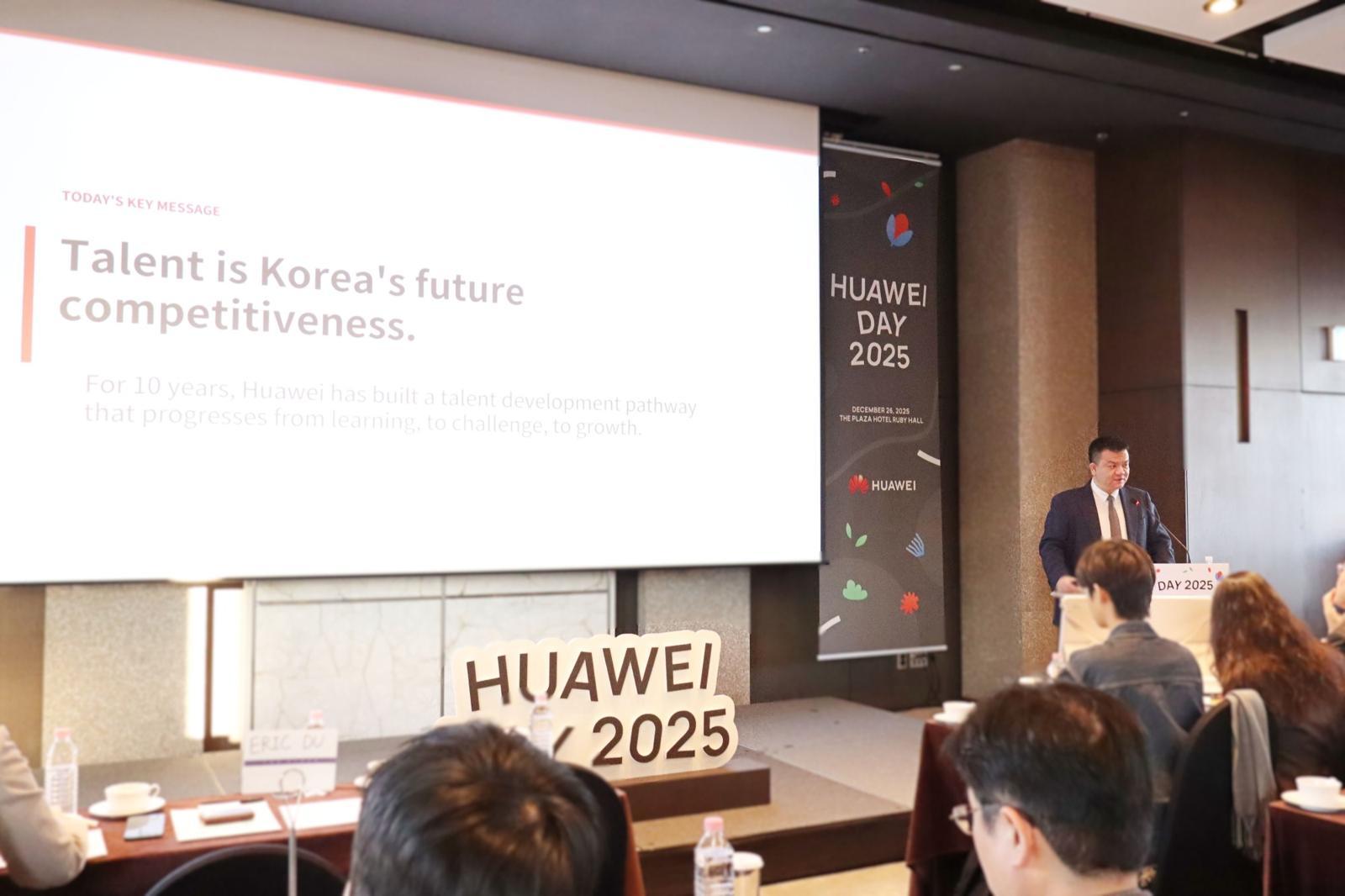
Balian Wang, CEO of Huawei Korea / Source = ITDongA
On December 26, Huawei Korea held “HUAWEI DAY 2025” at The Plaza Hotel Seoul. The event was organized to present the operation and cooperation achievements of its talent development programs, namely ▲Huawei ICT Academy ▲Huawei ICT Competition ▲Seeds for the Future. Starting with an opening address by Balian Wang, CEO of Huawei Korea, and a welcome speech by Hwang Seung-hoon, Dean at Dongguk University, professors from domestic universities and students participating in the programs shared the outcomes of industry-academia collaboration and on-site experiences through their presentations.
Global talent development program ‘Seeds for the Future’Huawei Korea positions talent cultivation as a core value and plans to continue investing in this area. CEO Balian Wang stated, “Huawei invests more than 25% of its annual revenue in research and development (R&D),” adding, “We will convert our accumulated knowledge into platform capabilities and contribute to fostering ICT talent in Korea.” He went on to say, “In 2026 as well, we will actively support Korean talents so they can gain practical experience that is difficult to obtain in the classroom and achieve tangible results.”
He also remarked, “Human talent is Korea’s core competitiveness, and the way for a technology company to gain the trust of Korean society lies in long-term investment in talent development rather than short-term results,” explaining, “Huawei’s programs are not one-off; they are organically connected so that talents can grow step by step.”
In practice, Huawei Korea has supported more than 19,000 students to date through its three major programs, working with over 420 institutions and 500 universities in 142 countries worldwide. In Korea, it has supported around 7,000 students over the past three years. Huawei ICT Academy provides systematic, theory- and practice-based education. The Huawei ICT Competition serves as a venue to verify students’ capabilities. Seeds for the Future helps expand ICT competencies by offering experience in practical training, collaboration, and project execution in a global environment.
Challenging the AI chip market next year…differentiation through a cluster strategy
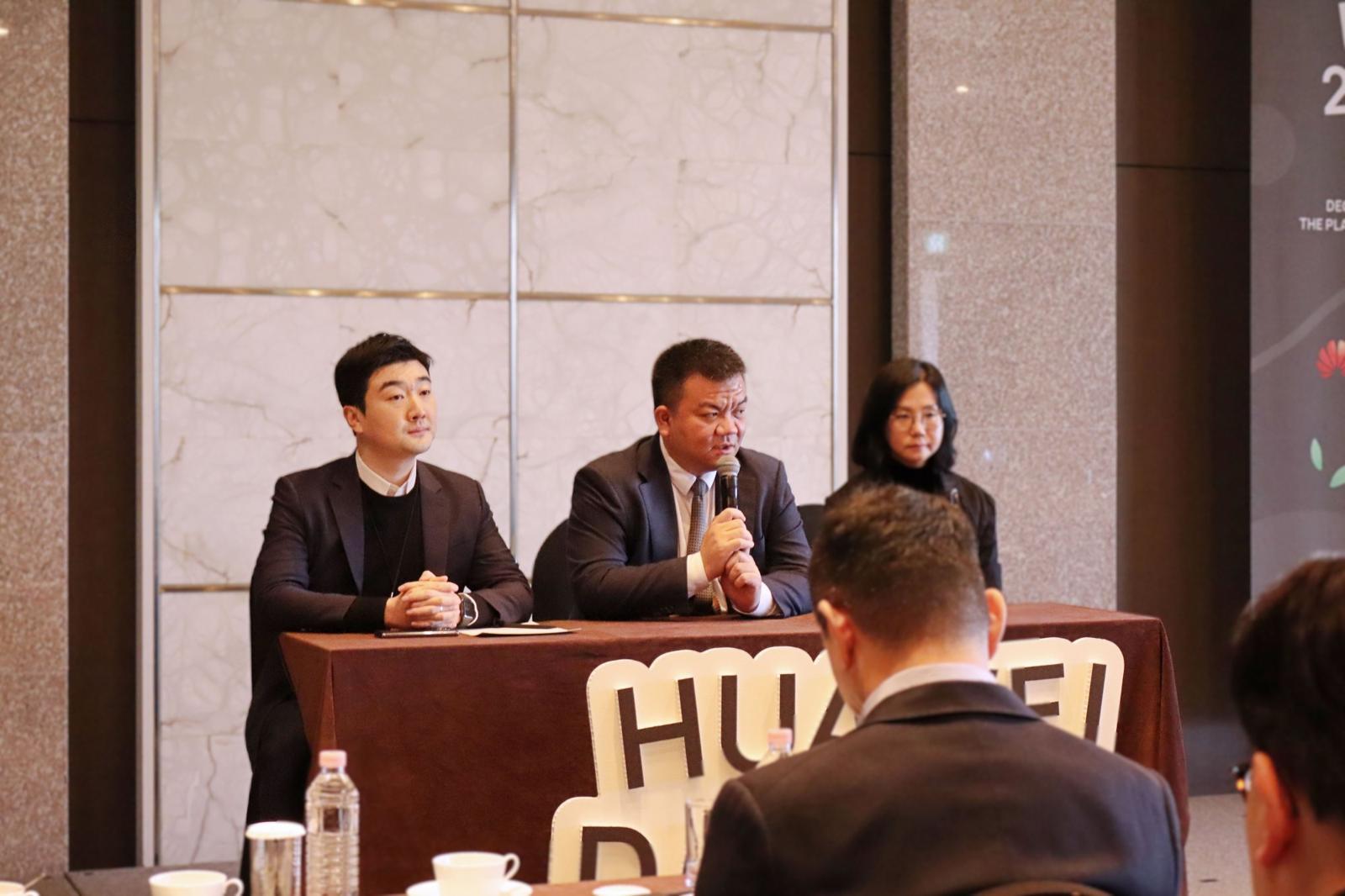
Balian Wang (center), CEO of Huawei Korea, and Eric Du (left), Vice President of Huawei Korea / Source = ITDongA
On the same day, Huawei Korea also unveiled its AI data center solution strategy that includes the AI chip “Ascend 950,” scheduled for release next year. The company aims to offer Korean enterprises a new option in an AI infrastructure market currently dominated by Nvidia. CEO Balian Wang said, “We will provide solutions not as a single chip product, but in a cluster form that combines nodes, storage, and networks,” adding, “This integrated approach can have advantages in performance optimization compared to competitors’ methods of selling single servers.”
The Ascend 950 is the latest AI chip that was revealed at the Huawei Connect Forum in September. It is known to be equipped with Huawei’s self-developed silicon architecture and high bandwidth memory (HBM). Huawei’s strategy is to secure competitiveness not by relying solely on the performance of individual chips, but by bundling network and storage facilities and offering end-to-end solutions that encompass both hardware and software.
However, the company refrained from disclosing specific sales methods or partnership plans. CEO Balian Wang said, “There are customers and partners we are in discussions with, but as we are still at an early stage, it is difficult to talk about it,” adding, “Huawei aims to go beyond simply supplying AI servers to accelerating service applications, and in the process of providing integrated services, there may be no need for separate partners,” leaving the possibility open.
The company also shared its vision for expanding the software ecosystem. Huawei Korea plans to provide its self-developed operating system “HarmonyOS” in Korea to foster cooperation with domestic partners. HarmonyOS is operated through an open-source community, and Huawei Korea will focus on supporting ecosystem formation. Meanwhile, CEO Balian Wang added, “HarmonyOS is an operating system that can be applied not only to smartphones but also to various devices such as smart home appliances,” and “There are no plans to launch HarmonyOS-based smartphones in the Korean market in 2026.”
ITDongA reporter Kim Ye-ji (yj@itdonga.com)
ⓒ dongA.com. All rights reserved. Reproduction, redistribution, or use for AI training prohibited.
Popular News