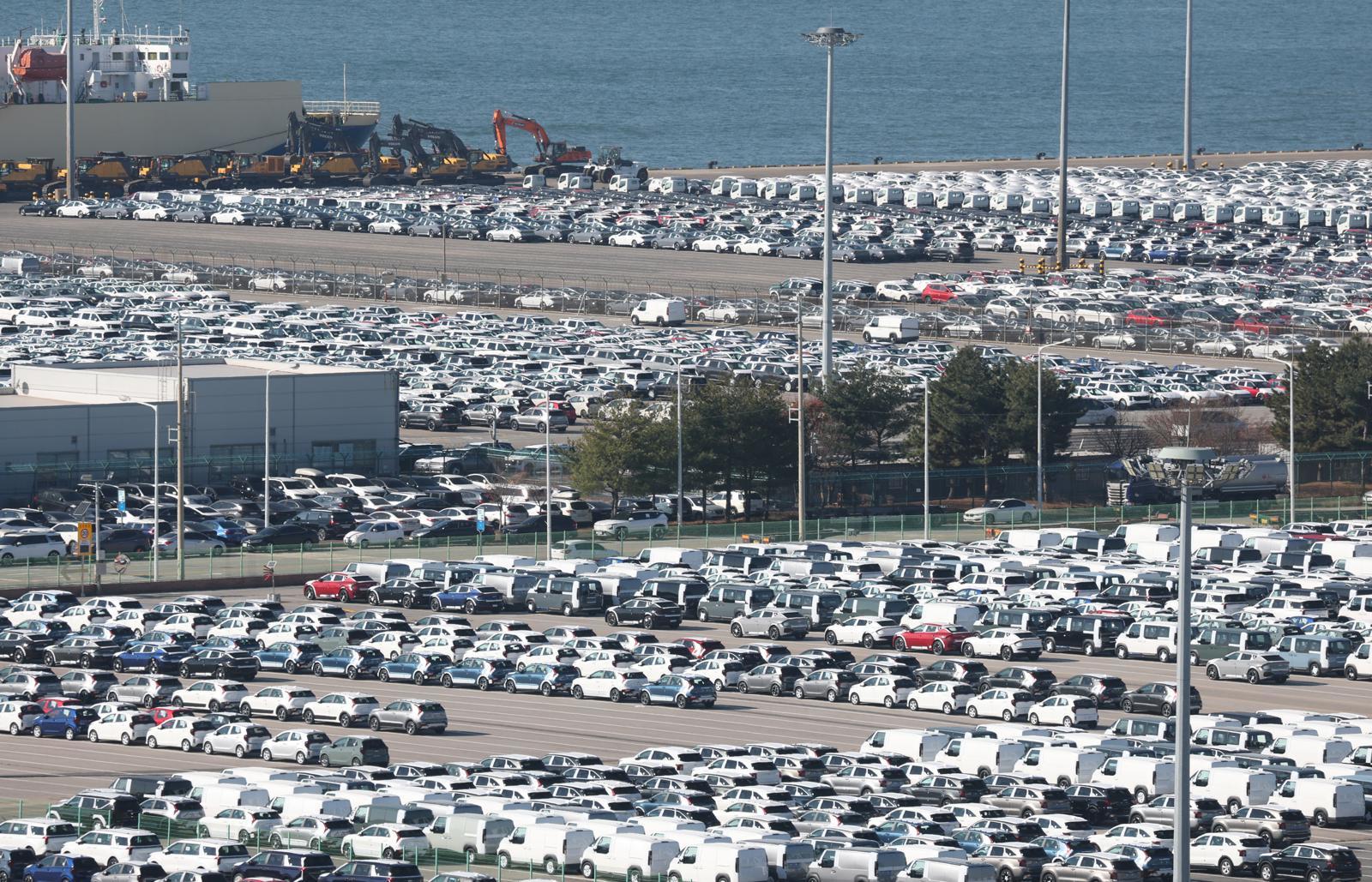
Export vehicles are parked at Pyeongtaek Port in Poseung-eup, Pyeongtaek-si, Gyeonggi Province, on the 4th. A notice by the U.S. government on the reduction of tariffs on Korean-made automobiles to 15% was published in the Federal Register on the 3rd (local time). The notice will be officially published and take effect on the 4th local time, and the tariff reduction will be applied retroactively to imports from November 1, 2025 onwards. 2025.12.4/News1
From January to November this year, Korea’s automobile exports surpassed USD 66 billion, leaving only about USD 5 billion to reach a new annual record high. Although exports to the United States declined sharply due to factors such as U.S. tariffs on automotive products, exports to third markets including Asia, Europe, and Latin America increased, raising expectations that a new all-time high can be achieved this year.
According to the “Automobile Industry Trends for November” released by the Ministry of Trade, Industry and Energy on the 21st, Korea’s automobile exports last month amounted to USD 6.41 billion, up 13.7% from a year earlier. This is the second-highest export value for November on record, following 2023 (USD 6.53 billion).
An official from the ministry explained, “Last year, exports decreased as the loading of export vehicles at Incheon Port and Pyeongtaek Port was delayed due to severe weather caused by heavy snowfall, and the base effect from this was significant.”
Cumulative automobile exports from January to November this year reached USD 66.04 billion, an increase of 1.9% compared with the previous record high of USD 64.8 billion last year.
By region, exports to North America stood at USD 32.542 billion, down 11.7% from USD 36.861 billion in the same period last year. However, exports to non-EU Europe (USD 5.862 billion) and Asia (USD 7.377 billion) increased by 33.6% and 38.3%, respectively, driving strong overall export performance. Exports to the European Union (EU) also rose 19.7% year-on-year to USD 8.817 billion.
Exports of eco-friendly vehicles from January to November came to 745,983 units, up 26.6% from the same period a year earlier. Among eco-friendly vehicles, exports of hybrid vehicles were 520,137 units, an increase of 17.7% from a year earlier. Over the same period, electric vehicle exports also rose 52.2% to 207,119 units, which appears to reflect the base effect from last year’s sluggish performance due to the so-called “EV chasm” phenomenon.
A ministry official said, “With uncertainties resolved following the conclusion of tariff negotiations with the United States, the government will further strengthen support for the growth of the automobile industry ecosystem next year through the development of artificial intelligence (AI) autonomous driving technologies, promotion of eco-friendly vehicle production, investment and research and development (R&D), and efforts to remove export obstacles.”
ⓒ dongA.com. All rights reserved. Reproduction, redistribution, or use for AI training prohibited.
Popular News