Reporters on the Dong-A Ilbo IT Science Team introduce notable technologies, trends, and companies in IT, science, space, and bio. “What is this company?” The behind-the-scenes stories of tech companies changing the world through technology. From the ideas that astonished the world to the founder’s latest concerns, they dig into everything readers have been curious about.
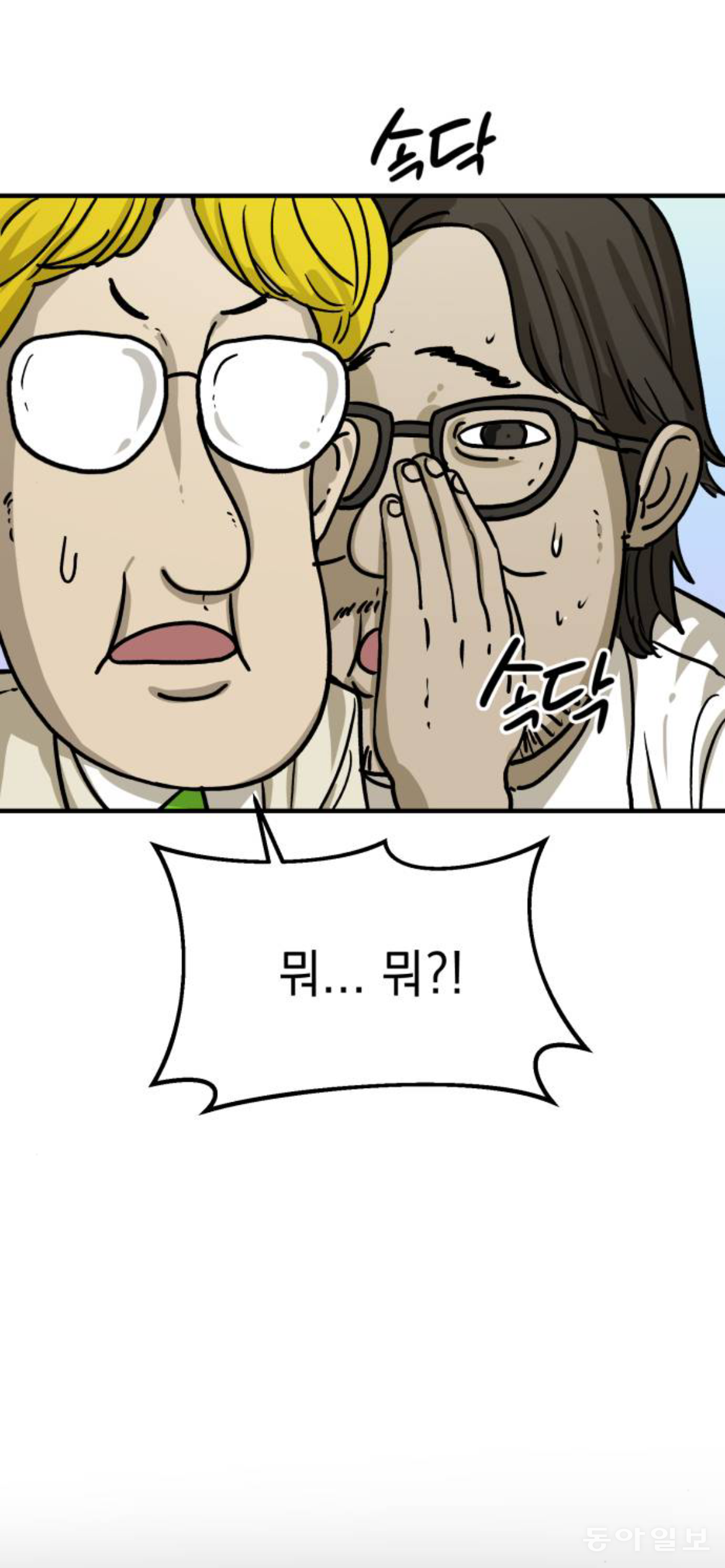
Naver Webtoon CEO Kim Jun-koo (left in the illustration) and Chae Yu-gi, Vice President of Korea Service (right in the illustration), as drawn in the “20th Anniversary Masterpiece Theater” webtoon produced to commemorate the 20th anniversary of Naver Webtoon. Provided by Naver Webtoon.
In December 2005, 20 years ago, three “webtoon” titles, including and , were uploaded to Naver Comics, which was then running a paid print-comics service. These early works are now called the “ancestors.” In an era before smartphones, the vertically scrolling webtoons that appeared on PC screens became the starting point for Naver Webtoon, which was listed on the U.S. Nasdaq in 2024 and this year has gone on to collaborate with “Disney.”
The neologism “webtoon” was first coined in August 2000 on Cheollian by combining web and cartoon. Since then, “Naver Webtoon” has led the popularization of webtoons and successfully “exported” the term “webtoon” to global markets. Today, the term “webtoon” has become a common noun representing a genre in its own right.
In an interview with this newspaper on the 12th, Chae Yu-gi, Vice President of Korea Service at Naver Webtoon, who oversees its domestic business, said, “In the U.S. market, the term ‘webtoon’ is essentially understood as ‘WEBTOON Entertainment’ (Naver Webtoon’s U.S. head office),” adding, “The global success of a single piece of content, such as a drama or a song, is impressive, but we want to make a K-platform that provides intellectual property (IP) succeed. It is a path that no one has taken.”
Marking Naver Webtoon’s 20th anniversary, he set out the ambition to grow into a global content platform on par with Netflix. If titles such as and brought worldwide attention to K-culture through their global success, he argued that it is now time to ensure the success of a platform that has a pipeline of continuous IP generation for K-content. In a structure where overseas platforms such as Netflix and YouTube reap the benefits of K-content’s global box-office success, this is interpreted as a strong intention to build global competitiveness for a K-content platform. Chae, who has even appeared in an entertainment show in scenes where star webtoon artist Gian84 naps in the Naver office while writing, is regarded as a “living witness” of the Korean webtoon industry. This is his first media interview.
Naver Webtoon Vice President of Korea Service Chae Yu-gi during an interview with the Dong-A Ilbo on the 12th. Provided by Naver Webtoon.
As of September this year, Naver Webtoon had 155 million monthly active users (MAU) worldwide, and as of December 2024, the number of webtoon and web novel creators had reached 26 million.
In North America, where the service is offered in English, Korean webtoons are also recognized as globally competitive, with view counts reaching 530 million for and 550 million for . On the back of this global competitiveness, Naver Webtoon is achieving substantial results in the United States, historically a barren ground for webtoons.
In September this year, WEBTOON Entertainment, Naver Webtoon’s U.S. head office, announced that it would launch a new platform on which users can read more than 35,000 Disney comics in webtoon format. A distinctive feature is that it encompasses all intellectual property (IP) owned by Disney, including Marvel, Star Wars, Pixar and 20th Century Studios. Following the decision to feature around 100 representative Disney titles such as and on Naver Webtoon’s global platform “WEBTOON,” the companies have now agreed to build a dedicated Disney webtoon platform.
“What we can gain through collaboration with Disney and others is global recognition,” Chae said, adding, “In the United States, where the term ‘webcomic’ is more commonly used, many people still do not know what a ‘webtoon’ is. We plan to reformat print comics into vertically scrolling webtoons and also create original works. By doing this, we aim to accumulate webtoon experiences and draw in fandoms in the U.S., such as Marvel fans.”
The North American comics market is divided into several segments: the traditional comic book market, in which publishers such as DC and Marvel own the IP, continue series with authors, publish by issue, and then bundle them into volumes; the translated Japanese manga market; the graphic novel market centered on standalone volumes by individual authors; and the webtoon segment, represented by Naver Webtoon. As the readership of the traditional comic book market ages, attempts are also being made to convert comic books into webtoons.
In effect, Naver Webtoon, as virtually the only player, provides the “webtoon platform” structure. As global OTT services roll out films and dramas based on K-webtoons and overseas users seek out the original works, the global webtoon ecosystem is expanding further. Of the 14 original (exclusive) Korean dramas released on Netflix in 2023, half were based on Naver Webtoon IP. The recently aired Netflix series is also a representative case that demonstrates the power of a “super IP.” The system of adapting webtoons with established fandoms into dramas and films to reduce box-office risk has already become an established formula for success.
“We have already verified box-office potential both domestically and overseas through webtoons, and there is a fandom in place, as well as existing visualizations, so it is relatively easy to move into screen adaptations. For global users, we are continually narrowing the episode gap between webtoons launched in Korea and those launched globally.”
The strength of webtoons lies in “limitless imagination,” something that dramas and films cannot match. In a user environment where viewers are more engrossed in short-form videos and watch YouTube at multiple speeds, webtoons are also the only type of content for which users can control the pace of viewing entirely on their own.
“Unlike video content such as dramas and films, which require large production budgets, webtoons involve relatively little cost difference whether the story is about a ‘space war’ or about ‘campus life,’” Chae said. “As long as there is imagination, it is possible to create content without limits.” Quantitatively, too, webtoon production is in a different league from dramas and films. “At Naver Webtoon, 500 original titles are released each year,” he said. “There is no other platform anywhere in the world that releases 500 original works annually.”
Regarding the use of artificial intelligence (AI) in creative work by authors, he said, “AI can be helpful in production processes such as coloring or post-editing, but the most essential part will not change,” and added, “What matters is the story and worldview created by the author.”
Jang Eun-ji
AI-translated with ChatGPT. Provided as is; original Korean text prevails.
ⓒ dongA.com. All rights reserved. Reproduction, redistribution, or use for AI training prohibited.