Ramen exports reach KRW 2 trillion, surpassing last year’s full-year total
Samyang and Nongshim continue to increase overseas sales share
Ottogi sees profitability decline alone amid aggressive push to expand its global footprint
K-ramyeon exports have set a new all-time high for the 11th consecutive year. Samyang Foods has risen to the ranks of export champions on the back of Buldak Ramen, while Nongshim is continuing its global success through a collaboration between its Shin Ramyun and the Netflix film “K-Pop Demon Hunters” (hereinafter “KDH”). Ottogi, by contrast, remains constrained by sluggish domestic demand.
According to export-import trade statistics from the Korea Customs Service on the 17th, cumulative ramyeon exports for January–November this year totaled US$1,381.78 million (approximately KRW 2,040 billion), hitting a record high and surpassing last year’s full-year export value of US$1,248.39 million (KRW 1,850 billion).
Since reaching US$218.80 million (approximately KRW 320 billion) in 2015, K-ramyeon exports have increased for 11 consecutive years. In particular, as K-culture as a whole—including K-pop and dramas—has drawn heightened global attention, the export growth curve has steepened further.
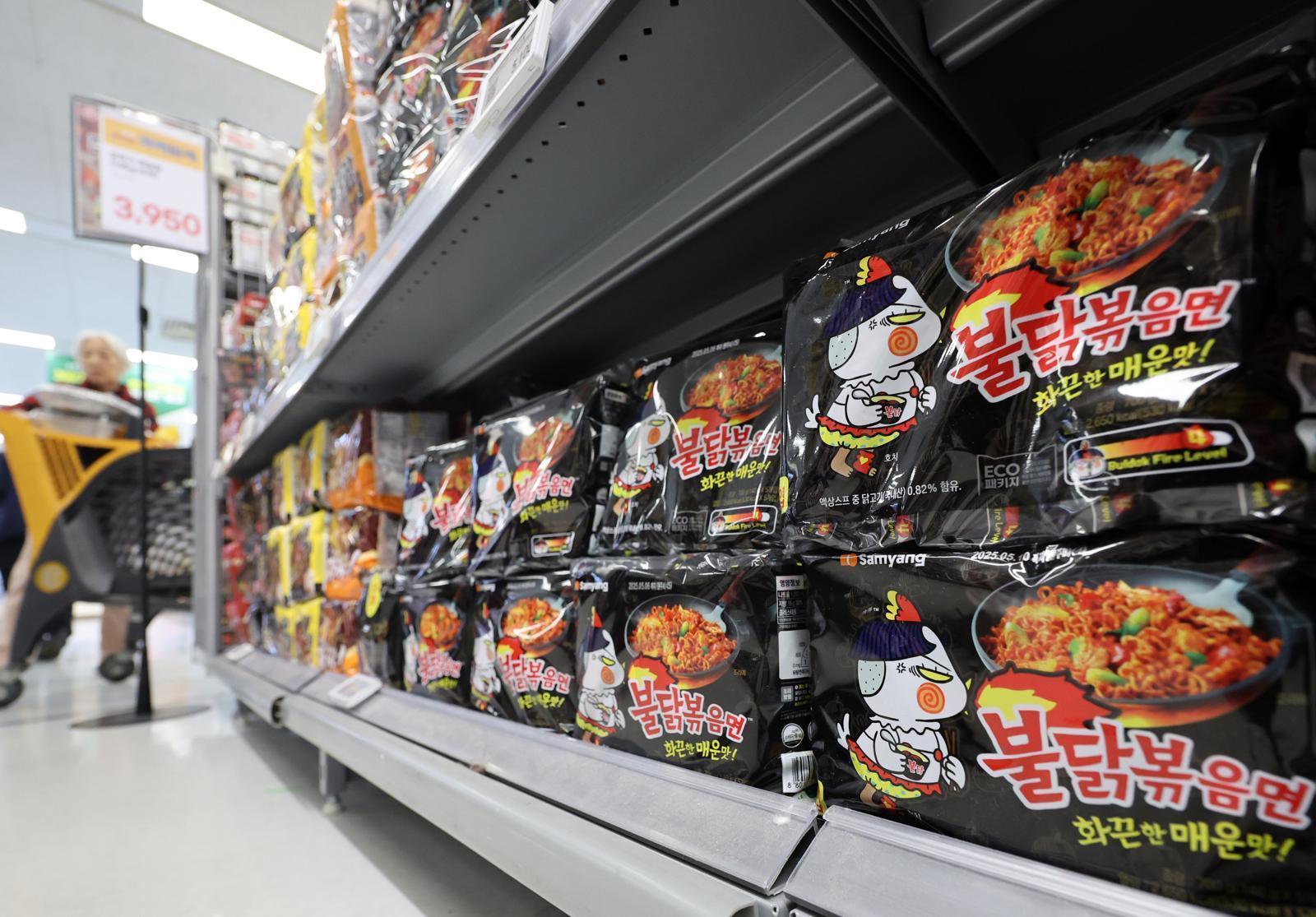
‘Buldak Ramen’ displayed at a large supermarket in Seoul. News1
Samyang Foods is at the center of the K-ramyeon boom. The company has been posting annual growth based on Buldak Ramen, which is also referred to as the “red semiconductor” or “noodle-conductor.” Its export value rose steadily from KRW 370.3 billion in 2020 to KRW 388.5 billion in 2021, KRW 605.0 billion in 2022, and KRW 809.3 billion in 2023, and further increased to KRW 1,335.9 billion last year. In the third quarter of this year, exports reached KRW 510.5 billion, the highest quarterly figure to date. The share of overseas business in total sales has also expanded annually, from 57% in 2020 to 61% in 2021, 67% in 2022, 68% in 2023, and 77% last year. In the third quarter of this year, it grew further to 81%.
Nongshim has launched marketing efforts to cement the image of “K-ramyeon = Shin Ramyun.” Shin Ramyun, which began local production in China and the United States in 2000, quickly leveraged the popularity of KDH and rolled out collaborative products. More recently, the company appointed idol group aespa as its first global ambassador and plans to air advertisements in major export markets—including the United States, China, Japan, Europe, and Southeast Asia—featuring “Spice up your life,” a signature hit by the renowned British pop group the Spice Girls, as background music.
According to the food industry, Nongshim’s overseas sales of Shin Ramyun are expected to reach KRW 950 billion to KRW 1 trillion this year. Shin Ramyun accounts for around 30% of Nongshim’s total sales (KRW 2,631.9 billion for the first to third quarters of this year), and overseas sales represent just over 60% of Shin Ramyun’s total sales. Overseas sales growth, which stood at around 15% in both 2023 and last year, is projected to be around 20% this year.
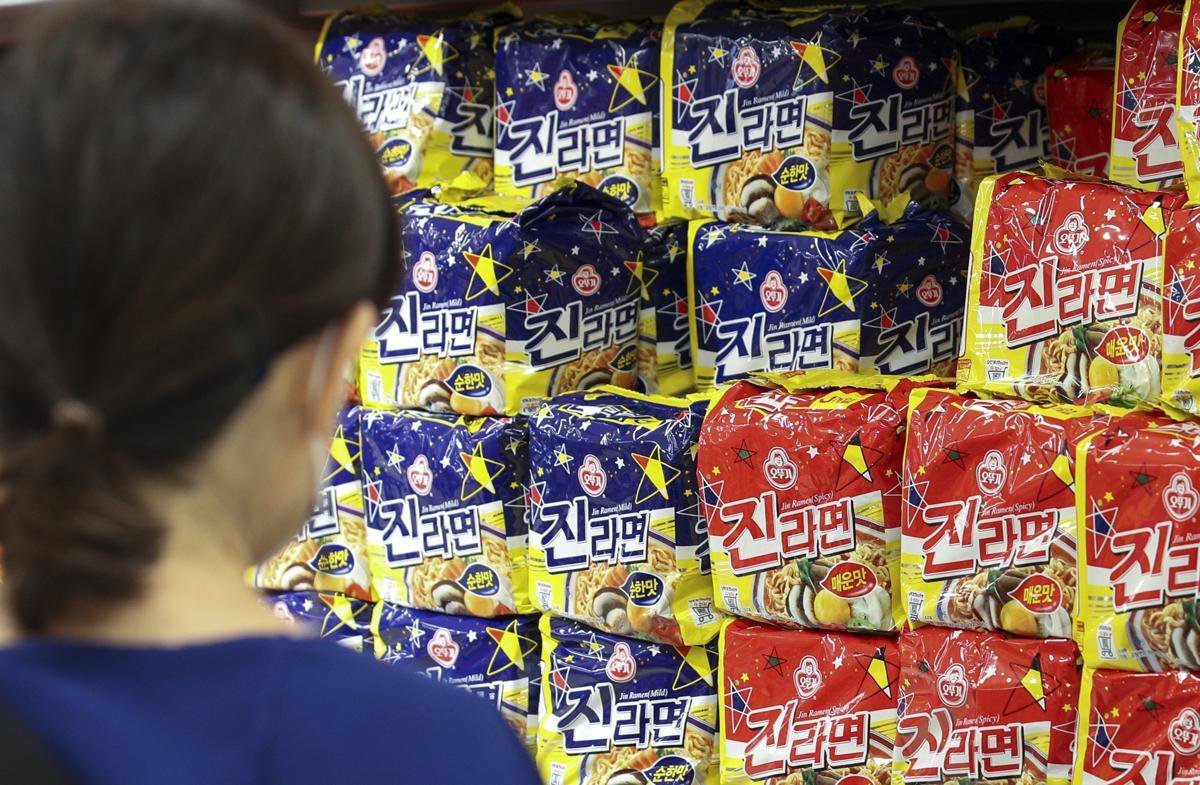
Ottogi announced that, due to higher raw material prices and continuously rising labor and logistics costs, it would raise the prices of key ramyeon products such as Jin Ramen by an average of 11.9% from the 1st. The photo shows shoppers selecting ramyeon at a large supermarket in Seoul on the morning of the 1st. Newsis
By contrast, Ottogi, which is highly dependent on the domestic market, is showing weakening profitability. On a consolidated basis, third-quarter sales increased 5.7% to KRW 955.5 billion, but operating profit fell 12.9% year-on-year to KRW 55.3 billion. This contrasts with Samyang Foods and Nongshim, whose operating profits over the same period rose 50% and 44.6% year-on-year, respectively, to KRW 130.9 billion and KRW 54.4 billion. Ottogi attributed the decline to increased cost burdens and higher promotional expenses amid intensifying market competition.
Industry observers point out that, against a backdrop of continued sluggish domestic consumption, Ottogi has been slower than its competitors in responding to global demand. In fact, Ottogi’s overseas sales for the first to third quarters of this year totaled KRW 296.1 billion. While this represents a 14.3% increase year-on-year, overseas sales accounted for only 10.7% of total sales.
Ottogi is now also shifting into high gear on global expansion. In 2023, it launched the production unit Ottogi Food America, and at the end of last year it secured a site in La Mirada, California, where it is building a production base slated for completion in 2027. In addition, following Jin Ramen, the company has placed its Cheese Ramen in Costco outlets in the United States, accelerating its push into the North American market. Based on these efforts, Ottogi plans to achieve KRW 1,100 billion in global sales by 2030.
ⓒ dongA.com. All rights reserved. Reproduction, redistribution, or use for AI training prohibited.
Popular News