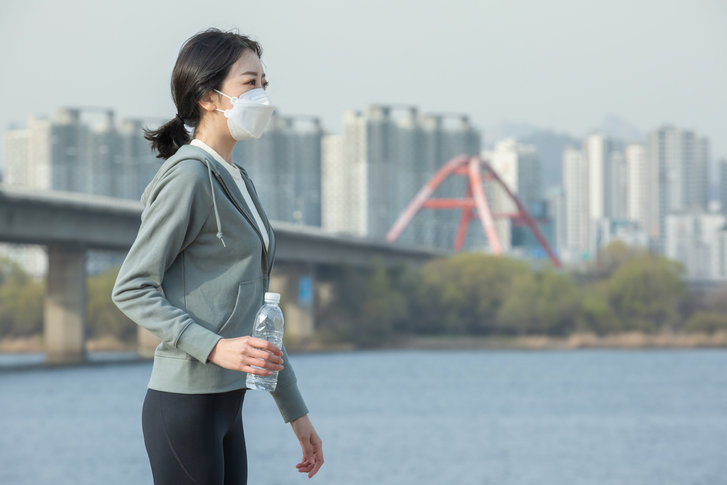
Photo=Getty Images Korea.
Long-term exposure to highly polluted environments significantly reduces the health benefits of regular exercise.
A joint research team from the UK, Denmark, China, Taiwan, and Australia analyzed data from over 1.5 million people tracked for more than 10 years worldwide.
The results showed that in areas with severe air pollution, the protective effects of regular exercise on overall mortality, particularly from cancer and cardiovascular diseases, tended to decrease. However, the effects did not completely disappear.
The researchers focused on the concentration of fine particulate matter with a diameter of 2.5 micrometers or less (PM 2.5). These particles are about 1/20th the thickness of a human hair, small enough to bypass the nose and bronchial filters, penetrate the lungs, and spread throughout the body via the bloodstream. (The prefix micro (μ) means one-millionth)
The researchers confirmed that when the annual average PM 2.5 concentration exceeds 25μg/m³, the health benefits of exercise are noticeably weakened.
According to a recent paper by Professor Hong Yoon-chul's team at Seoul National University Hospital's Public Health Center, the concentration of fine particulate matter in Seoul from 2016 to 2020 was 23.5μg/m³. This was below the risk threshold of the study but significantly exceeded the Ministry of Environment's standard (15μg/m³).
Professor Po-Wen Ku of National Chung Hsing University in Taiwan, who led the study, stated, "Exercise is still beneficial even in polluted environments, but the health effects of exercise are much greater when air quality improves."
Main FindingsAnalysis of data from seven existing studies showed that individuals who engaged in moderate to vigorous exercise for at least 2 hours and 30 minutes (150 minutes) per week had a 30% lower risk of death during the study period compared to those who did not meet this criterion.
However, for those in the high-activity group living in areas with PM 2.5 concentrations exceeding 25μg/m³, the risk reduction effect of exercise weakened to 12-15%, about half.
Particularly, when PM 2.5 was above 35μg/m³, the benefits of exercise were further reduced, and the reduction in cancer mortality was virtually eliminated.
The study results were published in the medical journal
BMC Medicine.
Basic Mechanism of Air Pollution's Adverse Health EffectsRecent large-scale studies and meta-analyses consistently show that higher concentrations of particulate matter in the air can weaken the protective effects of regular exercise.
During exercise, breathing volume and heart rate increase compared to usual. This leads to inhaling more polluted air, which can cause more particulate matter to accumulate in the lungs, blood vessels, and heart, potentially causing inflammation, oxidative stress, vascular irritation, and blood pressure changes.
Should You Exercise on 'Bad' Fine Dust Days?Several studies suggest that engaging in prolonged vigorous exercise outdoors when air quality is poor, especially when fine particulate matter concentrations are high, can reduce or even reverse the benefits of aerobic exercise. (If pollution levels are low or moderate, the benefits of exercise remain significant)
Therefore, it is recommended to refrain from outdoor exercise on days when fine dust warnings are issued. There is no reason to forgo exercise; it can be replaced with indoor activities. However, attention should be paid to indoor air quality as pollutants can infiltrate indoors, so air purification is advisable.
If unwilling to give up outdoor activities, it is necessary to adjust the intensity and duration according to the level of pollution. This can be done by reducing distance and lowering intensity.
Related research paper link:
https://dx.doi.org/10.1186/s12916-025-04496-y
ⓒ dongA.com. All rights reserved. Reproduction, redistribution, or use for AI training prohibited.
Popular News