Article at a GlanceCJ CheilJedang’s Hetbahn, which celebrates its 30th anniversary in 2026, is a prime example of turning market failure into a new opportunity. Instant rice products existed before Hetbahn was introduced, but they failed to win over consumers. However, CJ CheilJedang concluded that this was not because consumers did not want instant rice, but because no product had yet been developed that met their expectations. The company subsequently continued investing in quality improvements and market development despite incurring losses for more than a decade, eventually establishing instant rice as a distinct food category. Hetbahn’s 30-year growth journey can be examined through the lens of “dynamic capabilities,” a concept referring to a company’s ability to continually reconfigure its resources and capabilities in response to changes in the market and consumer preferences. More recently, the company has been uncovering new demand through its market intelligence organization, which analyzes not only the preferences consumers express in surveys but also behaviors and needs they themselves may not consciously recognize. The company invests consistently in areas with strong long-term growth potential while initially launching individual new products on a small scale, assessing market response and then expanding their reach. Hetbahn’s 30-year history can thus be seen as a process of continuous corporate evolution aimed at solving consumers’ changing problems.
Editor’s Note | This article is based on the CJ CheilJedang Hetbahn case study, “Hetbahn Pioneers a New Market by Creating a New Category, Evolving From an Emergency Food to an Everyday Staple,” published in DBR No. 93 (November 2011 Issue 2), and has been newly developed through additional reporting and research.
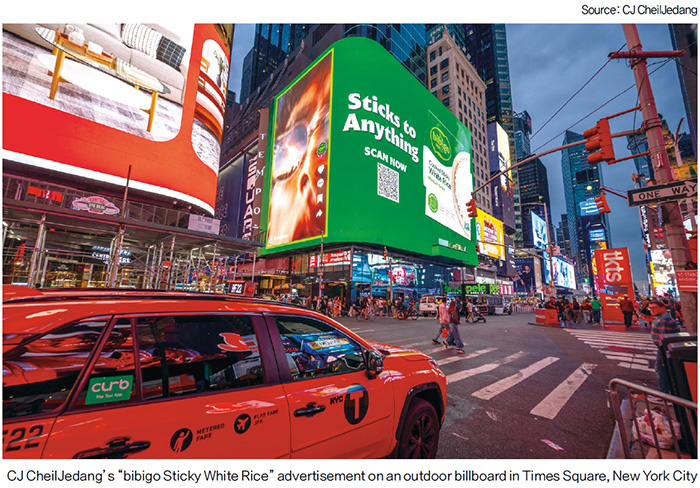
On August 31, 2026, advertisements for CJ CheilJedang’s “bibigo Sticky White Rice” appeared on outdoor digital billboards in New York City’s Times Square and along Broadway. The slogan was “Sticks To Anything.” Korean sticky rice, once regarded by foreign consumers as having an unfamiliar and unappealing texture, is now expanding the reach of K-food by highlighting that very characteristic. By reinterpreting rice that “sticks to anything” as rice that “pairs well with any food,” the company has turned a former weakness into a new competitive advantage.
Hetbahn is now available in approximately 60 countries worldwide, including the U.S., Canada, Australia and Mexico, and its overseas sales have continued to grow at an average annual rate of approximately 30% over the past five years. Instant rice, once unfamiliar even to Koreans, is now making its way onto dining tables around the world and illuminating iconic global landmarks. Behind this dramatic transformation are “changing consumers.” Consumer preferences, both in South Korea and abroad, are constantly shifting, sometimes unpredictably. Foreign consumers who once shunned sticky rice have begun to embrace its unfamiliar texture as a symbol of “healthiness” and a distinctive feature of K-food. This is because rice is increasingly perceived as healthier than other carbohydrates, such as bread, and as a good accompaniment to protein-rich dishes like chicken and steak. The share of U.S. consumers who eat rice at least once a week also rose from 37% in 2023 to 45% in 2025.
Of course, changes in consumer preferences do not automatically create opportunities. The growth story of Hetbahn, which celebrates its 30th anniversary in 2026, illustrates a 30-year journey of anticipating constantly evolving consumer tastes and demands and continually adapting to meet them. In particular, closely tracking Koreans’ distinctive attachment to rice and the evolution of their lifestyles, shaped by a long-standing reliance on rice as a source of sustenance, while also pioneering new markets was no easy task. After all, people’s preferences are as varied as the number of spoons at the dining table. Some prefer a heaping bowl of rice, others consider leaving half a bowl uneaten a virtue in their efforts to cut carbohydrates, while still others insist on brown rice or multigrain rice.
Copyright Ⓒ 동아비즈니스리뷰. All rights reserved. 무단 전재, 재배포 및 AI학습 이용 금지














 경제·경영 질문은