Article at a Glance
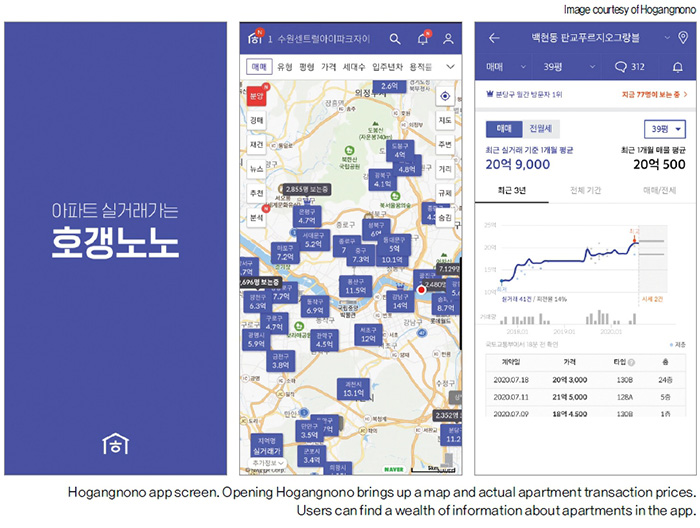
One real estate app has been gaining popularity to match the recent frenzy in the property market. That app is Hogangnono. Hogangnono is a proptech company — a term that combines “property” and “technology” — that launched in August 2015. With its standout user interface and user experience design, it quickly drew users by presenting public apartment data, including actual transaction prices, in an easy-to-view format in its app. Riding that popularity, the app climbed into the industry’s top tier less than five years after its founding. Hogangnono’s growth strategy can be summarized in three points:
1. By offering not only apartment prices but also a wide range of information relevant to daily living, the app resolved the “information asymmetry” that prospective apartment buyers had previously faced.
2. It presented complex, hard-to-read public apartment data in an easy-to-view format, designed strictly from the user’s perspective. It also made every one of the app’s many features intuitive.
3. Hogangnono “locked in” users with features unique to the app, from “Stories,” where users can exchange information with actual apartment residents, to a “Bank Loan Calculator” and a “3D Sunlight Check.”
Editor’s Note | Research Intern Go Gyeong-ju, an intern researcher at the Dong-A Ilbo Future Strategy Institute and a senior majoring in tourism at Kyung Hee University, contributed to this article.
Q. “How many of the following 10 abbreviations do you know?”(If you know all 10, you are a real estate god; 8 or 9, a supreme master; 6 or 7, a master; 4 or 5, a warrior; and 3 or fewer, a “burini,” short for “real estate child.”)
① Geumgwan-gu ② Aripak ③ Chokoa ④ Chubun ⑤ Moha ⑥ Teukgong ⑦ Chopi, mapi, cheongmupisa ⑧ Seulsegwon ⑨ Yeongkkeul ⑩ Gwondanbujang
(See the answers at the very end of the article.)
A “real estate expert test” has recently become a hot topic online. With home prices soaring over the past few years, public attention appears to be focused almost entirely on real estate. The emergence of all kinds of abbreviations and real estate jargon is further evidence of this fervor. The more measures the government rolled out to rein in home prices, the hotter the public’s craze for studying real estate became.
In fact, South Koreans’ love of real estate is nothing new. For decades, buying “a home of one’s own” has been a cause for family celebration. Even today, one of the first things people do after landing a job is open a housing subscription savings account. It is no exaggeration to say that people without a home save to buy one, while those who own a home save to move into a larger one. The statistics clearly bear this out. According to the “2019 Korea Housing Survey Report,” released by the Ministry of Land, Infrastructure and Transport in June 2020, 84.1% of respondents said owning a home is essential. That sentiment was even stronger than the previous year’s 82.5%. When households that had moved were asked why, the most common reason, cited by 42.6%, was a desire to upgrade to better facilities or amenities.
Perhaps that is why people in South Korea attach so much meaning to a “home.” The question “Where do you live?” often serves as a gauge of someone’s standard of living. As real estate prices have risen steadily without major declines, people have increasingly come to view homes as assets rather than places to live. Indeed, real estate plays an important role in the nation’s overall wealth. According to the national balance sheet compiled by the Bank of Korea and Statistics Korea, real estate accounts for more than 75% of household net worth.
Copyright Ⓒ 동아비즈니스리뷰. All rights reserved. 무단 전재, 재배포 및 AI학습 이용 금지














 경제·경영 질문은