NeuroFusion Tops Overall AI Future Prediction Benchmark, Surpassing Even Human Expert Groups
Financial AI startup NeuroFusion ranked first among 550 models on the future prediction benchmark ForecastBench, surpassing the scores of human expert forecasters. Image = generated by ChatGPT
A domestic artificial intelligence (AI) startup has taken first place in a global evaluation that predicts the probability of future events, beating Google DeepMind, OpenAI, Anthropic and others. By scoring higher than a group of professional human forecasters, it demonstrated the potential of a Korean AI company competing with global big tech firms.
NeuroFusion, operator of the AI investment analysis platform “Valley AI,” announced on the 20th that its financial AI research team achieved the highest score on the overall leaderboard of the future prediction benchmark “ForecastBench.”
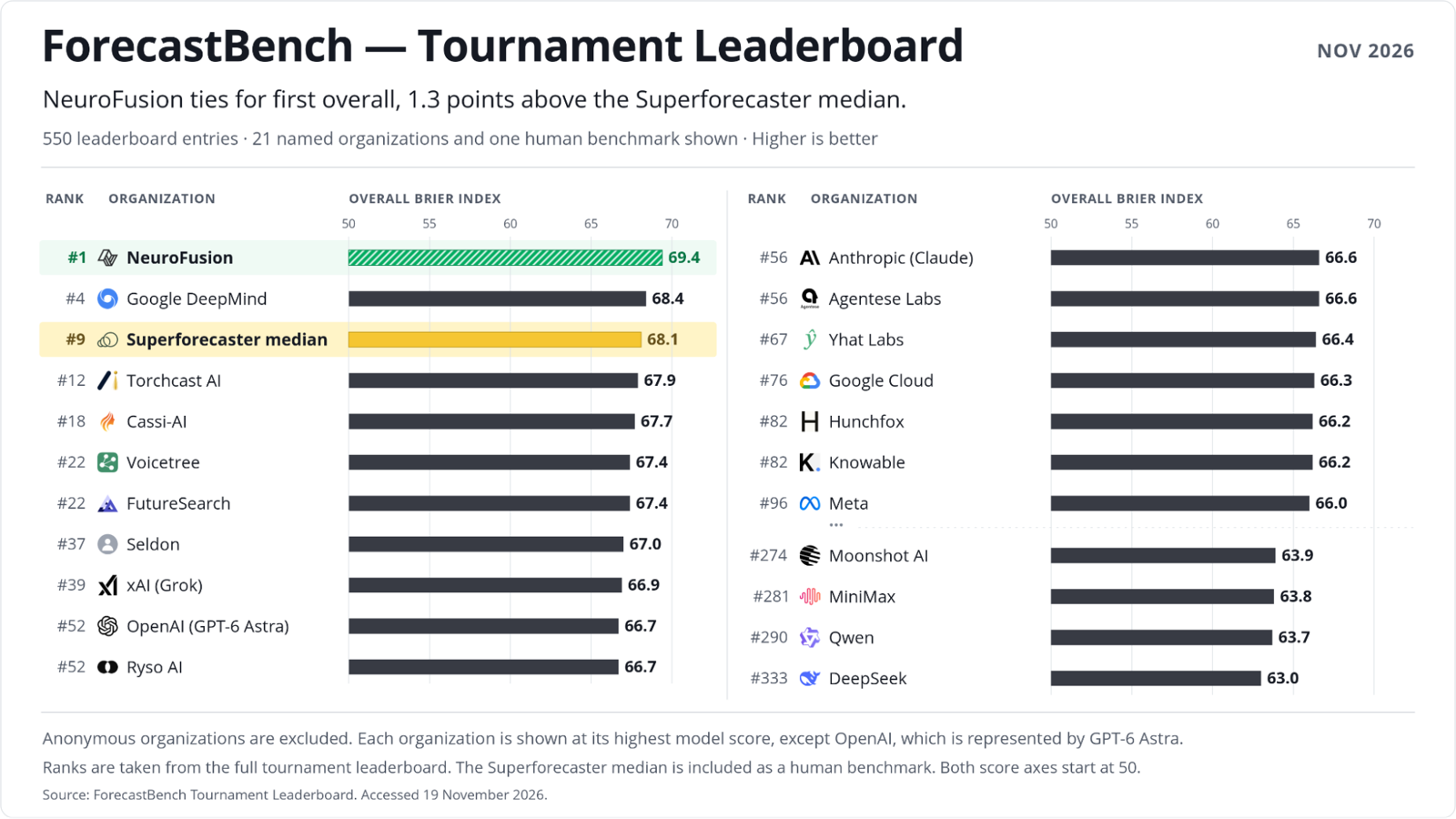
As of the 17th, NeuroFusion’s submitted prediction system “hybrid ensemble 1” ranked first among all 550 registered entries with an overall score of 69.4.
The prediction system directly submitted by Google DeepMind scored 68.4, and xAI’s “Grok 4.20” scored 66.9. OpenAI’s “GPT-6 Astra,” evaluated by the ForecastBench organizers with web search capabilities enabled, scored 66.7, Anthropic’s “Claude Opus 5.5” scored 66.6, and Meta’s “Muse Spark 1.3” scored 66.0.
The overall score for the group of professional human forecasters, the “Superforecasters,” was 68.1. NeuroFusion scored 65.5 in the dataset category and 73.9 in the market category, surpassing the Superforecasters’ scores (63.4 and 73.5, respectively) in both.
● Evaluating AI predictive power on events that have not yet occurred
Overall ForecastBench leaderboard rankings as of 19 November 2026. Chart = provided by NeuroFusion
ForecastBench is a framework that evaluates prediction performance by having AI assign probabilities to events whose outcomes are not yet known and then comparing those predictions with the actual results. Unlike conventional AI benchmarks that use questions for which the answers are already known, it targets future events, reducing the likelihood that AI encountered the correct answers during training. It is operated by the Forecasting Research Institute (FRI), in which Philip Tetlock, a professor at the Wharton School of the University of Pennsylvania, participates.
The evaluation is divided into two categories: dataset and market. The dataset category covers questions based on time-series data such as stock prices, interest rates and inflation, while the market category covers questions drawn from prediction markets, such as election results or whether negotiations will resolve international conflicts.
The Brier Index is used for the evaluation. It adjusts and converts Brier scores, which measure the difference between predicted probabilities of events and actual outcomes, according to question difficulty. The dataset and market categories are reflected with equal weight, and a higher overall score indicates better predictive performance. Official rankings are updated only after 50 days have passed since predictions are submitted.
In this evaluation, NeuroFusion predicted events across a wide range of areas, including not only financial markets but also politics and international affairs. According to the company’s own classification of evaluation items, questions directly related to finance, such as stock prices, interest rates and inflation, accounted for around 20% of the total.
NeuroFusion also ranked first on a preliminary leaderboard in September that evaluated only the dataset category. This time, it achieved the top score on the official leaderboard that combines both categories.
● Prediction system combining multiple AI technologies, to be expanded into financial servicesThe latest performance was achieved with a prediction system developed by combining multiple AI technologies and data analysis tools. The company stated that it applied user-based hypothesis collection, AI-assisted research support, iterative performance improvement, and validation of historical data using large language models (LLMs).
NeuroFusion explained that more than 530 data pipelines built over the past four years, along with its proprietary financial analysis technology, supported this prediction system.
ForecastBench allows participating teams to build prediction systems by combining multiple AI models and external tools. While the same evaluation criteria are applied, the models, data and tools used can differ by system.
NeuroFusion’s overall score was 1.0 point higher than that of Google DeepMind. However, the company added that, because the 95% confidence intervals for the two systems’ scores partially overlap, it is difficult to conclusively state that the performance difference is statistically significant based on this result alone.
A NeuroFusion representative said, “What can be confirmed from this result is limited to the fact that our system recorded a higher score on this benchmark,” and added, “Actual investment decisions or portfolio management performance were not within the scope of this evaluation.” Regarding the significance of the achievement, the company stressed that it showed “the predictive capability of AI on questions that have historically relied on qualitative judgments by experts due to limited historical data.”
Based on these research results, NeuroFusion is preparing to expand its existing services into financial-specialized autonomous AI agents. Valley AI, which is currently in operation, provides information necessary for investment decision-making, from stock discovery and corporate valuation to portfolio analysis.
According to the company, Valley AI has attracted more than 10,000 paying subscribers and over 30,000 free members since its official launch in January this year.
Choi Han-cheol, CEO of NeuroFusion, said, “Many AI agent services currently focus on performing given tasks well, but the focus will gradually shift toward future prediction,” and added, “If AI begins to make better judgments than humans even on problems with limited data, it will herald imminent innovation in a far broader decision-making domain beyond financial markets.”
ⓒ dongA.com. All rights reserved. Reproduction, redistribution, or use for AI training prohibited.
Popular News