※ The Startup Support Group at Seoul National University of Science and Technology operates various support programs to help startups grow, including the Preliminary and Early Startup Packages and global corporate collaboration programs. IT Donga, together with the Startup Support Group at Seoul National University of Science and Technology, introduces promising startups that are developing and growing.
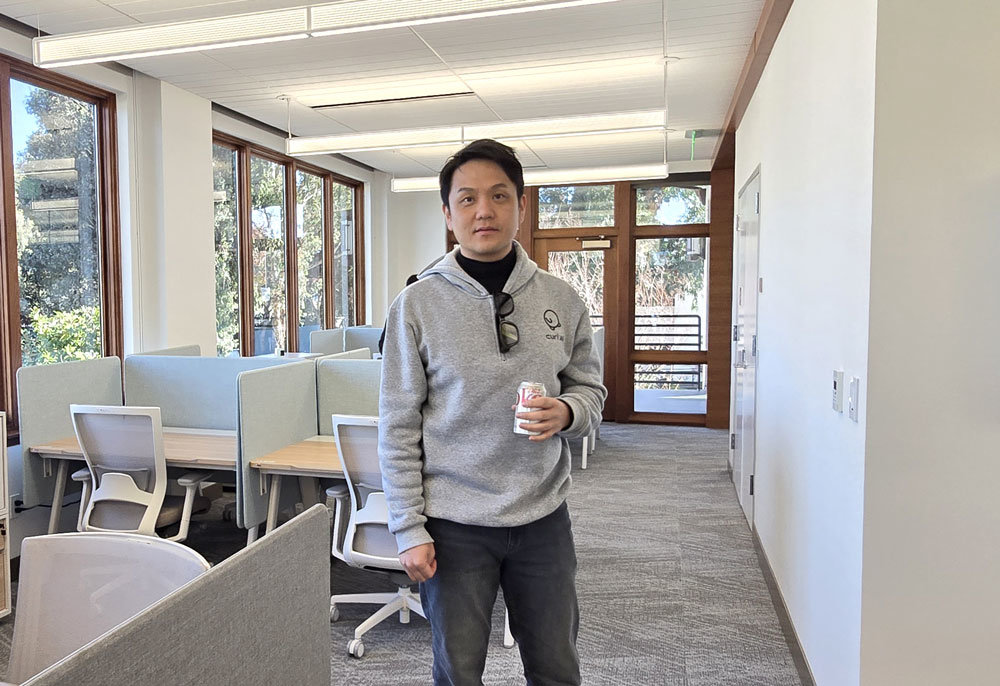
Lee Eun-ho, CEO of Blackhoods / Source=Blackhoods
Listening carefully to the customer’s voice is a basic principle of business. This is even more critical in sectors such as the beauty industry, where it is necessary to grasp customers’ detailed preferences. The most common method used for market analysis is surveys, but these are confined to a five-point scale from “very satisfied” to “very dissatisfied,” making it difficult to uncover customers’ true feelings, or their detailed preferences and needs. Meeting hundreds of customers one by one for in-depth interviews, on the other hand, is constrained by massive time and cost burdens.
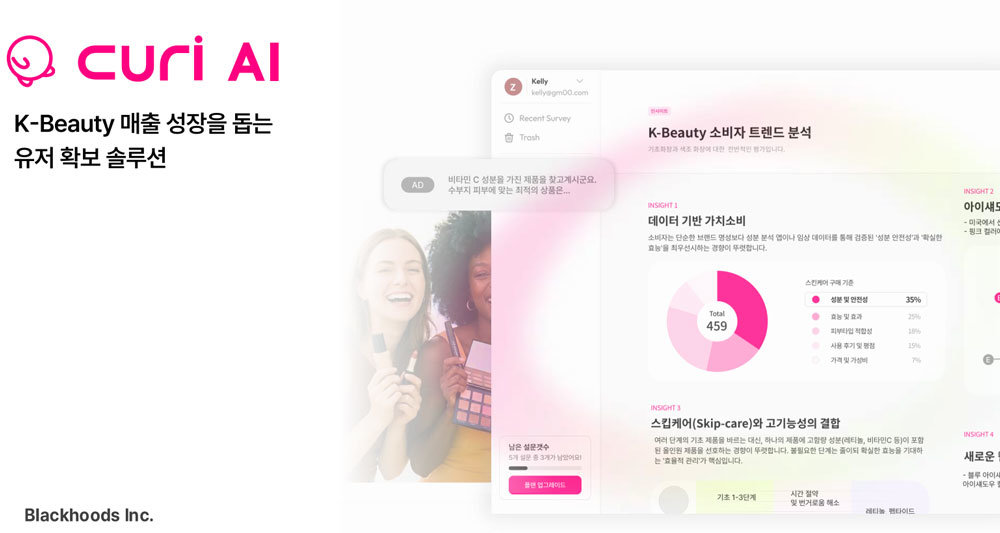
Startup Blackhoods (CEO Lee Eun-ho) is a company seeking to solve this structural dilemma in market research through artificial intelligence (AI). Its solution, “Curi AI,” is not a simple survey tool. It is an “AI researcher” that converses like a human and asks questions using AI.
Without mobilizing large amounts of time and manpower, it can easily conduct in-depth interviews with hundreds or more customers and analyze the results within just two days. Blackhoods stresses that it can offer a new alternative to companies that have hesitated to conduct qualitative research due to cost and time constraints, and that it will be especially helpful to the so-called “K-beauty” businesses that have been attracting attention in the global market in recent years.
CEO Lee Eun-ho is a serial entrepreneur and former management consultant who has founded a beauty startup in Singapore and served as the head of a Company-In-Company (CIC) at Kakao affiliate Krust Universe. With both on-the-ground business acumen and data science capabilities, he discussed how AI is transforming the research market and shared Blackhoods’ vision.
- You have a notably diverse entrepreneurial track record. How did you move from consulting through a beauty startup and the blockchain field to where you are now?: It all started around 2014 during the mobile boom. At that time, I jumped into entrepreneurship with a coworking space (shared office) business and later moved to Singapore, where I launched “CELUV,” a K-beauty commerce platform. It attracted enough attention to secure local investment, a first for a Korean company, but there was always an unfilled thirst while running the business. That was the difficulty of understanding the customer’s “real thoughts.” After returning to Korea, I studied at KAIST Graduate School of Data Science and served as CEO of a CIC at Kakao’s blockchain affiliate Krust Universe, but this concern persisted. I ultimately concluded that the essence of business lies in reading the “mind of the customer,” and in 2023 I founded Blackhoods to tackle this with AI technology.
“Curi AI” introduced by Blackhoods / Source=Blackhoods
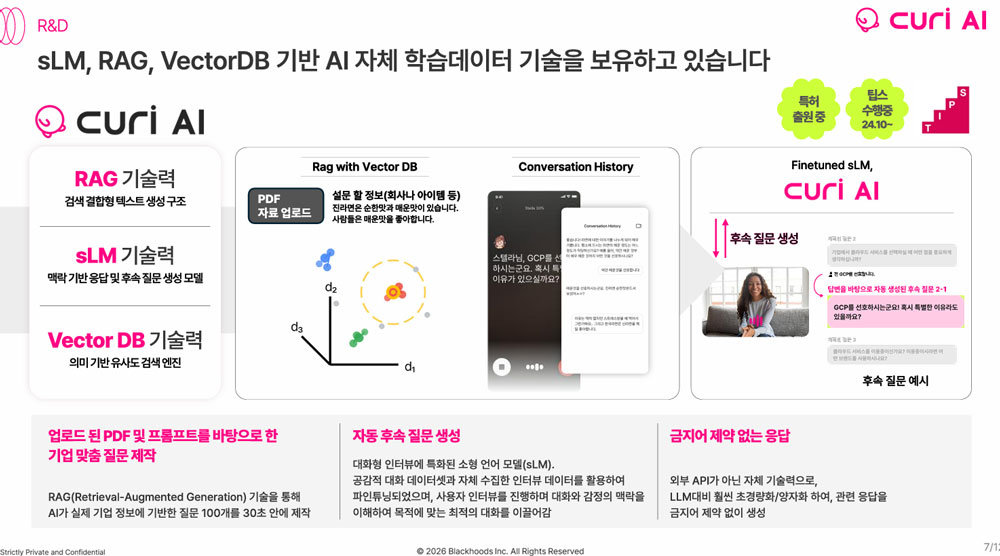
- Technologically, how is Blackhoods’ “Curi AI” different from existing survey tools?: If traditional surveys are like a “multiple-choice test” where respondents select from predefined answers, Curi AI is like an “in-depth interview” with free conversation. For example, when a consumer answers, “I don’t really like this cosmetic product,” the existing form-based method stops there. It cannot ask “Why?” However, Curi AI follows up with questions such as “What specifically did you not like about it? Was it because the texture felt sticky, or because the scent was not to your taste?” and so on. It goes beyond simply collecting responses, understanding the context of the conversation and identifying customers’ hidden intentions and emotions. Conducting in-depth interviews with many people in person could take several months, but our “AI researcher” can talk to many people at the same time, so no matter how large the sample is, an in-depth analysis report can be obtained within just two days.
- Can non-expert, general staff members use it easily?: That is the core competitive edge of Curi AI. Typically, in-depth research requires expert support from the questionnaire design stage because it is difficult to know what questions to ask to obtain the desired answers. We eliminated this entry barrier entirely by using generative AI technology. When a user simply types in the chat window, “I want to know why women in their 30s in the United States like our brand’s toner,” the AI automatically understands the interview objective and designs the optimal question scenario. Anyone can launch an expert-level in-depth study within one minute, without complex settings.
- From the perspective of client companies, cost efficiency is also critical. What is your business model?: Our core model is “RaaS (Research as a Service).” In the past, companies wanting to conduct in-depth interviews had to outsource to a professional research firm. That typically involved at least tens of millions of KRW in costs and a lengthy period of two to three months. It was a structure that was hard to attempt unless you were a large corporation. We have automated this process with AI and provide it in a SaaS (subscription software) format. Companies can pay a monthly subscription fee or purchase credits as needed to conduct interviews with numerous customers at any time. Compared with traditional outsourced research, we have reduced the cost to about one-tenth and shortened the time to results from several months to just two days. This is the clear economic value we offer the market.
- Who are your main target customers, and what are some actual adoption cases?: Our primary target is the “K-beauty” sector seeking to expand globally. The beauty market is one in which customer preferences are extremely detailed. However, it is practically difficult for Korean companies to directly interview local customers in markets such as the United States or Japan. We can help them overcome these challenges.
Recently, a healthcare solution company that measures hormone cycles using Apple Watch used our service. Before entering the U.S. market, Curi AI conducted in-depth interviews with a large number of local women, enabling the company to identify local needs and establish its marketing strategy in just two days. It was effectively able to understand local customers’ inner thoughts from home, without establishing a local subsidiary or making business trips.
Various AI technologies that make up Curi AI / Source=IT Donga
- Is it possible to expand into other sectors as well?: Absolutely. A representative example is the hiring (HR) market. Recently, a job-matching platform for women returning to the workforce after a career break adopted Curi AI and achieved strong results. People who have been away from the workplace for a long time often feel great pressure about writing résumés. For them, we allowed the AI to conduct a relaxed voice interview, like a phone call. It gently guided the conversation with questions such as “What kind of work did you do in the past?” and “What work skills are you most confident about?” to uncover job seekers’ hidden capabilities and matched them with companies based on that. From the corporate side, it is impossible to interview every single applicant, so having AI conduct the first round of in-depth interviews dramatically reduces hiring costs and time. In this way, every business domain that requires “large-scale conversations” is our market.
- It is understood that you used the Early Startup Package program operated by the Startup Support Group at Seoul National University of Science and Technology. How helpful was it?: It meant more than just simple funding support. AI startups face very high R&D costs such as GPU server operating expenses, making early survival difficult. The prototype production support from Seoul National University of Science and Technology played a decisive “priming” role in helping us endure this period and advance our technology. Thanks to this, we were freed from financial pressure and able to focus on enhancing the fundamental competitiveness of our product. Mentoring and networking were also a great help. When immersed only in technology development, it is easy to overlook the essential business model (BM), but through expert mentoring we were able to rigorously verify and refine our business feasibility. In addition, the university’s robust industry-academia cooperation network enabled us to connect with investors (VCs) and potential partners, which for an early-stage startup otherwise left to fend for itself in the market was like gaining a powerful ally. It essentially built the foundation for moving beyond technology into “business.”
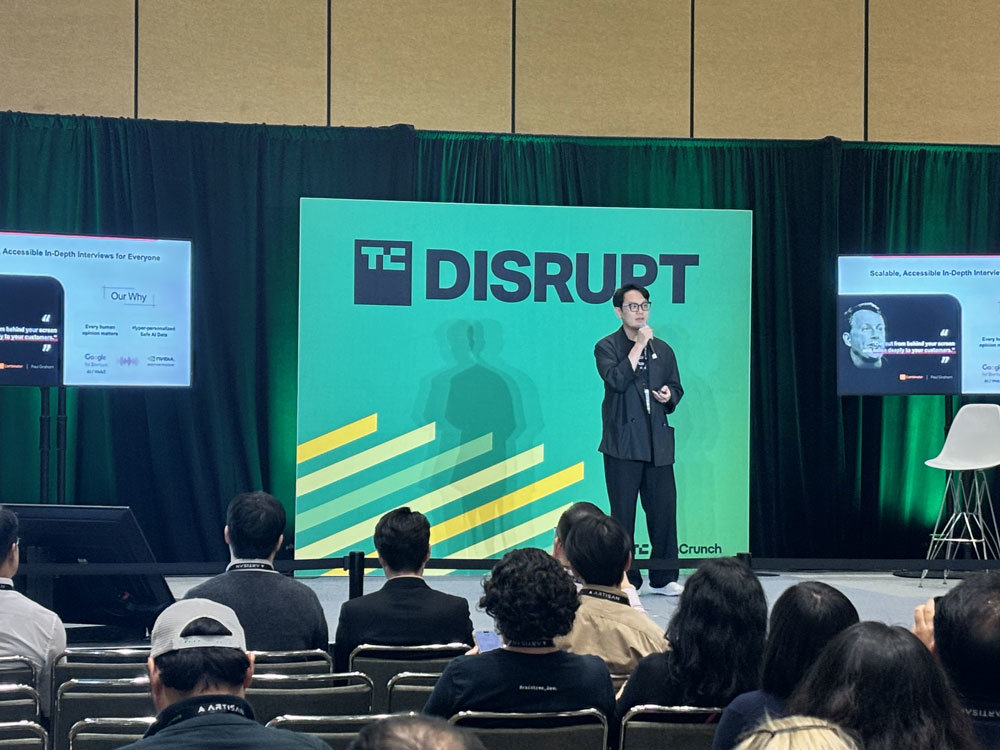
Blackhoods promoting Curi AI through overseas exhibitions / Source=Blackhoods
- What are your future goals?: In the short term, our goal is to establish ourselves as an essential partner that supports K-beauty companies’ successful expansion into global markets. Having experienced the difficulties of information gaps while doing business in Singapore in the past, I want to help younger entrepreneurs avoid the same hardships. In the long term, we aim to create a new standard in the research market. We want to provide a solution that enables companies, when planning or improving products, to move away from relying on vague “gut feelings” and instead clearly confirm the customer’s voice through AI and make data-based decisions. Through this, we hope to become a reliable partner that reduces business uncertainty.
Reporter Kim Young-woo, IT Donga (pengo@itdonga.com)
ⓒ dongA.com. All rights reserved. Reproduction, redistribution, or use for AI training prohibited.
Popular News