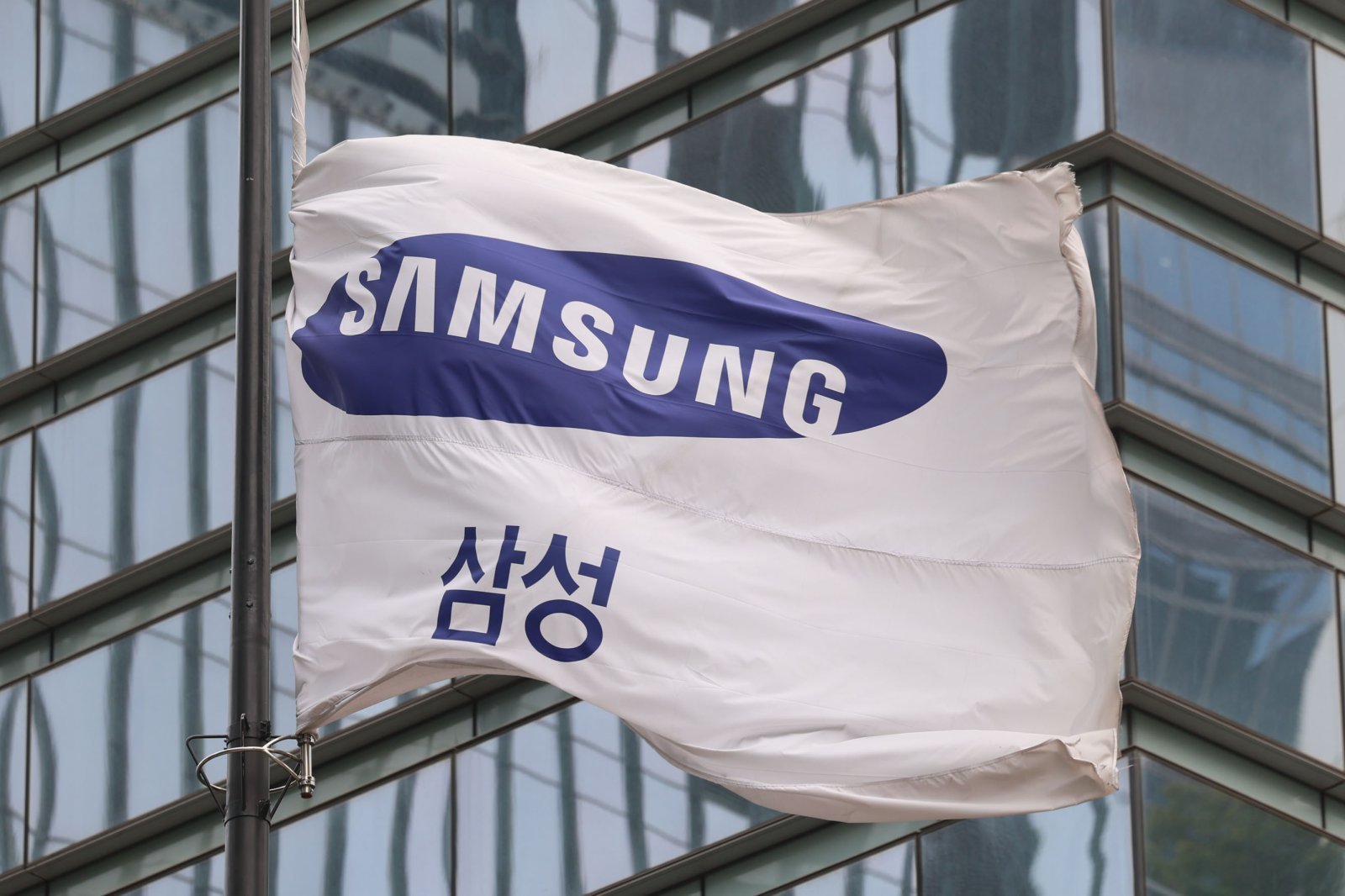
The Samsung Group flag is fluttering in the wind at Samsung Electronics’ headquarters in Seocho-gu, Seoul. 2026.05.26 Newsis
Samsung Electronics broke its record for quarterly revenue and operating profit for the fourth consecutive quarter. In particular, it became the first among global tech companies to post a quarterly operating profit exceeding KRW 100 trillion.
Samsung Electronics announced on the 29th that on a consolidated basis it recorded revenue of KRW 195.3 trillion and operating profit of KRW 107.4 trillion for the third quarter of this year. Compared with the previous quarter, revenue increased 14% and operating profit rose 20%, while year-on-year they surged 127% and 783%, respectively. The operating margin reached 55.0%, up 2.8 percentage points from the second quarter (52.2%).
The performance was effectively driven by semiconductors alone. The Device Solutions (DS) division recorded revenue of KRW 147.1 trillion and operating profit of KRW 106.5 trillion, accounting for 99% of the company’s total operating profit. In particular, memory revenue jumped 427% year-on-year to KRW 140.7 trillion. This was attributed to a sharp increase in sales of sixth-generation high bandwidth memory (HBM4) and responding to demand for server SSDs. The average selling price (ASP) of DRAM rose by about 20% from the previous quarter. Foundry performance also improved significantly as sales of base dies, a core component of HBM, and advanced-node volume increased.
The Device eXperience (DX) division was unable to avoid cost pressures stemming from higher memory prices as well as rising raw material and logistics costs. Revenue increased to KRW 52.1 trillion (up 8% quarter-on-quarter) thanks to the launch of the Galaxy Z Fold 8, but the operating loss came to KRW 800 billion, the same level as in the second quarter.
Exchange rates were also a burden. During the conference call, Samsung Electronics explained, “Due to the impact of a decline in major currencies such as the dollar and euro, there was a negative effect of about KRW 10 trillion on company-wide operating profit quarter-on-quarter, mainly in the components business.”
The company also dispelled concerns about a “semiconductor peak.” At the conference call, Kim Jae-joon, Executive Vice President of the Memory Business, said, “While the competitiveness of our HBM products is being highly evaluated, negotiations for 2027 HBM supply volumes have been completed at our target price levels, and they are already sold out.” He added, “Additional requests from key customers for increased HBM supply continue to come in.”
According to Samsung Electronics, third-quarter HBM4 revenue was more than three times that of the previous quarter, and HBM4 accounted for around 60% of total HBM revenue. Next-generation HBM4E will begin mass production in the first half of next year.
Samsung Electronics is also expanding multi-year supply agreements with major customers. It has already completed multi-year supply contracts with 10 large customers and is in additional negotiations with 10 more in mobile, automotive, and network sectors. The goal is to secure 60–70% of total production capacity under long-term contracts by 2030.
The company expects the tight memory supply situation to continue into 2028. It cited the long lead time required to build new fabs and the fact that chips after HBM4E will be larger in size, making it difficult to quickly increase supply.
Samsung Electronics forecast that results will continue to grow in the fourth quarter, led by semiconductors. The company expects strong market conditions to persist in 2027, as investment in agentic AI continues and semiconductor supply constraints overlap. Accordingly, it plans to execute annual capital expenditure of KRW 84.4 trillion, of which KRW 76.8 trillion will be allocated to the DS division.
Meanwhile, Samsung Electronics will pay a third-quarter cash dividend of KRW 4,601 per share for both common and preferred shares, totaling KRW 30 trillion. The payment date is the 27th of next month.
Of this year’s total planned shareholder return of KRW 90–110 trillion, the remaining funds after subtracting the KRW 35 trillion already executed or confirmed amount to KRW 55–75 trillion. Samsung Electronics stated that it intends to return this remaining amount through cash dividends along with a substantial share repurchase and cancellation program. The specific size and method will be finalized at the board meeting at the end of January next year together with the next shareholder return policy.
ⓒ dongA.com. All rights reserved. Reproduction, redistribution, or use for AI training prohibited.
Popular News