First official domestic agreement with “OpenRouter” AI automatically selects models based on question complexity and cost Enterprise service launches on the 30th… moves to preempt the token market
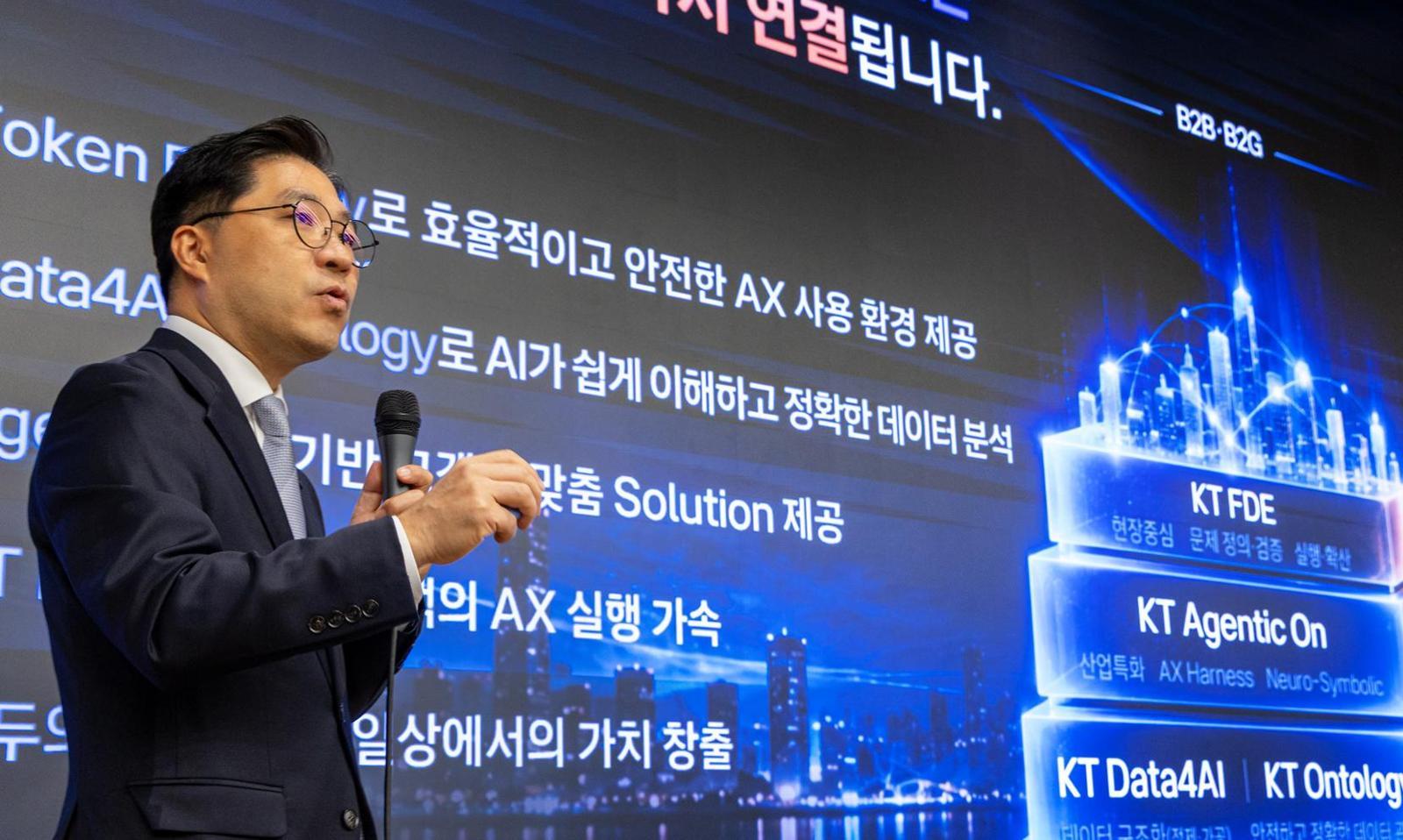
Park Sang-won, Head of KT’s AX Business Division, announces KT’s AI business strategy at a press conference held at KT Gwanghwamun Building West in Jongno-gu, Seoul on the 27th. Provided by KT
“I am a 32-year-old office worker with an annual salary of KRW 42 million. Please draw up a plan for buying a house and preparing for retirement with a goal of retiring at 60.”
The same question was entered into artificial intelligence (AI), but the answers were different. When prioritizing quality, KT’s high-performance model “Mi:dm K 3.0 Pro” organized recommended investment allocations for stocks, bonds and pensions in a table and presented an execution order. When prioritizing cost, OpenAI’s cost-efficient model “GPT-OSS” explained the investment approach in a brief narrative format. The system automatically selected an AI model suited to the user’s desired answer sophistication and budget.
KT held a press conference at KT Gwanghwamun Building West in Jongno-gu, Seoul on the 27th and unveiled “Token Factory,” an AI platform with these capabilities. It is a service that allows users to access multiple domestic and overseas AI models in one place and manage token usage and related costs. A token is the basic unit of data that AI processes to understand a question and generate an answer, and fees are charged according to usage. Leveraging its billing expertise accumulated in the telecommunications business and its data center operation capabilities, KT is moving to preempt the AI token market by directly servicing AI models and distributing models developed by other companies.
KT has signed the first official agreement in Korea with “OpenRouter,” a global AI model distribution platform, securing access to more than 500 AI models. Its proprietary “Auto Model Router” automatically selects the most suitable AI model based on factors such as question complexity and cost. KT has also applied technology that removes unnecessary expressions from user prompts (commands) to reduce token usage. For example, the sentence “다음 주 출장인데 월요일 오전 서울에서 부산으로 가는 KTX 열차를 찾아줘” (I am on a business trip next week; find me a KTX train from Seoul to Busan on Monday morning) is compressed to “다음 주 월요일 오전 서울 부산 KTX” (next Monday morning Seoul Busan KTX), reducing the amount of data the AI needs to process. This enables a token reduction effect of 25%.
KT will launch the Token Factory service on the 30th, initially providing 73 AI models to enterprise customers. Among them, three domestic models, including KT’s “Mi:dm K 3.0 Pro” and Upstage’s “Solar Pro 4,” as well as four overseas open-weight models, will process queries and generate answers from KT’s domestic data centers. This is intended to reduce the risk that user information might be transferred abroad. KT has also applied security technology that blocks personal data and sensitive information from being entered into the AI or included in AI-generated responses. In March next year, the company plans to open the service to individuals and developers and introduce subscription-based pricing plans.
Park Sang-won, Head of KT’s AX Business Division, said, “We will extend the connectivity, billing and protection capabilities accumulated in the telecommunications business to AI services to support customers’ AX transition.”
Han Chae-yeon
AI-translated with ChatGPT. Provided as is; original Korean text prevails.
ⓒ dongA.com. All rights reserved. Reproduction, redistribution, or use for AI training prohibited.